By Brent Anderson
On November 1 last year, Canadian airlines began announcing that all flights to Cuba were being halted due to fuel shortages on the island. The announcements were met with suspicion and condemnation since these actions align with US economic warfare against Cuba – halting Canadian flights during peak tourist season made a significant impact on the number of vacationers from Canada, Cuba’s number one source of tourists. In January the US Government announced an oil blockade and pushed Cuba further into a humanitarian and energy crisis, severely impacting essential services and the daily lives of Cubans.
At that time, there was speculation among some people that the 32nd annual Che Guevara Volunteer Work Brigade, scheduled from April 26 – May 10 this year, may be cancelled.
But through determination and careful planning, the delegation of 38 brigadistas from across Canada (including several from the US) successfully visited Cuba to express their solidarity.
The Che Guevara Brigade joined with delegations from around the world including supporters from Germany, Italy, the United States, Britain, South Africa, South Korea, Sweden, Brazil and Chile. We also met representatives from the Canadian Union of Public Employees, the BC Teachers’ Federation and CoDevelopment Canada.
We were warmly welcomed by Cubans at schools, a hospital, cultural institutions, businesses, agricultural cooperatives and industrial sectors. This included the country’s main power plant, which was offline when we visited – workers there were working 24/7 to regain power.
At the power plant we were informed that, despite significant challenges, one gigawatt of solar power (enough to power 500,000 to 750,000 homes continuously) was added to the power grid in 2025 and there are plans to add another gigawatt in 2026. Cuban scientists are also moving forward in developing ways to process the nation’s heavy crude oil. In the meantime, the limited power available is prioritized for essential services.
From 2005-2024, renewable energy represented three to four percent of the nation’s power; from 2025-2026, this number jumped to 10 percent. A recent report estimated that $8 billion would allow Cuba to produce 93 percent of its electricity through renewable energy, with no need to import oil. Key challenges include funding and finding investors, who risk repercussions from the US government.
Historically, the international brigades stay at a camp outside Havana but this year, due to a lack of water and fuel, we stayed in hotels in Havana and Varadero. While in Havana we learned the brigades were the only guests in the hotel, and that the hotel would not be operating if we had not been visiting.
Varadero was a different experience. Without reading the news, a person would not be aware of the current crisis, except for the lower volume of tourists. Due to pre-planning by Cuba’s tourist industry, we experienced no blackouts, the internet worked well, and service was similar to previous visits to the island.
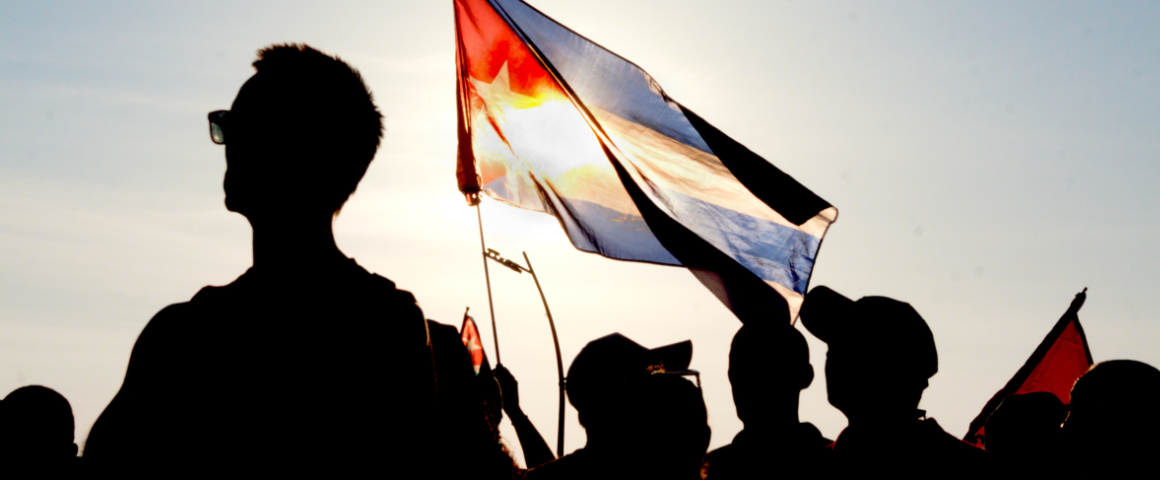
A highlight of the brigade was May Day, when 500,000 people marched to a location near the US embassy. Beginning at three in the morning, we witnessed masses of singing, dancing and celebrating Cubans. The media reported five million Cubans participated nationally in the annual march. Despite escalating US aggression, May Day delivered a strong message of Cuban unity and defiance to the Trump administration.
During the celebratory festivities it was announced that from April 19 to May 1, eighty-one percent of Cubans over the age of 16 – 6,230,973 people – signed a petition supporting peace and sovereignty while condemning the almost 70-year US blockade, the recent oil embargo and threats of a military attack from the most powerful country on earth.
One Cuban said that if the US invades, they will face an army of six million people.
Also on May 1, the US administration announced executive order 14404 which allows for the penalization of US citizens who provide donations to certain Cuban state institutions, as well as non-US companies and institutions doing business with the Cuban government.
Sherritt Mining, a Canadian company which has a joint nickel production venture with the Cuban government, announced it would dissolve its operations due to US pressure and threats. The company is the island’s main foreign investor and a key source of foreign exchange currency, and has a history of resisting US efforts to force its withdrawal from Cuba.
Sherritt recently changed its decision to dissolve operations, with recent news reports indicating that under a non-binding agreement 55 percent of company ownership will be sold to Gillon Capital, pending US government approval. Gillion is owned by a former Trump administrator.
Since the brigade’s return to Canada, events continue to change quickly with escalating threats and dubious maneuvering by the US. This includes Washington’s efforts to indict Raúl Castro for the 1996 downing of two airplanes flown by Miami-based counterrevolutionary terrorists – resulting in four deaths.
While the US ramps up its aggression, Cubans continue to suffer from the blockade. Within the health sector, in 2018, when Trump intensified the blockade, the infant mortality rate in Cuba was 4.0 per 1000 live births. By 2025 the rate had risen to 9.9 per 1000. This change represents a 148 per cent increase in infant mortality. According to Cuba’s Public Health Ministry, the waiting list for surgeries is over 100,000; 12,000 are children. Cancer medications are in short supply. Emigration has resulted in understaffing of medical programs.
The US blockade is killing people.
During an economics lecture we were informed that Cuba’s economy is “not functioning – it is surviving.” The blockade prevents the necessary stable investment and through various methods, as of 2025, had drained the country of over $170 billion. The United Nations reported last year that the Cuban government has lost the economic equivalent of $252 trillion USD in the last 18 years because of the blockade.
Despite severe US aggression, Cuba continues to work to prioritize the gains of the Revolution that aim to meet the social and health needs of the people while protecting the island’s sovereignty. There are reports that the US administration is becoming increasingly frustrated with Cuba’s continued ability to resist.
It is obvious where Cuba would be today if it had been allowed to flourish without US aggression. In a May 2 address to hundreds of brigadistas from around the world, President Díaz-Canel emphasized the importance of international solidarity in countering efforts to isolate Cuba. Acknowledging the responsibility to the Revolution he said: “We will not fail you, because to fail you would be to fail the hope of all humble people on this planet.”
Fernando González, President of the Cuban Institute of Friendship with the Peoples, Hero of the Republic of Cuba and a member of the Cuban Five, told the Canadian brigadistas that the Revolution will still be here when the 33rd Che Guevara Volunteer Brigade returns in 2027.
Support working-class media!
If you found this article useful, please consider donating to People’s Voice or purchasing a subscription so that you get every issue of Canada’s leading socialist publication delivered to your door or inbox!
For over 100 years, we have been 100% reader-supported, with no corporate or government funding.