PV Manitoba Bureau
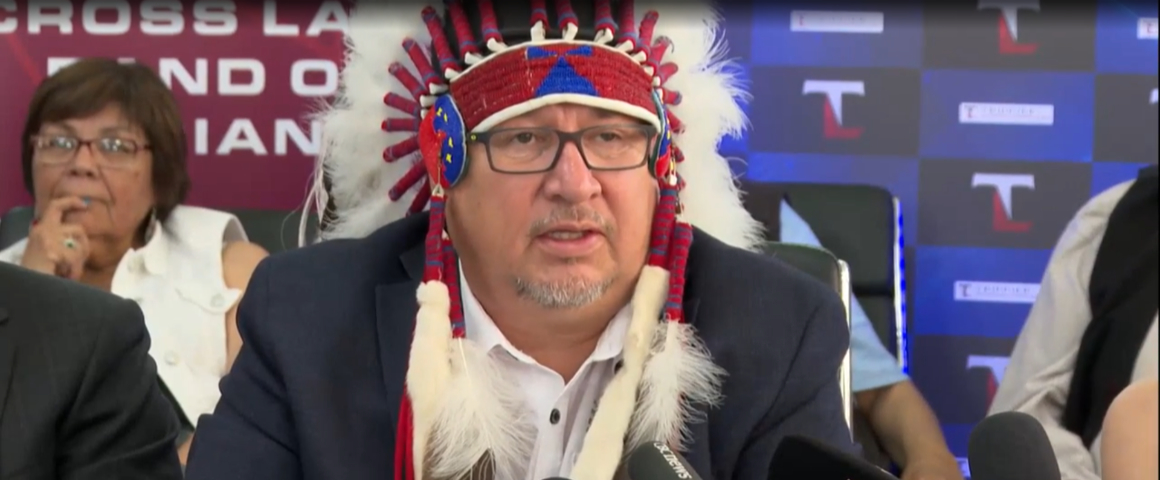
On July 29, Chief David Monias of Pimicikamak Cree Nation and Chief of the Cross Lake Band of Indians held a press conference to announce that a suit has been filed at the Manitoba Court of King’s Bench to take Canada, Manitoba, and Manitoba Hydro to court due to the negligence leading up to and in the aftermath of the December 28 power failure that devastated the community of Cross Lake.
Chief Monias spoke with support of Chief and Council, Traditional Council, the Women’s Council, the Elders Chief and Council, Youth Chief and Council and Northern Flood Agreement team members.
“The harm continued long after the lights came back on,” stated Chief Monias, describing how the power was out in severe winter weather from late 2025 until early 2026 for 110 hours, resulting in no heat, running water, sewage operations and “all other basic services and program services were lost.” Families were quickly displaced to Winnipeg and other southern communities, forced to leave with very few belongings. People were separated from their homes and essential community supports, including cultural supports, and forced into facilities that were “unsuitable housing for a large number of people.” Monias described how many community members have remained cooped up in hotels, in some cases for months, with little access to privacy, proper food or normal activities for children.
4,000 people, half of the community of 8,000 had to be evacuated, which means that the community was quite literally split in two. Frozen burst pipes led to soaked insulation and mould infestations, and other deep structural damages. In some cases portable heaters that were provided ended up resulting in fires that burned down homes. Many homes and much of the community’s essential infrastructure have therefore been destroyed, with damages estimated in many millions.
The entire situation, Chief Monias emphasized, had been completely avoidable. The single hydro line to the community, long deemed insufficient, failed after repeat warnings from the community that upgrades were necessary. Suffering repeat failures, even after mild storms in the lead up to the disasters, community leaders had clearly communicated to Manitoba Hydro and the province that a second line was needed. Manitoba Hydro is also responsible for having chosen a less accessible route for the generating station, resulting in longer blackout periods, and when the disastrous 2025-2026 power failure hit, had even directed crews to the wrong location.
Such negligence continues. “At this moment we have about 180 homes that are uninhabitable, and about 35 of them need to be replaced completely. Some homes have burned down, and we were told that they will not replace those homes. So, we are expecting Canada, Manitoba and Manitoba Hydro to provide accommodations to those people until such time as those homes are replaced.”
Community members are now being sent back to homes that are either uninhabitable or already overcrowded. When asked what provisions had been supplied by Indigenous Services Canada, Monias said there were ongoing discussions, and some provisions had been made through the Emergency Management Assistance Program and other initiatives, but these still failed to cover all the homes. “They are sending our people home to a homeless situation.”
“This is a real problem, and they have a responsibility to make it right”
The displaced people of Cross Lake are homesick for their community, Monias stated, and those still in the community are struggling with refrigeration and clean water. “They’re feeling like they’re in a third world country, they’re feeling like they’re neglected by the government. Like we don’t matter… We’re ready to go through the full journey to make this right…. We waited 49 years. We can’t even trust them anymore. We can’t even believe them anymore. This is all words.”
Monias’s warranted statements of distrust reflect similar sentiments from Indigenous leaders from across the country. This includes at the recent Assembly of First Nations General Assembly, which took place concurrent with wildfire destruction of Northern Ontario Indigenous communities due to the unchecked extractive industry practices and failed provincial and federal responses to the resulting fires. Leader after leader spoke about having given up on Canada coming through on its obligations, and the emptiness of the reconciliation rhetoric of federal ministers, while emphasizing that those commitments continue to exist and that Indigenous rights will not be extinguished.
In the case of Cross Lake, to add insult to injury, the province of Manitoba “tried to infer through the media that we broke our own line,” Monias said. “It’s ridiculous.” He detailed some scope of the impacts: “It affects the water the fish, our livelihood. We’re told we can’t have kids swimming there anymore. Our kids are gonna get sick. The fish and the food and the wildlife that we eat, if we’re going to ingest that, we’re going to get sick.”
The infrastructural state of the community’s water was disgraceful even before the disaster. “The water plants, both north and south, are on life support, meaning they were actually in operation using duct tape and glue to keep things together. And they keep breaking down, they were using trash pumps to troll water to fill the wet well so that we can fill it up to a certain pressure, and then it would break down again each and every time. So we’ve now applied for funding to bring it up to an operational area. Manitoba didn’t even want to power that source, we had to fight to get that power source and we had to use generators so it kept on breaking down. Now they’re temporarily fixed.”
Monias spoke of the need for a new power plant that would allow the population to have proper water and sewer facilities, so that if there are future power failures the community’s water supply won’t freeze. “We’re now at that point where we’re finishing our feasibility study to get that thing done. We’re hoping that Canada, and Manitoba, and Manitoba Hydro will put funds to fix it and build that new water plant.”
The community is now proceeding to seek court approval for the suit to proceed as a class action suit. The suit currently lists a number of demands for the proper affordance of water and electricity, including the immediate construction of a secondary power line, damages and adequate rebuilding.
In tandem with the press conference, the Assembly of Manitoba Chiefs released a statement declaring full solidarity with Cross Lake Band of Indians in their pursuit of justice. In it, Chief Kyra Wilson restated Canada’s obligations to uphold treaty obligations and constitutional commitments.
“This action should serve as a wake-up call to all governments. Reconciliation cannot coexist with chronic underinvestment in First Nations infrastructure. Treaty implementation requires more than acknowledgements – it demands sustained action that protects lives before tragedy occurs.”
Support working-class media!
If you found this article useful, please consider donating to People’s Voice or purchasing a subscription so that you get every issue of Canada’s leading socialist publication delivered to your door or inbox!
For over 100 years, we have been 100% reader-supported, with no corporate or government funding.