PV Labour Bureau
The 2026 Canadian Labour Congress convention met from May 11 to 14 in Winnipeg, against the backdrop of the deepest federal austerity drive since the 1990s. Prime Minister Mark Carney’s $150 billion war budget is being paid for through slashed public sector jobs and wages and social services. Under cover of false patriotism, billions of dollars in public money are being shifted to corporate monopolies through military contracts, P3 infrastructure, and fast-tracked resource projects that trample Indigenous sovereignty, labour rights and environmental security.
Yet the convention also gathered as working people across the country are fighting back. Postal workers continue to resist attacks on the public post office, BCGEU members struck for eight weeks to push back BC NDP austerity, and Alberta teachers carried out the largest walkout in provincial history. Air Canada flight attendants defied back-to-work orders and won, Rio Tinto steelworkers in Quebec held their picket line against scabs, and grocery workers are delivering massive strike votes. The question hanging over the convention was whether the CLC leadership would rise to the moment and chart a course for a coordinated, militant fightback.
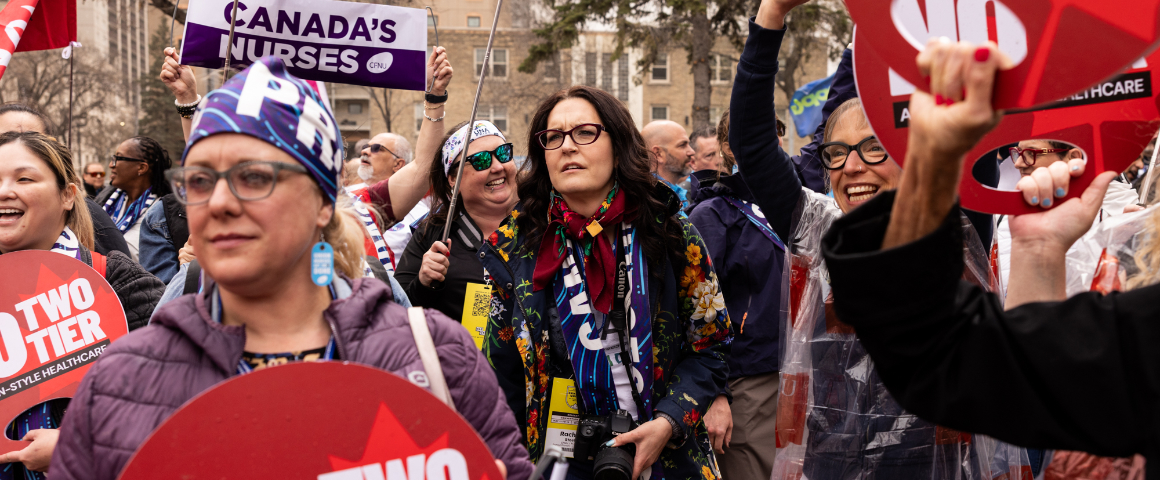
More than 2,100 delegates from unions across Canada assembled for a convention that produced mixed results: it took some steps forward, blocked some steps backward, but was unable to win a commitment to build the mass, united fightback that many on the floor were demanding.
Organized labour has been under sharp attack since the 1980s. Yet the dominant trend among CLC and affiliate leadership has been to avoid mobilizing members into militant, united political action, and instead to rely on lobbying efforts to block the worst anti-labour attacks and legislation.
While a majority of Convention delegates don’t see lobbying as effective or useful, the time for debate on the issues and the fightback has been steadily reduced and replaced with numerous guest speakers, guest panels and videos filling the time. This has led to abbreviated time for discussion and debate on the most important issues and a reduction in delegate speaking time to just 3 minutes.
In Winnipeg – likely in response to a public campaign by Labour 4 Palestine urging the CLC to stop burying a “Hot Cargo” resolution on Palestine solidarity – the entire week’s agenda was rushed through on the first day, eliminating the usual chance to revisit it each morning. Resolutions were bundled into long, sometimes contradictory thematic composites, making it hard to debate how to fight on key issues. A call to nationalize the auto and steel industries, for example, was passed inside a composite that also called for tax cuts for Canadian manufacturers.
Fight for labour democracy
Fortunately, delegates blocked two constitutional amendments which were designed to further restrict democratic decision making. One of these would have allowed only cross-Canada affiliates – not local unions – to submit resolutions, drastically reducing left and progressive motions; it was overwhelmingly defeated.
The second constitutional amendment would have imposed a “double majority” voting rule on the CLC’s Canadian Council, effectively giving the largest unions a veto and weakening smaller affiliates, labour councils and equity vice-presidents who are directly elected by caucuses. This was the second consecutive convention in which the proposal was brought forward, following its narrow defeat in 2023.
The National Union of Public and General Employees (NUPGE), Canada’s second-largest union, led the push this time. Its president spoke in favour but also read aloud an Action Caucus leaflet opposing the undemocratic changes – and then unconvincingly argued the amendment was a form of “proportional representation” for big unions.
Largely as a result of the Action Caucus campaign, the vote was 724 in favour with 885 opposed, well short of the required two-thirds and an even more decisive defeat than three years ago.
International solidarity – a bright spot
The Convention did see some real advances on international solidarity.
While the resolutions committee initially rejected a “Hot Cargo” resolution and buried it to keep it off the floor, a pre-convention public campaign forced the leadership to reverse that decision. The initial backwardness on Palestine was striking given the genocide in Gaza over the past two and a half years, which has isolated open supporters of Zionism and even pushed the NDP to clearly denounce Israel’s crimes. Pro-Palestine delegates moved to refer a weak peace resolution with instruction to include the demand that the CLC cut ties with Israel’s Histadrut labour federation, the main concrete call of the Hot Cargo resolution.
The Histadrut boycott is a longstanding demand of the international BDS movement, and gained urgency after the Histadrut chair signed a missile to be used in Gaza in 2023. The resolutions committee added the demand, and the amended motion passed the next day with upwards of 90 percent support, demonstrating how far labour has moved on Palestine solidarity in just a few years.
Solidarity with Cuba was also a major theme, as Donald Trump’s illegal and genocidal oil blockade continues and sanctions by Marco Rubio forced Canadian company Sherritt International to shut down operations in the country just one week before the convention.
The Canadian Network on Cuba (CNC) and the Action Caucus co-hosted an event with Dany Tur de la Concepción, Deputy Head of Mission from the Cuban Embassy. More than 130 people, mostly delegates, packed a local bar to hear from the embassy, the CNC and labour solidarity activists. The event raised $2,500 for the Canadian Network on Cuba’s material aid campaign which ships energy, medical and food supplies to Cuba on a monthly basis.
Tur also addressed meetings of the Canadian Union of Postal Workers’ (CUPW) and the Elementary Teachers’ Federation of Ontario (ETFO) caucuses and met with other labour council and union leaders. On Thursday, the Convention nearly unanimously passed a resolution in solidarity with Cuba, with the CLC agreeing to strengthen its ties to the Workers’ Central Union of Cuba (CTC), make a financial contribution to the Canadian Network on Cuba and call on the whole labour movement to build solidarity with the Cuban people. From the floor of the convention, ETFO pledged an additional $20,000 for the campaign.
No coordinated fightback, despite militant mood on the floor
While international solidarity was a bright spot, a clear disconnect emerged between the presidium and much of the floor when it came to the need for a mass, extra-parliamentary fightback. The reports, resolutions and action plan spoke of austerity, layoffs, healthcare privatization and cuts to social services, yet there was no clear and consistent general condemnation of the Liberal government’s corporate agenda.
The action plan, split into several thematic resolutions, was heavy on policy and very light on action. There was no proposed plan to mobilize, nor even an overarching campaign against the federal cuts. Air Canada workers were rightly held up as a model for defying back-to-work orders and winning, but no strategy was offered for how to defeat such orders through defiance and solidarity on a broader scale.
The floor told a different story. Action Caucus participants called for coordinated mobilization against austerity and linked Carney’s cuts to massive military expenditures. Former CUPW president Mike Palecek gave a well-received speech opposing the “building worker power” resolution because of its heavy tilt toward lobbying and lack of a mobilization plan. Throughout the week, OPSEU leaders called for a general strike, as the CLC organized in 1976. Notably, however, they did not put forward a clear plan for the content of such a political strike or how to build toward it.
Still, the divide between the presidium and the floor on the threat posed by the Carney government – and what it will take to defeat it – was stark. This was clearly illustrated when the “building worker power” section of the action plan was voted against by roughly a third of delegates because of its lack of militancy.
Despite these debates, the outgoing leadership around CLC President Bea Bruske was re-elected. The only change was the retirement of Executive Vice-President Larry Rousseau (PSAC), with CUPW’s Marc-Édouard Joubert elected to the position. All officer posts were won by acclamation and were on the same slate.
The challenge: from a divided house to unity in action
A key question at the Convention concerned the large unions currently outside the CLC, including Unifor and the Teamsters. Notably, the CLC and Unifor issued a joint statement for International Workers’ Day. A Windsor delegate asked from the floor for an update on Unifor rejoining the house of labour, pointing out that a divided movement has been especially damaging for cities like Windsor and Oshawa, which are home to massive Unifor plants. Bruske responded that there was a “good pathway to final solutions,” that “the ball is in Unifor’s court,” but she was “hopeful” to receive Unifor’s official request to rejoin.
This response from the CLC president seems a bit lackadaisical given the urgent situation facing workers in Canada, particularly those in the private sector. Autoworkers, steelworkers, softwood lumber workers and many others are facing mass layoffs in the wake of Donald Trump’s tariff war, Carney’s sweeping cuts to the public sector, and the upcoming USMCA negotiations. This threatens the livelihoods hundreds of thousands of workers in Canada, who are looking for unity and allies.
Rather than the CLC and Unifor leadership’s narrative of “calm and steady progress” without showing anything concrete for several years, union members and workers in general need a labour movement that builds unity in action around concrete campaigns.
A current example of this kind of fighting approach is Alberta, where the Alberta Federation of Labour has specifically reached out to non-affiliated unions like Unifor and the Alberta Union of Public Employees to help build their Common Front and the province-wide day of protest on May 29. A similar example is the Quebec Common Front, which three years ago built unity in action among four unions representing over 420,000 workers, even though none of the unions shared a common labour central.
These and other examples show that there is a huge capacity for building unity in action across the labour movement, without waiting for formal unity of structure. This is what delegates to the CLC Convention needed to hear, not that “the ball is in their court.”
With the Convention over, a key challenge for the Action Caucus and others on the left is to forge a fighting unity around specific campaigns throughout the year. A good place to start is at the local level, where labour councils can engage all unions and allied social movements in building efforts like anti-cuts committees, strike support initiatives and, in provinces with municipal elections this fall, civic reform movements based on labour’s independent political activity.
The 2026 CLC convention captured a labour movement in search of a way forward as the corporate attack intensifies. Delegates defended democratic space, pushed through important Palestine and Cuba solidarity measures, and voiced a growing appetite for militant, coordinated action. Yet the leadership’s action plan remained trapped in a lobbying-first approach.
With public and private sector workers already on the move, and Carney’s corporate offensive accelerating, the task of building that coordinated fightback now falls urgently to the shop floors, picket lines and local labour councils that are already showing the way. Mass, united action by labour and its allies is the response that workers need now.
[Photo: CLC]
Support working-class media!
If you found this article useful, please consider donating to People’s Voice or purchasing a subscription so that you get every issue of Canada’s leading socialist publication delivered to your door or inbox!
For over 100 years, we have been 100% reader-supported, with no corporate or government funding.