
By Stéphane Doucet
On April 11, members of the Public Service Alliance of Canada (PSAC) demonstrated outside the Palais des congrès de Montréal as the Liberal Party of Canada held its convention. They were protesting major job cuts in the federal public sector, as part of the Carney government’s austerity budgets for public services which accompany the shift towards a war economy.
A few days later, CBC News reported on an investigation they performed across several Loblaw’s and Sobey’s grocery stores across the country, revealing consistent overcharging on meat packed in-store. This follows similar findings which have popped up in the news with alarming frequency, but which have prompted very little investigation or enforcement action.
What do these two stories have in common?
The workers responsible for watchdogging our food supply – from producers in farms, slaughterhouses, packing and processing plants, all the way to grocery warehouses and local stores – are federal public service workers, most of them from the Canadian Food Inspection Agency. They recently received more than 500 job cuts, as well as notice that 1,300 of them are being affected by “employment transition measures” or disguised cuts. This represents almost a quarter of the Agency’s personnel.
So, let’s do the math: less oversight means more cost-cutting by big business, more recalls, more poisoned food, more sickness, more overcharging. In the end, we all lose – well, most of us.
Who stands to win exactly? Certainly, the big grocery chains, who can’t seem to turn down an opportunity to fleece people – remember the bread price-fixing scandal? But another winner is the large agri-business companies who will take advantage of less oversight to increase exploitation of workers in meat packing and processing, as well as reducing food safety measures.
Overall, the food processing industry in Canada is worth almost $175 billion annually, with 8,800 worksites employing over 300,000 workers. Large monopolies like Cargill, Maple Leaf, Olymel, Saputo and McCain own dozens or more plants across the country, and have revenues in the billions.
Gutting inspection work and downloading responsibility onto producers themselves is the same logic which led to the train disaster at Lac Mégantic which claimed 47 lives. That particular incident showed exactly how safety inspections were falsified or simply ignored by in-house protocols run by profit-hungry companies.
We can expect the same to happen to our food supply if the federal government takes this misguided approach: food safety is not a joke, and breaches can lead to death, illness or other tragedies. Food recalls can cripple and shutter small producers who don’t have the financial strength to sustain that kind of an economic hit.
Again, the only beneficiaries are the monopolies, who are able to roll the costs of recalls into their massive budgets and then download them onto consumers or small producers.
Agriculture Union (PSAC) president Milton Dyck notes the dual impacts of the cuts: “job cuts are harming food safety and the agricultural industry, taking away valuable research and inspections” while for the workers, “morale is at the bottom, rock bottom – people are afraid, competing for their jobs, going against friends and coworkers that they’ve worked alongside for years.”
Dyck is also quick to point out that cuts to the CFIA are compounded by cuts in 2012, in a department which is already “lean” and never saw the large expansion that is Carney’s pretext for the recent reductions. Workers are meant to “restructure with less people,” leading to fear of overwork and burnout. This is on top of the CFIA delaying an already agreed-upon pay equity contract, just days after International Women’s Day.
All of this takes place as the federal government renegotiates the USMCA trade pact, in which the US has been particularly aggressive about seeking access to Canadian food markets, on behalf of the massive US agribusiness sector. This brings into play the impact of major cuts to the US Department of Agriculture and US Food and Drug Administration, which have threatened the safety of US-produced food.
Combined with the threats to consumers through organized price-gouging and fraud, this point to the importance of opposing cuts to food safety and of fighting for expanded and more frequent inspections.
At the April 11 demonstration, the Parti communiste du Québec put this into clear perspective: “Politically, it is easy to target civil servants, who are all too often portrayed as a privileged class whose services are dispensable. Yet it is only once these jobs are eliminated that we realize how essential their work is. They themselves have paid the price: the automation of their pay through the Phoenix system has resulted in millions of dollars in unpaid wages for tens of thousands of public servants.”
Carney’s intention to gut the public service, to pay for the war economy, exposes people to more dangers in the food supply and price gouging at the grocery store. Working people have nothing to gain from this somber calculus.
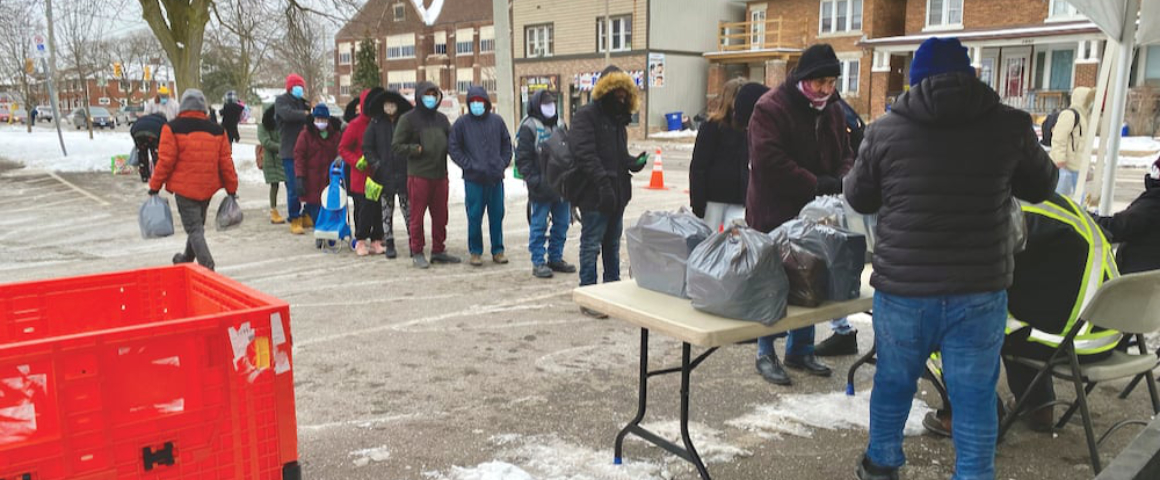
[Photo: PIPSC]
Support working-class media!
If you found this article useful, please consider donating to People’s Voice or purchasing a subscription so that you get every issue of Canada’s leading socialist publication delivered to your door or inbox!
For over 100 years, we have been 100% reader-supported, with no corporate or government funding.