By Robert Crooks
On April 17, Global Affairs Canada (GAC) announced that they would be sending a meagre $5.5 million worth of medical and food supplies to the Pan-American Health Organization and the World Food Program in Cuba. The package will also include fuel to help distribute the aid on the island.
Canada sent an $8 million aid package to Cuba in February via UNICEF.
In its April 17 press release, GAC claims that “Canada works through experienced and trusted organizations to ensure that assistance reaches the Cuban people directly, particularly the most vulnerable.”
The subtle distrust embedded in the Canadian government’s communications regarding Cuba is reproduced in Canada’s dominant media outlets. It implies a division between the Cuban government and the Cuban people, and the suggested inability of the former to meet the needs of the latter. If the decades-long genocidal blockade is mentioned at all, it is treated as secondary to Havana’s presumed ineptitude.
This attitude inevitably seeps into the solidarity movement. Canadians who donate to material aid drives do so to help people who are suffering conditions beyond their control. This does not necessarily mean that donors understand who is responsible for the humanitarian crisis perturbing their conscience.
Aid against the blockade
For 24 years, the Canadian Network on Cuba (CNC) has been sending shipping containers of aid to Cuba. Since Trump’s energy blockade began in February, the CNC has been sending multiple containers a month, including three in April 2026 alone. This is possible thanks to the support of the network’s two dozen member groups and the generosity of progressive people in Canada.
The shipment of aid to Cuba is coordinated through the Cuban Institute of Friendship with Peoples (ICAP), which is a branch of Cuba’s Ministry of Foreign Affairs. With increased donations to its campaigns comes more questions about the CNC’s partnership with the Cuban government: What about government corruption? Are there observers in Cuba to ensure the aid reaches the people? How can donors be sure that the aid doesn’t end up on the underground market?
Friends of Cuba who wish to work through official channels must be able to confidently answer these questions.
The underground market in Cuba is a product of the US blockade. Fidel once used the example of someone who privately brings “10 kilograms of medicine” into Cuba as a solution to the state’s lack of resources. “It is seen as a formula for help,” he explained, “but it becomes a source of the [underground] market.”
Medical aid delivered to the government is distributed to clinics and hospitals where it is most needed. If the aid circumvents the government, it is more likely to end up in the hands of an individual who may choose to sell it rather than to put it to direct use. Were it not for the blockade, all the required medications would be available in subsidized pharmacies, voiding their re-sale value.
Long road to equality
Having the Cuban government take the blame for deprivations caused by the blockade is precisely the point of US strategy. In his infamous memo from 1960, Lester D. Mallory sketched a strategy to cause “disenchantment and disaffection” and turn the people against the Revolution.
The blockade aims to break the unity that the US government begrudgingly recognizes to exist. It is a constant struggle waged by the Cuban people for unity against the divisive forces of the blockade.
Take racial disparities in Cuba, for example. Fidel lamented that ending legal racism didn’t defeat racism altogether. What he came to see was how the economic conditions caused by the blockade perpetuate colonial legacies.
White Cubans were typically better off than Black Cubans before the Revolution. More white Cubans therefore fled to places like the United States. Since Cuba decided to open up its economy to family remittances in foreign currencies, this has consequently benefitted white Cubans more than Black Cubans.
In the 1990s, Cuba reopened to tourism, a decision they did not take lightly. The state entered into partnerships with foreign capitalists to build and operate tourist infrastructure like hotels and resorts. But these foreign companies arrived with their racist baggage into Cuba, disproportionately hiring white Cubans for positions that interface directly with tourists, granting access to tips in US dollars. The Cuban state has ejected corporations from the island for these kinds of discriminatory practices, but the risks remain.
What is Cuban democracy?
The common wisdom in liberal societies is that Cuba can’t be democratic because it is a one-party state. More devious politicians and media figures won’t even allow leadership to fall to a party. They call it “Castro’s Cuba,” as if Fidel and now Raul, omnipotently control every aspect of Cuban society. It reduces the aspirations of a nation to the will of one person, erasing the agency of an entire people.
To liberal thinking, democracy is the free market of politics. The basis of a functioning free market is competition, and politics is a competition for your vote. If there are not multiple parties competing for your vote, it is not democracy.
This relegation of the elector to such a passive role is completely alien to Cuban democracy. Fair and free elections take place regularly in Cuba without interference from the Communist Party. Each of the municipal, provincial and national assemblies in the country are elected by direct popular vote. But Cuban democracy goes much deeper than elections.
For socialist Cuba, democracy is not the choice between competing parties. Politics isn’t about winners and losers. It is a process of synthesizing viewpoints and building consensus. The government, civil society organizations and everyday people all actively contribute to the ongoing construction of political unity on the island.
Unity has been a cornerstone of Cuba’s struggle for self-determination since Jose Marti wrote about his impression of the democratic process in the United States. Dividing the Cuban people into different parties weakened the common struggle against colonialism, just as the Democrats and Republicans divide the working class into two parties that represent the interests of competing capitalists.
The defeat of the Batista dictatorship in 1959 was prefaced on the deal made between the July 26 Movement, the Revolutionary Directorate and the Popular Socialist Party to combine the tactics of guerilla war, urban sabotage and general strike. Together these three organizations would go on to unite as the Communist Party of Cuba.
“It was an enormous victory for us to achieve that revolutionary unity,” Fidel said in a 1992 interview. “It is the United States that has always tried to divide the people, divide forces, divide everything.”
Participation of the masses
Consider the Cuban constitution, the document that defines the legal framework of the country.
In 1975, a draft constitution was proposed by the National Assembly. Over six million people, out of a population of 9.5 million, were involved in consultations resulting in sixty percent of the document being revised. The amended version was adopted with 96 percent of eligible voter approval.
In 1992, the Constitution was amended to expand the democratic processes in response to the economic crisis that followed in the wake of the overthrow of socialism in the Soviet Union. In 2002, George W. Bush said that the US blockade would remain in place until Cuba abandons socialism, prompting 8 million Cubans to sign a constitutional amendment making socialism legally irrevocable.
Cuba undertook a year’s worth of public consultations for the Constitution they ratified in 2019. Eight million people made 800,000 suggestions resulting in 760 revisions, amending more than half the document. Seventy-four percent of all eligible voters voted in favour of the final draft.
Out of this process also came the 2022 Families Code and the 2024 Code on Children, Adolescents and Youth. These two documents are included among the most progressive laws in the world, enshrining love as the legal basis for family bonds and protecting the agency of young people in determining their own lives.
Discussions on these issues were accompanied by a massive education campaign to ensure the debates reflected a factually informed and not a prejudiced understanding of the issues.
Education is a key pillar to the Revolution. Prior to 1959, illiteracy in Cuba was 23 percent and only 56 percent of children went to school. Within two years, illiteracy had been eradicated, and by 1986 every school aged child was receiving institutional education. Education is not only a human right; it also helps equip the people to run their own country.
The Special Period
The overthrow of the Soviet Union in the nineties caused Cuba’s gross domestic product to fall by 35 percent as they lost 70 percent of their markets. Cuba’s oil supply fell from 13 million tons to 5.8 million, and 3 billion rubles worth Soviet imports were not received. This downturn is known as the “Special Period in the Time of Peace.”
The US government took this opportunity to tighten the blockade by passing the 1992 Torricelli Act and the 1996 Helms-Burton Act. Section 109 of the Helms-Burton Act pledges support and financial aid to opposition forces in Cuba. Like in any other country, taking money from foreign actors for the purpose of overthrowing the political order is illegal in Cuba, as are actions such as arson and attacking police officers.
Nobody in Cuba is in prison for their political beliefs; so-called “political prisoners” have been incarcerated for criminal offences.
The long list of terrorist acts committed by the United States or US-funded Cuban reactionaries is well-documented. But even in their darkest hour, Cuban authorities never used these violent attacks as an excuse to tighten their grip on power and consolidate their hold over civil society, as you would expect from an authoritarian regime.
Cuba did the opposite. It further decentralized decision making, strengthening necessary reforms through popular consultation.
The workers’ parliaments that Cuba convened in the 1990s should inspire any labour activist who takes workers’ control seriously. Three and a half million working people from eighty thousand union sections took part in these parliaments. In response to the worst economic crisis that the Revolution had faced up to that point, the workers decided how to make their enterprises more efficient, how to increase productivity, how to improve national self-sufficiency and how to boost morale.
“A fundamental principle of the workers’ parliaments,” explains Pedro Ross, the general secretary of the Workers Central Union of Cuba (CTC), “was that the workers are the owners.”
It wasn’t only unions that took part in this process. The Cuban Federation of Women, the Committees in Defence of the Revolution, the National Association of Small Farmers and the Federation of University Students all played key roles in this island-wide project calling on the people of Cuba to fortify the Revolution against economic collapse.
As a result, Cuba avoided neoliberal policies and protected the core pillars of the Revolution: education, public healthcare and social security.
In defence of the Revolution
Today, conditions in Cuba are much worse than they were during the Special Period. And Cuba continues to rely on the ingenuity and creativity of the people to weather the storm.
Popular consultations on how to protect the country have been ongoing. Since this past October, over 76,000 meetings have been held in which over 140,000 proposals have been made. The objective is to minimize the impact of this crisis on the Cuban people and figure out how to use the country’s internal resources to increase economic activity.
As President Díaz-Canel recently reminded us, democracy is not abstract but concrete in Cuba. The government will continue to serve the needs of the people, while “seeking solutions through unity and collective contribution.”
To someone who has only ever known liberal democracy, the absence of an opposition is a seemingly obvious sign of an undemocratic state. But what would an opposition in Cuba oppose? The participatory process that engages the entire population in the country’s governance? An education system ensures the highest levels of schooling are accessible to all? A universal healthcare system that puts Canada’s system to shame?
The Revolution of 1959 wrested control of the country’s economy from foreign capital and placed the country in the hands of the people. To assume an antagonistic division between the people and the government is to deny the agency of the people in carrying out the Revolution.
It’s not just that the people of Cuba support the Revolution – the people are the Revolution.
Robert Crooks is a long-time Cuba solidarity activist and a member of the Canadian Network on Cuba executive
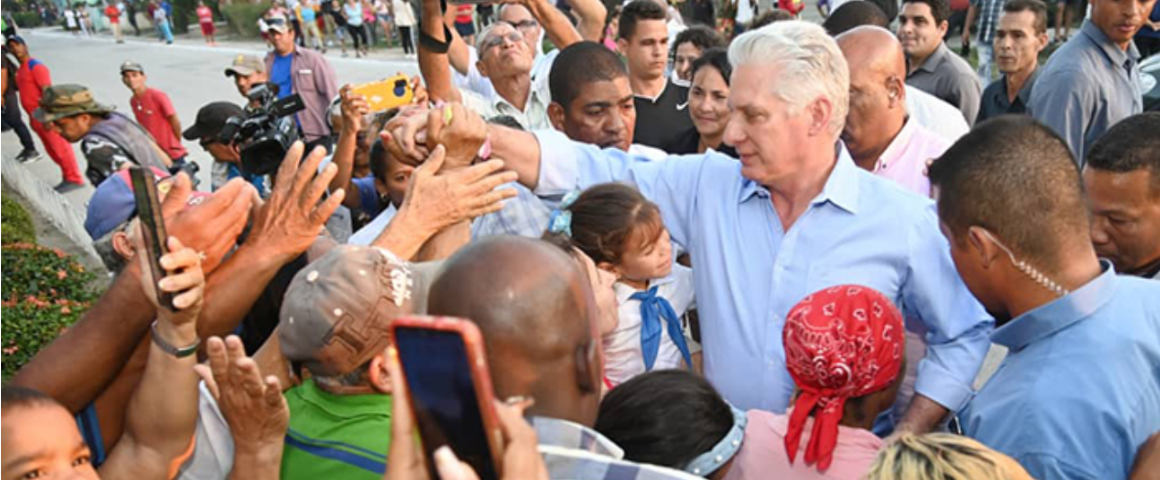
[Photo of Cuban president greeting the people: Cuban News Agency]
Support working-class media!
If you found this article useful, please consider donating to People’s Voice or purchasing a subscription so that you get every issue of Canada’s leading socialist publication delivered to your door or inbox!
For over 100 years, we have been 100% reader-supported, with no corporate or government funding.