It has not been “100 days in office.” It has been 100 days since the bombings of Caracas, the US military intervention, and the kidnapping of Nicolás Maduro. Through a political sleight of hand, Delcy Rodríguez has transformed an episode of imperialist aggression into a supposed review of her administration.
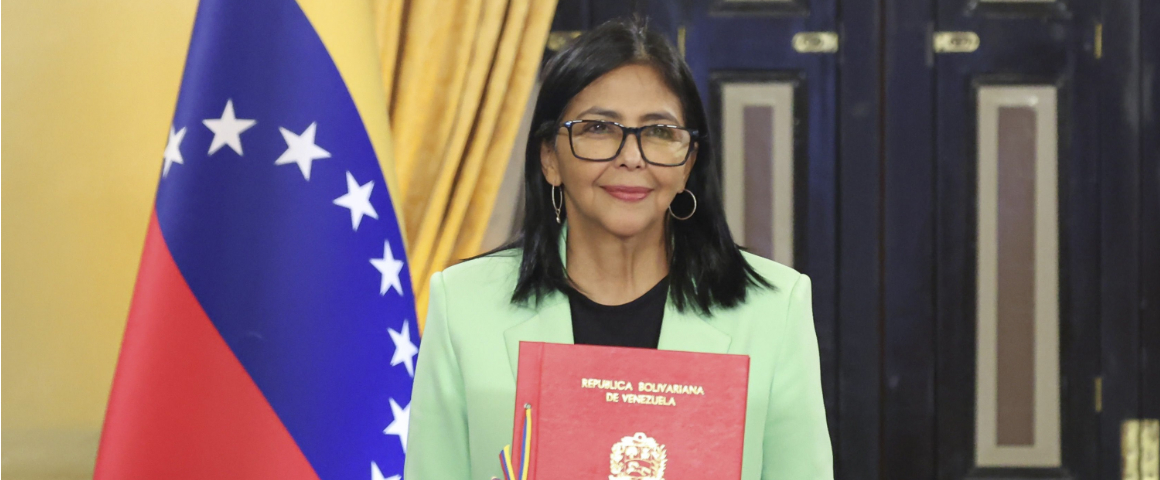
Rodríguez presented herself to the nation as a leader who had to account for her “first 100 days.” She did so through a carefully edited speech using selected data, taken out of context, to construct an image of stability, growth and normality. She said nothing about the foreign intervention that gave rise to this new political scenario. Nothing about her predecessor, who remains imprisoned in New York today. The military operation was erased from the official narrative and replaced by a phrase repeated like a mantra: “the beginning of a new era.”
The official discourse spoke of “peace,” “stability” and “sustained economic growth.” It emphasized the claimed “20 quarters of expansion” of the Venezuelan economy. But that constantly repeated growth figure is not reflected in the daily lives of working people. Wages remain in tatters, pensions reduced to a pittance, and the cost of living in constant rise. Inflation has not ceased while real incomes continue in free fall.
At the same time, government measures that are simply efforts at political realignment are being presented as achievements. These include the selective release of previously detained individuals, the strengthening of the police apparatus, and the relaunch of an economic model now marketed as “pragmatic.” This pragmatism is nothing more than capitulation.
The new official narrative is dangerous and contradictory. Those who demand sovereignty, labour rights and a living wage are branded as deluded, while the technocrats who now run the economy – the very ones responsible for the collapse – are presented as the only people capable of “moving the country forward.” This is the narrative of resignation, accepting the loss of rights as a condition for stability.
Within this framework, Rodríguez’ proposal for a “responsible income increase” is deliberately intended to replace discussion about wages. There is no talk of a living wage or of its adjustment in line with the cost of a basic basket of goods, as mandated by the Constitution. Instead, there is talk of discretionary mechanisms and non-wage income that neither generates benefits nor protects workers.
The response to the issue of pensions is even more brutal, with the government labelling them “unsustainable.” In other words, pensioners themselves are blamed for a crisis they did not create. Rodríguez clearly feels that guaranteeing rights is incompatible with economic stability.
These 100 days are not the beginning of a new era. They mark the deepening of a model that combines external dependence, economic austerity and political control. They represent the consolidation of a path that does not rely on popular sovereignty or the rights of working people, but rather on agreements among elites under foreign oversight.
In the face of misinformation, we must demand the truth. No rhetorical exercise can hide the obvious: there is no growth without social justice, there is no stability without sovereignty, and there is no future as long as the people continue to pay for a crisis they did not cause.
Tribuna Popular
Translated from Spanish by PV staff
Support working-class media!
If you found this article useful, please consider donating to People’s Voice or purchasing a subscription so that you get every issue of Canada’s leading socialist publication delivered to your door or inbox!
For over 100 years, we have been 100% reader-supported, with no corporate or government funding.