
PV Manitoba Bureau
On October 20, Manitoba premier Wab Kinew confirmed his government would proceed with stronger rent control measures first introduced in the spring. This announcement marked a decisive victory for tenants and their supporters, who had fought for improved regulations in the face of a landlord lobby that was pressing for concessions.
The NDP came to power partly on the promise of better conditions for renters. While falling short of the core longstanding demands of housing and tenant advocates in Manitoba, the proposed package of legislative and regulatory changes offers some limited relief to tenants, and includes none of the landlords’ concessions.
Tenant organizations have offered critical support for the measures. The West Broadway Tenants Committee welcomed them as an outcome of growing tenant organizing while insisting that tenants deserve better. The Committee warned that “tenants face a serious threat that landlords will lobby to have these amendments repealed or undermined” and called on tenants and their supporters to organize to seize the improvements proposed while fighting for still better protections.
The changes include raising the rent control ceiling to cover units costing up to $2,000 per month, up from the previous $1,670. They also cut the portion of capital expenses that landlords could charge to tenants through above-guideline rent increases (AGI) by 50 percent, essentially cutting renovation-related rent increases in half.
This cut to claimable capital expenses is at the core of a sharpened class battle over housing.
Initially, this battle was fought on the official terrain of government legislative and consultative measures, and in the sphere of public discourse on social media and in the pages of the Winnipeg Free Press. While the tenant perspectives in local media have helped reshape public discourse on housing in Manitoba, the institutional terrain initially proved advantageous to landlords, whose most valuable ally, the official opposition Progressive Conservatives, designated the government’s legislation (Bill 13, The Residential Tenancies Amendment Act) and delayed its progress until the fall session.
Despite designation, the government could have gone ahead with the more consequential pro-tenant regulatory changes, since these do not need to go through a legislative process. But there was an apparent tacit agreement between the parties that designation would delay the regulatory changes as well, since the government did not pass them.
Landlord and tenant disputes did not abate in the months between the spring and fall sessions. In August, the Winnipeg Free Press reported on a local landlord who had advised tenants that their rent would increase from 60-125 percent, depending on the unit. The landlord also owns Bosk Construction and Power Electric, which had been contracted to do the renovation work that the pending rent increase would be paid through.
A watershed moment was a CBC report in late summer about a 78-percent rent increase in West Broadway. The landlord, Alberta-based Wingspan Properties, also announced rent increases at its other buildings, ranging from 54-125 percent. It became clear that Wingspan had purchased dozens of the most affordable buildings on Winnipeg’s private market and saw an opportunity to capitalize on years of poor maintenance and displace low-income tenants in the process.
With the support of the West Broadway Tenants Committee, tenants in Wingspan buildings began forming tenant associations and organizing across buildings. They identified patterns of improper notice, unsafe work practices and common intimidation tactics by Wingspan.
The situation was made far more dire owing to a Residential Tenancies Branch (RTB) policy requiring tenants to pay above-guideline rent increases when they are scheduled by the landlord to take effect, even if the landlord’s AGI application has not yet been approved.
Given the magnitude of Wingspan’s proposed rent increases, it was not realistic for tenants to pay up front, even in the hopes of being partially reimbursed many months later. Tenants would have had to leave their homes without a meaningful opportunity to exercise their legitimate right to challenge an AGI. As such, organized Wingspan tenants initially united around demanding an end to the RTB policy requiring tenants to pay unapproved rent increases.
This demand was bolstered by the 2019 case of a tenant who refused to pay an unapproved rent increase. When the landlord applied for an eviction, the RTB granted it. The tenant appealed, however, and the Residential Tenancies Commission reversed the order and clarified that there was nothing in the Residential Tenancies Act requiring a tenant to pay an unapproved rent increase. Tenants made this case known in the press and their communications with politicians and RTB personnel.
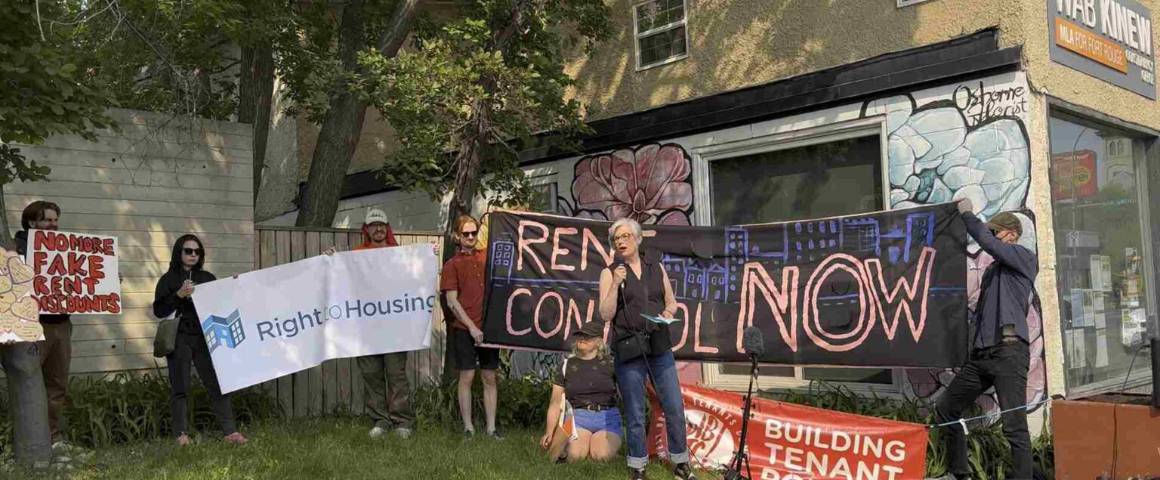
In early September, when the government announced its intent to increase the rent control ceiling, it made no mention of the proposal to cut capital expenses in AGI applications. Faced with an announcement that offered them no relief in the face of their imminent displacement, Wingspan tenants and supporters escalated their fightback and held a rally outside Wab Kinew’s office days before the fall legislative session began [photo].
Framed by tenant action, the beginning of fall session brought several important developments as the battle over housing resumed. One day into the session, Obby Khan stepped down as PC leader, and the party’s infighting dominated Manitoba’s headlines in the following days. Soon after, a coalition of a few dozen landlords, developers and associates launched a campaign opposing the proposed changes to rent increases.
As Bill 13 progressed, more than 100 landlords, tenants and housing advocates spoke before the legislative committee. The primary point of contention was the regulatory change on capital expenses. Tenant organizer Stefan Hodges warned that tenant advocates had learned in a meeting with Minister Sandhu that the government was considering caving on this crucial regulatory change.
One week later, the Right to Housing Coalition issued an open letter signed by more than 50 organizations calling on the government to pass all proposed legislative and regulatory changes without concessions to landlords. The letter was launched at a press conference featuring speakers from CUPE Manitoba, the Manitoba Association of Newcomer Serving Organizations, Pride Winnipeg, the West Broadway Tenants Committee and Right to Housing. With signatories from organized labour (including the Manitoba Federation of Labour), Indigenous organizations, newcomer organizations, queer organizations, women’s centres, neighbourhood organizations, harm reduction organizations and more, the list was made up of prominent organizations the NDP would count among its base.
In late October, just ahead of the November 1 date that Wingspan had scheduled for rent increases to be paid at three of its buildings, the government announced it would move forward with its rent control proposals. Bill 13 had passed third reading and awaited royal assent. The government also announced the immediate end to the RTB policy requiring tenants to pay unapproved rent increases, agreeing to a core tenant demand.
Furthermore, the government said it would move forward with the proposal to cut claimable capital expenses by 40 percent, effective October 28. Crucially, no AGIs would be legacied in – all existing AGI applications would see allowable capital expenses cut by 40 percent.
In his announcement, Kinew took on an uncharacteristically adversarial tone toward landlords, implying they were trying to get rent increases in before stronger controls came into effect. He revealed that Manitoba had already seen 500 AGI applications and was on track for 800 by the end of the year, when the annual average is approximately 300.
This is a decisive victory for tenants and working people across Manitoba. Tenant organizing and coalition building secured the passage of the measures proposed in the spring as well as additional protections, and forced the government to pass measures that limit landlords’ ability to profit from tenants’ income.
Through struggle, tenants ultimately won better than what was on offer from the NDP. In the process, they began building the organizational muscle to win even more going forward.
Support working-class media!
If you found this article useful, please consider donating to People’s Voice or purchasing a subscription so that you get every issue of Canada’s leading socialist publication delivered to your door or inbox!
For over 100 years, we have been 100% reader-supported, with no corporate or government funding.