Solidarity with Unifor 1285 – build the struggle for an economy that works for workers!
By Jack Copple
“Outrageous,” those were the words Prime Minister Mark Carney used when he was asked about the sale of the long-idled Stellantis assembly plant in Brampton, Ontario, to military contractor Roshel. The sale will see permanent job losses in the hundreds to the thousands, as the plant permanently shifts operations to armoured car manufacture, all without upholding the contract standards won through decades of workers’ struggle.
Outrageous indeed.
These sentiments, mirrored by Industry Minister Mélanie Joly, are not the first time Carney has blasted Stellantis in recent memory. In late October 2025, when the cancellation of production plans at the then idled Brampton plant were first announced, Carney threatened Stellantis with legal proceedings and lawsuits if they reneged on their commitments to EV manufacture. This ended up as little more than hollow legal threats and limp political theatre however, as the plant remained idled and workers’ lives and livelihoods were thrown into jeopardy.
Despite the fact that these empty threats did little to move Stellantis back into production then, and were not able to prevent Stellantis’ move to sale, Carney and Minister Joly are offering little more than rhetoric now. In fact, Roshel CEO Roman Shimonov expressed his confusion at Carney’s sudden public outrage, telling the business press that the government had been aware of the planned sale for months. Carney has since been forced to admit knowledge of the deal himself, with recent reporting indicating his office has been in on the sale talks since August.
Knowledge of the deal should come as no surprise either, as subsequent reporting from has revealed that Shimonov is a longtime Liberal insider and member of their elite “Laurier Club,” which critics have long described as a cash-for-access scheme that gives wealthy donors regular facetime with cabinet ministers and even the PM. If anyone betrayed workers in Brampton, it appears to have been the Liberal government.
But should people be surprised? These betrayals by Ottawa are not isolated incidents.
Stellantis, formerly Chrysler, has a history of feeding at the public trough. In the 2009 bailout, GM and Chrysler received $13.7 billion in government bailouts, with taxpayers ultimately absorbing a loss of nearly $3.7 billion. Just three years ago, the federal and Ontario governments promised Stellantis and Volkswagen up to $28 billion in performance incentives, a massive transfer of public wealth into private, foreign hands. Now, Stellantis is turning its back on the workers and community that sustained it, and simply walking away after pocketing billions in public cash – notwithstanding their “voluntary” commitment to repay some of the funding they have received since 2022.
And what’s the plan to scuttle the sale and protect the jobs that Carney, Joly and Ontario premier Doug Ford have cooked up and proposed in closed door meetings with Stellantis in the weeks since the announcement? Doubling down on the failed strategy of corporate dealmaking, with even more public cash being offered to Stellantis to keep the plant in operation.
So much for pursuing them to the “full extent of the law.”
Unifor workers at Stellantis have made clear their opposition to the plant’s sale, with the union’s National President Lana Payne calling the announcement of the sale a “betrayal” of workers in Canada. Local 1285 President Vito Beato went further, highlighting that despite the spin that “some jobs are better than no jobs,” workers were losing out here. Beato told the press, “The reality is that thousands of good-paying Canadian auto jobs are being sacrificed permanently in exchange for hundreds of hypothetical jobs that depend on military procurement contracts that haven’t even been awarded yet.”
Unifor is correct, and the sale to Roshel is just further proof that Carney’s “military Keynesianism” in response to the ongoing trade war with the US is a failed strategy, with thousands of jobs lost even if Roshel is awarded military contracts. Worse still, Roshel’s purchase will expand Canada’s role in global destabilization and the immiseration and death of working people abroad, with millions worth of recent orders sent to the IDF in Israel and ICE in the United States.
Military Keynesianism – directing huge amounts of public funds into massive military spending in order to stimulate economic growth – is not an effective jobs program. Military spending is capital-intensive, creates jobs in capital goods industries rather than consumer goods, and produces commodities which are designed to kill, destroy and be destroyed. While Carney may claim that this spending will create jobs, it is in fact a program of job destruction – as is clear from the mass layoffs in Brampton.
Looking beyond just Stellantis, Carney’s war economy is leading to mass layoffs across the country to fund his ever-ballooning war budget. At Canada Post, the move to cut home delivery is expected to permanently lay off some 10,000 workers, while the government’s war budget is already causing layoffs in the financially starved healthcare sector. Where’s Carney’s outrage for those workers and the thousands more, who are forced into unemployment by his policies?
If the government were serious about protecting jobs, Canadian sovereignty and working people’s living standards, it would not be talking about more bailouts for foreign-owned private companies. Instead, the federal government would be seriously talking about nationalizing Stellantis operations in Canada. This would keep the plant operating and maintain workers’ jobs, incomes and benefits.
Crucially, nationalization of Stellantis and the other auto plants in Canada would also be the first step toward creating a publicly owned and democratically controlled auto industry. Instead of making armoured cars or other tools of war, a nationalized auto industry could produce an affordable electric Canadian passenger vehicle and rapidly expand manufacturing capacity for municipal and inter-urban public transit such as buses and light rail, as well as light industrial vehicles and farm equipment. Such a project would create thousands of jobs, improve the lives of working people across the country.
The economic benefits – from job creation to industries in the supply chain – would be enormous and would far outweigh any supposed benefit from repeated transfers of public money to huge corporate monopolies, and it would be a key component of a genuine just, green transition
Beyond Stellantis, defunding Carney’s war economy opens the possibility for a real program of job creation. Research shows that for every $1 million spent on the military, only 5 jobs are created. But spend that same $1 million on healthcare, and you create 9 jobs; spend it on education, and you create 13 jobs. Cutting military spending by 75 percent over pre-increase levels would mean more than $163 billion to invest in jobs, infrastructure, housing and more, right across the economy.
But this won’t be motivating to Carney, or any of big business’ other preferred politicians – CEOs like Roman Shimonov do not pay them to protect union jobs, they pay them to protect corporate profits. Working people must recognize that the betrayal at Stellantis – and at Canada Post, Stelco and elsewhere – are a feature of Carney’s war economy, not a bug.
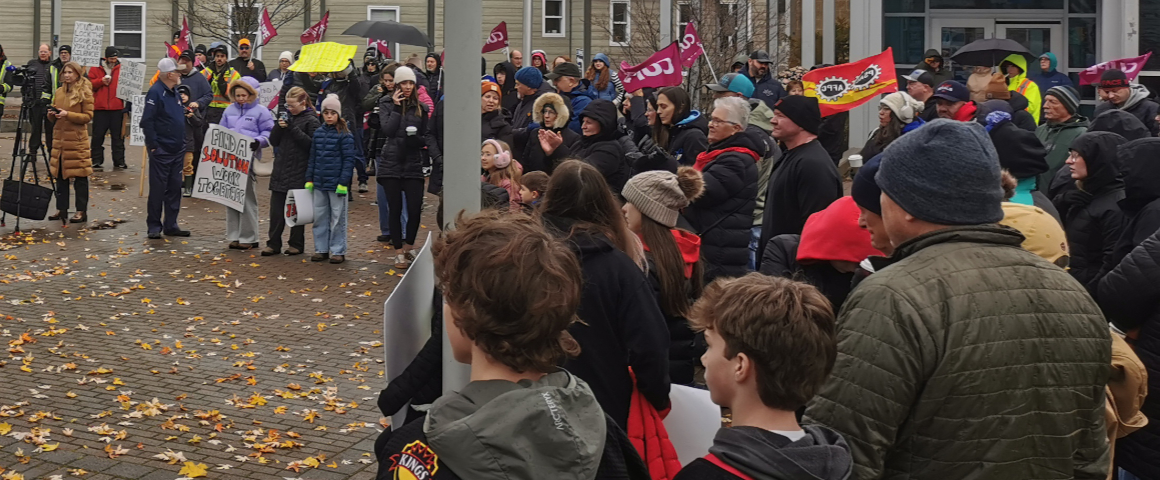
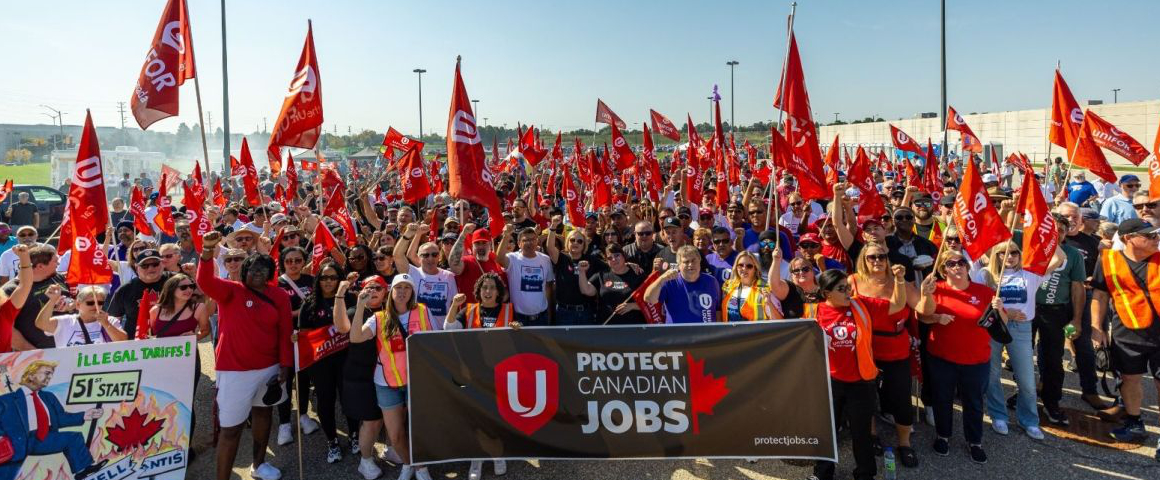
To win our just demands – jobs, wages, retirement benefits, labour and equality rights, peace and a livable environment – working people need to fight for them. Workers at the Stellantis plant in Brampton are doing just that – at publication time, Unifor 1285 members are picketing daily at the plant, and they are planning for a big fight to defend their jobs.
This is a struggle in which all working people in Canada have a stake. This is more than a fight over one plant in one industry in one province. It is echoed in working people’s struggle for strong and sustainable resource industries, for expanded and affordable transit and transportation, for a stable domestic steel industry, for food security and sovereignty, and for a restored shipbuilding industry. It is reflected in our fight to defend and expand public services like Canada Post, healthcare, education, childcare, parks and recreation.
These different issues are all connected, so we need to build a strong and united fight, led by the labour movement, that can bring together the working class and its allies. Through mass struggle, we can confront the war economy, the corporate profiteers and the politicians who serve them.
We can start by building solidarity with Unifor 1285 and its fight for the Stellantis assembly plant in Brampton.
Support working-class media!
If you found this article useful, please consider donating to People’s Voice or purchasing a subscription so that you get every issue of Canada’s leading socialist publication delivered to your door or inbox!
For over 100 years, we have been 100% reader-supported, with no corporate or government funding.