Ottawa makes banks the masters of “our” destiny
By Drew Garvie
The Carney government titled its November budget “Masters of Our Destiny,” and the words “sovereign” or “sovereignty” appear 114 times in the document. The repetition is a smokescreen meant to signal a government reclaiming Canada’s economic future. What the budget actually delivers is a transfer of power away from working people and toward corporations, both domestic and foreign and including US firms, that will benefit from the same tax breaks showered on Bay Street.
The title itself reveals shocking ignorance of class analysis and how little thought went into how this would land in Quebec. “Masters of Our Destiny” is a loose translation of “Maîtres chez nous,” the rallying cry of Jean Lesage’s Quiet Revolution in the 1960s, when Quebecers fought to take control of their own economy and resources from English Canadian and foreign capital. This included fighting for, and winning, public ownership of Hydro Quebec. Using that phrase to brand a budget that hands tens of billions to corporations is an insult to the history it borrows from.
The core policy of the corporate giveaway is the Productivity Mega Deduction, a tax write-off that will cost the treasury $36 billion over five years. The Canadian Centre for Policy Alternatives (CCPA) calculates that 29 percent of the benefit goes to oil extraction and refining, with another 10 percent to mining – sectors that hardly need public subsidy to invest. The deduction will cut Canada’s marginal effective tax rate on new business investment from 13 percent to 6.4 percent, the lowest in the G7 and less than half the US rate of 16.9 percent.
Canada is racing to the bottom to attract foreign investment and selling off its resources at bargain-basement prices.
The overall shape of the budget confirms its priorities. The government is booking $151.5 billion in new spending over five years, and the budget document itself says roughly two-thirds of that new money is for business and economic growth, while supports for the people of Canada merit about a third of new commitments. The National Union of Public and General Employees (NUPGE) points out that $99 billion in new tax breaks and business spending flows to corporations.
The CCPA said the budget masquerades as a plan to help Canadians struggling with rising costs. On affordability, the budget offers a temporary top-up to the Groceries and Essentials Benefit, which the government says will lift 120,000 people out of poverty in 2027. Even if that claim holds, it is a rounding error against the millions struggling. The benefit amounts to about $28 more per month for a single adult, and as the Institute for Research on Public Policy notes, the lowest-income earners “may remain below the poverty line.” Around 9.8 million Canadians, including 2.4 million children, lived in food-insecure households in 2025.
The NDP’s Avi Lewis is right that the budget says nothing about the main causes of high prices, namely corporate price gouging. But condemnations of corporate profiteering are not a policy demand. Lewis has called for a windfall profits tax and a ban on surveillance pricing, but not for price controls, the one measure that would actually stop corporations from using their unrestrained monopoly power to drive up prices.
Smokescreens hide privatization agenda
The budget also promises to “end homelessness” within a decade, a claim that deserves deep skepticism. Every level of government has made similar pledges while stepping back from building direct, non-market social housing since the 1980s and 1990s, treating shelter as a speculative commodity for investors rather than a basic human right. The result has been an explosion of encampments and a housing bubble.
Carney’s plan offers $30 billion over a decade, but it works out to roughly 2,500 supportive units a year for a country of more than 40 million people, and it leaves corporate landlords in control. The promise is simply a smokescreen to pretend to do something to address the increasingly visible scenes of desperation everyone can see on streets across the country.
The Canada Health Transfer tells a similar story. What looks like an increase is, after 2027–28, an effective cut. The transfer is scheduled to drop from five percent annual growth to a floor of three percent starting in 2028–29, a rate that will not keep pace with inflation, population aging, higher drug prices or rising chronic conditions.
That will embolden provincial privatization schemes, none more dangerous than Alberta’s Bill 11, which legislates a two-tier system by allowing physicians to practice in both the public system and a private market for medically necessary services, threatening the core of single-payer Medicare.
The budget offers further proof of federal complicity by allowing private clinics to write off equipment like X-ray and ultrasound machines, making privatization more profitable. Ottawa is directly subsidizing privatization.
More austerity is already visible across the civil service. The Public Service Alliance of Canada (PSAC) reports that more than 13,000 of its members have received workforce adjustment notices, and the government plans to eliminate 30,000 federal public service jobs over the next three years. The federal government claims its economic program is about creating jobs. In reality it will lay off tens of thousands of public sector workers directly and hundreds of thousands more once the cuts trickle down through contracted services and provincial governments.
The shift from public sector employment to a smaller number of war-economy manufacturing jobs will hit women hardest, widening the wage gap and reducing the quality of employment for thousands of families.
Meanwhile, the programs that could create jobs and raise living standards sit starving to death, even the ones the Liberals have created in recent years. The National School Food Program is funded at $216.6 million a year starting only in 2029–30, a fraction of what universal school meals would require. Childcare remains massively underfunded relative to need: five years into the national $10-a-day program, the fee promise has not been met in most provinces, waitlists have grown dramatically, and Ottawa has fallen far short of its space targets.
These are exactly the areas where public investment could put people to work, support women’s employment and lift children out of poverty. Instead of feeding children, Carney has chosen to feed the corporations that made record profits of $677 billion in 2025.
Austerity for most … but not all
But it is not austerity for everyone in Ottawa. The budget allocates $6 billion over 10 years to the Canadian Security Intelligence Service (CSIS), plus $579.5 million ongoing, a roughly 60 percent increase for the spy agency. This comes just months after the government acknowledged the need for an apology over a secret surveillance program that targeted hundreds of Indigenous people for decades. These instruments of the security state have consistently been used to target those fighting for peace, labour and Indigenous rights historically, and they will be used to do that in the near future as these struggles heat up under the corporate attack.
The biggest counterargument to calling this an austerity budget is, of course, that military spending continues its rapid climb. Core defence spending is projected to rise from $43.9 billion in 2024–25 to $75.1 billion in 2026–27, an increase of more than $31 billion in just two years, on the way to a Parliamentary Budget Officer (PBO) projection of $163.6 billion by 2035.
This will mean austerity at home and war abroad. The federal deficit is projected at $62.3 billion, and annual debt payments will rise from $60.2 billion to $85.5 billion over five years. The government is borrowing to fund war preparation while families wait for childcare and hospital services, while public sector jobs are lost, and as wages and living standards decline across the board.
Is this “Canada Strong”? It is past time we blew the whistle on the Captain Canada charade.
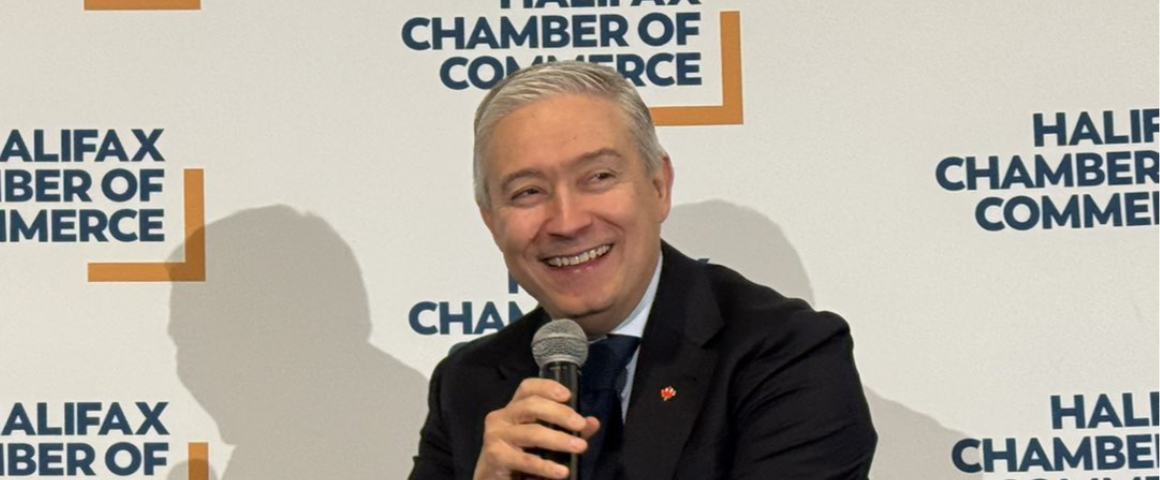
[Photo: Finance Minister François-Philippe Champagne in his happy place, among big business]
Support working-class media!
If you found this article useful, please consider donating to People’s Voice or purchasing a subscription so that you get every issue of Canada’s leading socialist publication delivered to your door or inbox!
For over 100 years, we have been 100% reader-supported, with no corporate or government funding.