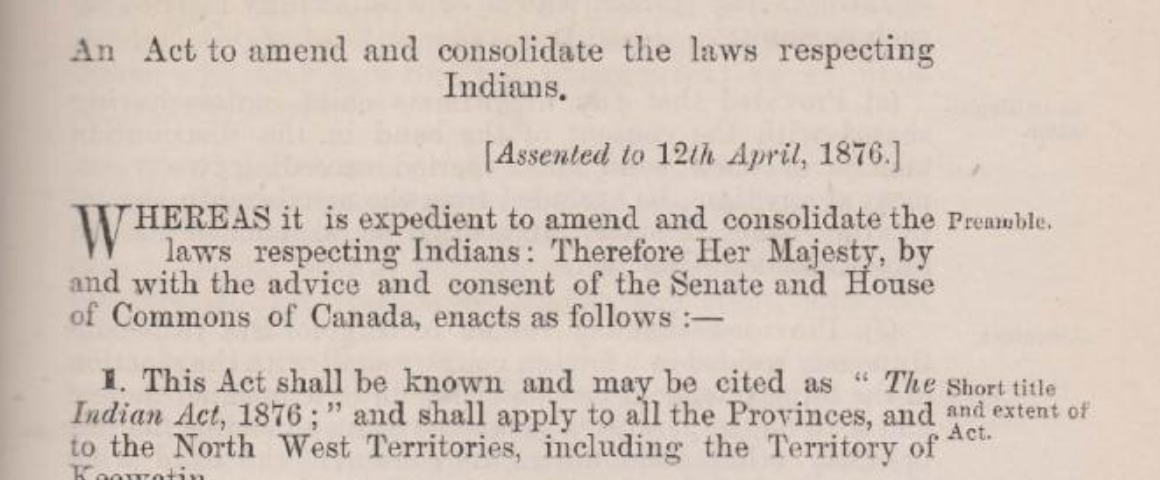
On October 26, during a meeting with federal, provincial and First Nations leaders, Manitoba’s NDP premier Wab Kinew held up his First Nations status card and called on Ottawa to abolish the Indian Act. His action, along with prime minister Mark Carney’s statement that he is open to it, quickly drew concern from many First Nations Chiefs, leaders and activists.
People’s Voice is pleased to publish the following guest commentary from Celeste Smith, founder and director of Cultural Seeds and Ga Gitigemi Gamik, North America Focal Point of the Civil Society and Indigenous Peoples Mechanism at the Committee on World Food Security, and Co-Chair of the International Programs Committee at the National Farmers Union.
As an Oneida woman, and someone who works on Indigenous rights at the UN level, I want to be clear: no one hates the Indian Act more than the people who’ve lived under it. It was built to control us, erase our governments and assimilate our children.
But abolition is not the same as decolonization. For anyone wondering why so many of us are nervous instead of celebrating, here is what’s at stake.
What the Indian Act does that people don’t realize
As racist as it is, the Act is also where many of the Crown’s legal obligations to us are written down. It’s the reason:
- Reserve land can’t be sold off, mortgaged away or seized by banks and creditors – it is held collectively, for the nation, not as private property that can be lost one parcel at a time.
- Property and income on reserve are protected from certain taxes.
- Status is recognized, and that’s tied to things like health benefits and education funding the federal government owes under treaty and its fiduciary duty.
- First Nations deal with Ottawa as nations, rather than being folded into provinces as just another group of citizens.
Rip the Act out without something agreed to in its place, and those protections can disappear with it.
We’ve seen this before
In 1969 the federal White Paper proposed exactly this: abolish the Indian Act, end status and hand everything to the provinces, all in the language of “equality.” Our leaders called it what it was – assimilation by another name – and fought it off.
In the US, the government broke up reservation lands into private parcels under the Dawes Act, and tribes lost roughly two-thirds of their land base. In the 1950s, “termination” policy ended federal recognition of nations like the Menominee and Klamath. They lost land, services and their legal standing, and spent decades fighting to get them back.
The pattern is always the same: freedom in the speech, land loss in the fine print.
So, the questions are:
Who decides? Under UNDRIP, self-determination and free, prior and informed consent belong to our nations, through our own governance. A premier is not that, status card or not. Many chiefs in that room said it wasn’t his call to make. And for us as Oneida, the Confederacy never consented to Indian Act councils in the first place.
Why now? This came at a meeting held while Ottawa is fast-tracking major projects, and chiefs are warning that this threatens our rights. “Moving beyond the Indian Act” has to mean restoring our jurisdiction, not clearing the way for resource extraction on our lands.
What replaces it? Land protections, treaty obligations and the Crown’s duties must be secured in law first, nation by nation, and designed by our people. They can’t be promised in a press scrum.
Back in 2012, Kinew himself told Parliament that swapping one paternalistic law for another isn’t progress, and that whatever replaces the Act should be designed by our people. I agree with that, Wab – let’s hold everyone to it.
Our nations will define our future. Not premiers. Not prime ministers.
Support working-class media!
If you found this article useful, please consider donating to People’s Voice or purchasing a subscription so that you get every issue of Canada’s leading socialist publication delivered to your door or inbox!
For over 100 years, we have been 100% reader-supported, with no corporate or government funding.