
By Ahmed Abbasis
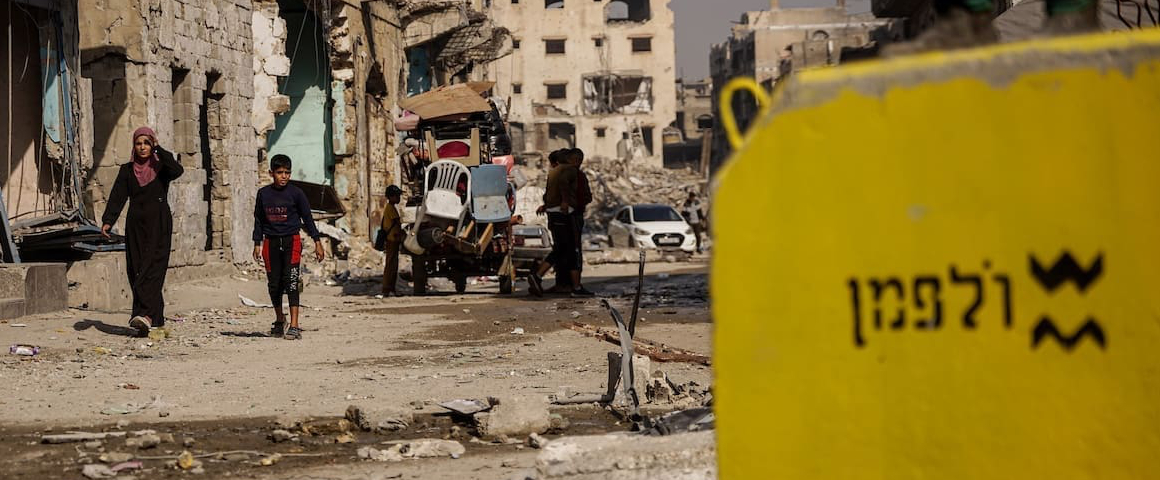
Israel drew a Yellow Line in Gaza to get what it has always wanted: Palestinian land. The Yellow Line is not a border; international borders are established by bilateral agreements or mutual recognition in accordance with international law. The Yellow Line is, on the other hand, a military demarcation line enforced by Israeli force. In some places, it is marked with yellow concrete barriers.
The Yellow Line is part of a broader colonial-settlement logic: Israel has never fully demarcated its borders. Some of them are still based on armistice lines, military occupation or disputed territorial claims. The continued ambiguity about the state’s borders allows Israel to steadily expand settlements, buffer zones and areas of military occupation under the pretext of security.
The ambiguity is not accidental. Although Israeli authorities present the Yellow Line and similar territorial markings as temporary security measures, enforcing these markings creates real change on the ground. Formal annexation would force Israel to pay a greater diplomatic and legal price, including a possible investigation by the International Criminal Court and even sanctions by the international community. This article argues that defining the Yellow Line as a temporary security measure rather than a permanent border allows the Israeli regime to seize territory while avoiding the political cost of formal annexation.
Marking creates reality on the ground
Since the ceasefire began in October 2025, Israel has moved the Yellow Line deeper into Gaza – about 300 meters west in the Shajaiyah area and about 500 meters west in the neighbourhoods of eastern Gaza City. Every day, the line is moved, erasing evidence of the genocide as the destruction continues. Israeli forces have demolished large parts of the built-up area in Gaza: homes, mosques, hospitals and universities. Families have been displaced by artillery fire and the advance of the occupation forces. Those who were later allowed to return found themselves in trenches where their homes had stood, as the Israeli army advances the yellow border markings to expand its areas of control.
The de facto annexation is proceeding in a pattern familiar from the occupied West Bank. As the Israeli offensive continues, Palestinians are forced to leave their homes and become displaced. The homes and civilian infrastructure left behind are destroyed, making it impossible to return. At the same time, the Israeli regime is taking “security” measures designed to prevent the displaced from returning. These actions have been repeated over and over in Palestine for decades, and each time the displacement has become permanent.
While the ceasefire required the Israeli army to partially withdraw, in practice the opposite is happening. Because Israel’s territorial expansion is proceeding through temporary security arrangements rather than formal annexation and is accompanied by media silence, the international community sees it as a technical violation of the ceasefire rather than a historic process of plundering Palestinian land.
History teaches: the temporary becomes permanent
Since 1948, the political arrangements that accompanied the ceasefires have served the Israeli policy of expansion. The Green Line, established in 1949 following the Nakba, was intended to serve as a military separation line.
But Israel’s de facto border was reversed. This left it with a much larger territory than was allocated to it in the UN partition plan. The 1993 Oslo Accords defined Palestinian self-rule as a step on the path to sovereignty, but allowed Israel to continue to take control of the West Bank and expand settlements – from 110,000 settlers in 1993 to over 700,000 today.
The disengagement from Gaza in 2005, which was presented as a withdrawal, also allowed Israel to strengthen its control over the borders, airspace, sea and access to Gaza, and even establish the separation between the Strip and the West Bank. In reality, these arrangements obscured the reality of Israeli expansion. They marked a rhetorical de-escalation, while military aggression and territorial takeover continued. The Israeli regime uses impermanence as a strategy, exploiting tentative arrangements to impose permanent rule.
Israel has already experimented with formal annexation. In 1981, Israel annexed the Golan Heights – a move that the UN defined as “null and void.” But despite condemnation from the Security Council, the latter took no enforcement action against Israel. Something similar happened with regard to East Jerusalem, whose annexation was also defined as “null and void,” while Israeli expansion continues despite international condemnation.
In contrast, the de facto annexation of Area C in the West Bank is proceeding without formal announcement, through settlement expansion, road construction, and the issuance of administrative orders. The lesson Israel learned from the Golan Heights and Jerusalem is that formal annexation exposes the violation of international law, while creeping annexation normalizes territorial change without a decisive moment of confrontation with the international community.
The Israeli regime therefore prefers temporary border markings to formal borders. This arrangement allows it to continue to take control of new territories while maintaining the illusion of temporality. The Yellow Line is part of the system: it obscures the reality of annexation, but destroys the lives of Palestinians whose homes, lands and livelihoods are caught up in the expanding sphere of control.
Zo Haderekh
Support working-class media!
If you found this article useful, please consider donating to People’s Voice or purchasing a subscription so that you get every issue of Canada’s leading socialist publication delivered to your door or inbox!
For over 100 years, we have been 100% reader-supported, with no corporate or government funding.