“National unity” cannot be based on misdirected anger and anti-immigrant sentiment
By Sean Butler
On the key question of moving forward to a binding referendum on separation, Albertans voted on October 19 by 75 percent to remain in Canada. This is a strong result, though we should hesitate to draw conclusions about what this means for “national unity,” or as Mark Carney concluded, that Albertans “have chosen to take care of each other, to move forward together with purpose, high ambition.”
This statement from the prime minister is directly contradicted by the results of the first five referendum questions, which presented a variety of restrictive measures designed to place access to social services behind barriers related to immigration status. Support for these measures was between 55 and 63 percent.
The problem isn’t specific to Alberta – as living conditions in Canada deteriorate under the weight of liberal austerity and capital accumulation, a notable portion of people are accepting the “citizen vs. immigrant” framing of the situation.
Worsening conditions for workers
Working people throughout Canada have experienced many of the same immiseration crises that are occurring simultaneously around the world. These are the crises of unemployment, housing, healthcare and other key conditions of the working class.
These crises have been sharply felt in Alberta. The province has experienced chronically high unemployment, hovering between 6 and 9 percent since the 2015 oil crash, with youth unemployment spiking as high as 16.5 percent in 2025 and currently resting at 12.5 percent.
Because of austerity policies, healthcare in Alberta has been ruthlessly underfunded for many years. In June 2026, an Angus Reid poll showed that 16 percent of Albertans did not have a family doctor and 45 percent reported not being able to get timely access to a family doctor, even if they have one. In 2026 so far, only 63 percent of surgeries in Alberta were completed within the medically recommended time frame, with some specific cancer surgeries being as low as 26 percent.
Windfall profits for the rich
Much of the separatists’ media push in the lead up to the referendum was focused on the metric of GDP per capita by province. Leaving aside the fact that this is inflated by government-subsidized oil production, the key issue with this figure is that it collapses class distinction. It explains how much value was produced per person, but it does not indicate who owns that value.
The more appropriate figure to understand is labour share of GDP – what percentage of that GDP is paid out as a wage. According to Jim Stanford at the Centre for Future Work, between 2017 and 2022 the Albertan labour share of GDP fell from 53 percent to 39 percent. This drop was by far the most notable of any Canadian province in that period. In the same period, net corporate surplus growth in Alberta was 229 percent compared to a Canadian average of 62 percent. Total GDP increased by 13 percent in that time, at just over 2 percent per year.
Taken together, what these numbers show is that economic growth in Alberta has been modest, but there has been a gigantic widening of class inequality with the rich taking an astronomically higher portion of the value.
Across the country, the right wing and liberal media have poured considerable effort in recent years into convincing the public that the problem is not the class-based distribution of resources, but the number and types of people who are attempting to make use of the artificially limited resources. In the case of housing, for example, the right wing frames the crisis not as an issue of the financialization of housing – wherein housing is commodified, hoarded, speculated upon and inflated – but as an issue of the ethnicity and immigration status of those simply seeking a place to live.
The immigrant experience
There is a narrative on the right that immigrants to Canada occupy a privileged position. According to this narrative, they are extra protected and supported by the government and preferentially given employment opportunities, privileges which come at the expense of “Canadians.”
None of this is the case. In 2023, the United Nations issued a report likening the conditions of migrant workers in Canada to “contemporary forms of slavery.” Immigrants face many economic and legal hardships in Canada. In fact, they are already restricted from receiving benefits in many of the ways the Alberta referendum proposes restricting them.
The referendum results paint the picture of a population that wants to remain within the federal structure of Canada but is angry at the idea of others enjoying the fruits of their labour when they perceive them as having not worked for it. In reality, permanent residents, people on work visas, temporary foreign workers and international students not only work and pay taxes but already struggle to access services.
The only people absorbing any significant value without working are the owners of capital, and they are absorbing it faster in Alberta than anywhere else in Canada, and by a considerable margin.
Class solidarity
The target of working people’s anger is misdirected, aimed at other workers and not at finance capital and austerity. If working people – Canadian-born and immigrants alike – are falling behind and being exploited by those who own the places where we work, how can we blame each other? Is it not clear that we should be entitled to more control over the products of our own work?
“National unity” cannot be based on misdirected anger and anti-immigrant sentiment. Canada is a multinational state – including Indigenous nations, Quebec, Acadia and English-speaking Canada. Unity needs to build through class solidarity that is based on national equality.
Alberta referendum result is a call to action for migrant solidarity across Canada. The path forward is to struggle against capitalism – instead of uniting with the ruling class against immigrant workers, working people need to unite with one another against the ruling class.
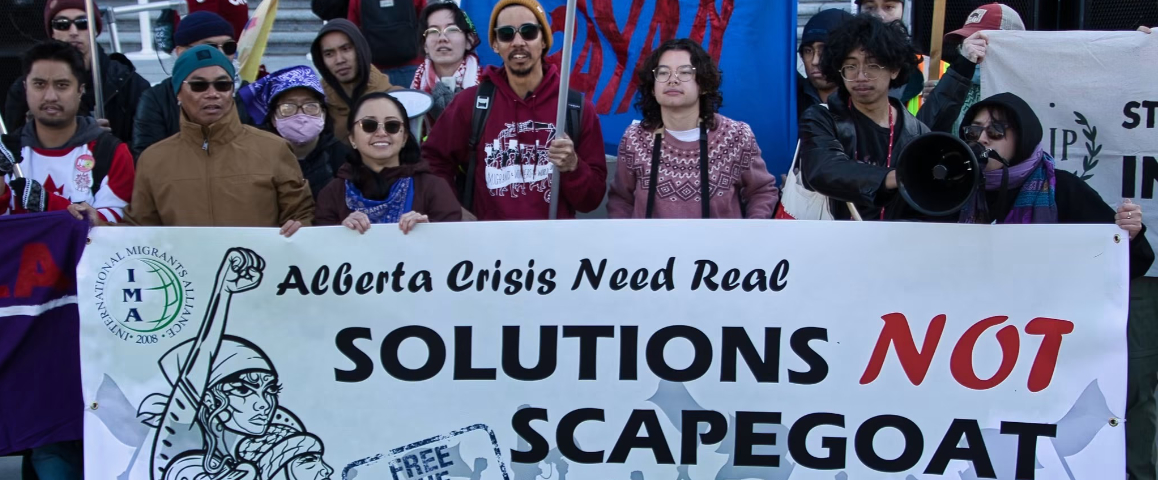
[Photo: Migrante Alberta]
Support working-class media!
If you found this article useful, please consider donating to People’s Voice or purchasing a subscription so that you get every issue of Canada’s leading socialist publication delivered to your door or inbox!
For over 100 years, we have been 100% reader-supported, with no corporate or government funding.