By Dave McKee
There’s no doubt that the labour movement moved quickly in response to the Carney government’s Bill C-39, which proposes to strip workers in federally regulated sectors of their right to strike and to bargain collectively.
The Canadian Labour Congress, by far the largest labour central in the country, issued denunciations of the legislation and warned that unions would fight back hard. Similar statements were made by the CLC’s affiliated unions, provincial federations and local labour councils.
Beyond the CLC, labour centrals in Quebec like the Confédération des syndicats nationaux (CSN), as well as non-affiliated unions including Unifor and Teamsters also issued sharp condemnations and warnings that they would mobilize in opposition.
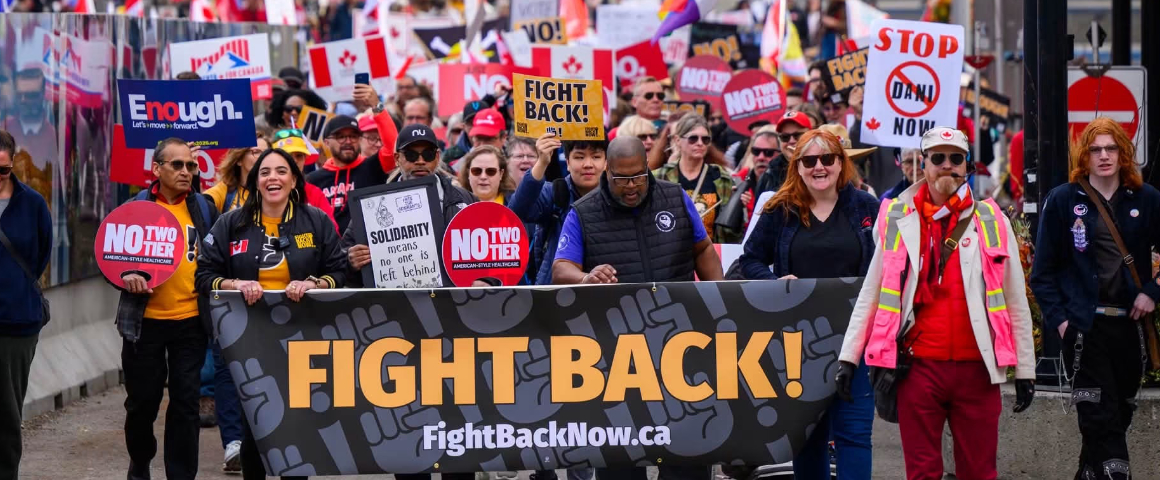
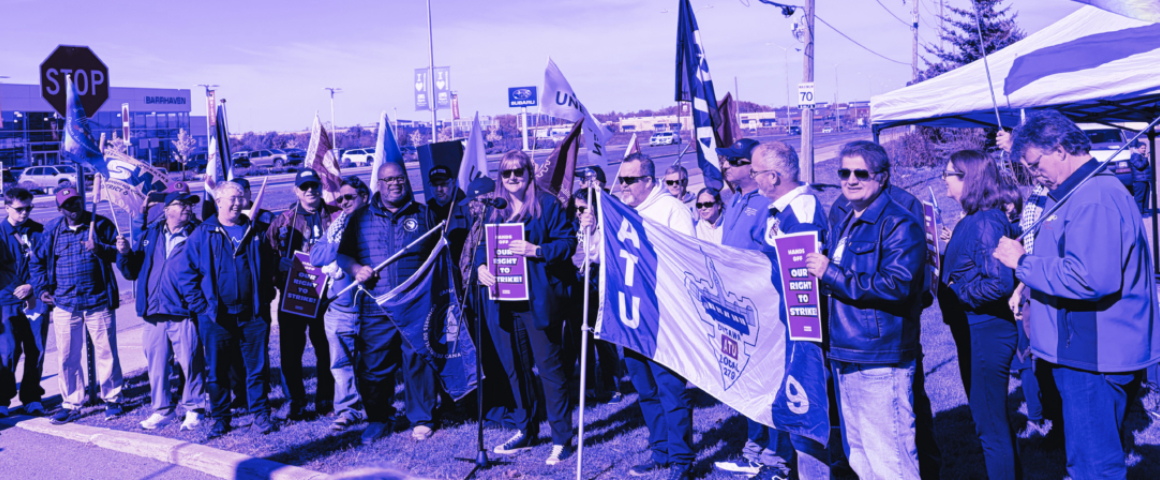
And labour didn’t stop at statements. On October 13, the CLC held a “telephone town hall” to mobilize workers against C-39. Some 6,000 people participated, and the town hall set the stage for a cross-Canada day of action on October 15.
Organized during the work week and just two days after the town hall meeting, the day of action was surprisingly successful. Workers demonstrated in at least 21 communities across the country, generally targeting federal MPs’ constituency offices. While the numbers were modest, the day demonstrated the labour movement’s capacity for rapid, coordinated mobilization in virtually every region of the country – a capacity which can be used to build and maintain the necessary struggle.
Labour has also worked with Indigenous nations and organizations, who have similarly moved into rapid action against C-39. In addition to its assault on the right to strike, the bill attacks and undermines Indigenous peoples’ Inherent and Treaty Rights and bypasses the government’s own duty to consult and receive free, prior and informed consent, most notably by creating a “national interest” designation for major infrastructure and resource extraction projects.
Add to this the broad range of environmental and climate justice organizations throughout the country, who are similarly concerned about the legislation’s weakening of regulations and restrictions, and we have the basis for a mass, sustained, escalating fight against Bill C-39 and the monopoly corporate forces it represents.
But once the CLC’s October 15 day of action passed, it became far from clear that the Congress and the labour leadership in general were prepared to organize and lead such a mobilization.
Less than a week after the day of action, the CLC shifted its momentum and focused on lobbying. Congress president Bea Bruske presented a package of amendments to the committee studying C-39, and the CLC’s communications team went into high gear encouraging working people to send email and phone blasts to MPs, calling on them to support the CLC’s amendments.
What are the amendments? Well, they’re pretty milquetoast.
In presenting the CLC’s package, Bruske stated that the union movement shares with business the goal of labour stability, warning of the risk (presumably a shared one?) of “illegal strikes.” To that end, two of the CLC’s four amendments detail how the government could create an “acceptable” process for ending a strike – specifically by determining if the action has caused aa “genuine national economic emergency” and then using a parliamentary vote rather than a ministerial order to break it.
Somewhat shocking that the leadership of the country’s main labour central would want to help the government – this government of war mongers and corporate profiteers – to break any strike, however “acceptable” the process.
Sure, the CLC submission also clearly opposed Section 107 in the Canada Labour Code, calling for its proposed expansion to be removed and for barring the existing provision from being used to end a legal strike.
But there is nothing about a Labour Bill of Rights to constitutionally enshrine workers’ rights to organize, bargain collectively and strike. Nothing about plant closure legislation that would compel corporations to show just cause before public tribunals with the power to stop closures and jail corporate executives. Nothing about getting out of job-killing corporate trade deals like USMCA, and adopting a progressive trade and industrial policy based on full employment, environmental sustainability and respect for Indigenous rights.
Beyond the CLC’s generally lightweight political response, the labour leadership also needs to beef up its organizational response, if it seriously intends to fight C-39.
Of course, there is a role to be played by “direct parliamentary pressure” (lobbying) but it is hardly as powerful a tactic as labour’s economic pressure. After all, there is a real reason Ottawa and its corporate backers specifically want to attack and sideline workers’ right to strike, rather than their right to vote, lobby or email their MP.
Labour needs to take the lead in building a powerful, united struggle of all working people. This starts with building unity within and throughout the union movement – the CLC and its affiliates working through provincial federations and labour councils, in genuine coordination with Quebec labour centrals and non-CLC unions like Unifor and Teamsters.
But labour’s role doesn’t stop at the edges of the union movement. It needs to reach out to and engage everyone who has something to lose from C-39 and the Carney agenda, and build a people’s coalition capable of resisting and defeating it.
This means Indigenous nations who are fighting to defend their land and water from mining and pipeline developments. It means climate and environmental groups fighting for a just green transition in the face of increasing carbon emissions and expedited extraction projects. It means peace and anti-war movements who are building opposition to Carney’s war economy.
A people’s coalition must include seniors and people with disabilities, whose lives are disproportionately threatened by the rapid privatization of healthcare. It must include students whose debt is soaring while provincial governments attack and dismantle quality, accessible education. It must immigrants whose rights are being rolled back and who are viciously and violently scapegoated for every social ill caused by capitalism.
And it means poor and unemployed working people, who are constantly targeted by capitalist governments and who are increasingly condemned to a life of rapidly declining incomes and quality of life.
This kind of powerful people’s coalition needs to be built at the grassroots level, through community-labour solidarity organizations that bring together public and private sector trade unionists and social justice and community activists, and coordinated through democratic provincial and country-wide structures. Such an effort can build the resistance and support necessary to sustain an escalating struggle, up to and including general strikes. This depth and breadth of organization is also required to build and demonstrate active solidarity when it is time for workers and unions to defy the government’s strikebreaking actions.
The labour leadership moved into action for October 15 because it realized immediately that Bill C-39 is a threat to all workers in Canada, starting with but not limited to 1.4 million workers in the federally regulated private and public sectors.
The October 15 day of action showed that the labour movement has what it takes to unite and mobilize. Now, the labour leadership has to show that it has what it takes to lead this fight.
Support working-class media!
If you found this article useful, please consider donating to People’s Voice or purchasing a subscription so that you get every issue of Canada’s leading socialist publication delivered to your door or inbox!
For over 100 years, we have been 100% reader-supported, with no corporate or government funding.