By Rozhin Emadi
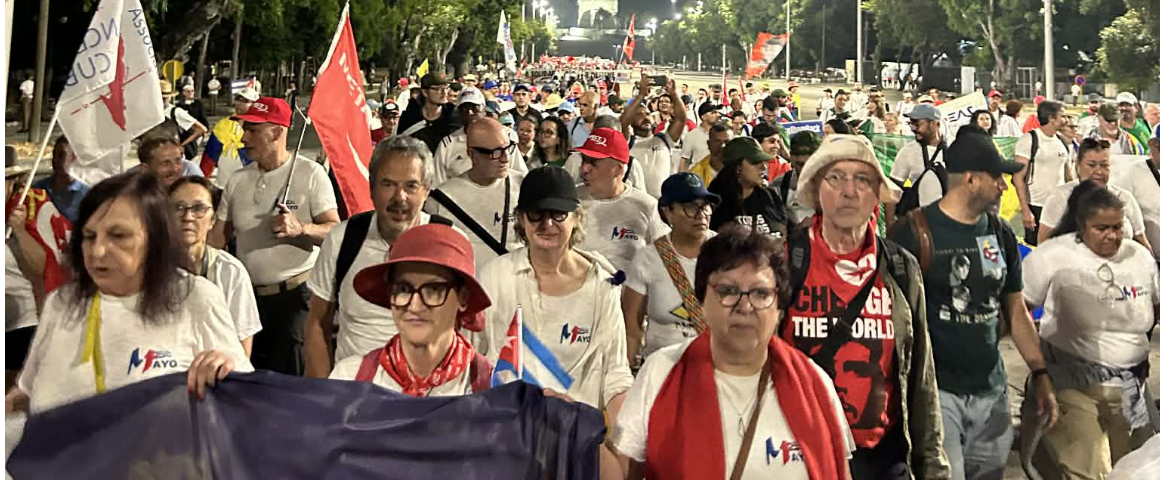
On May 1, International Workers’ Day, I had the opportunity to be in Cuba on behalf the British Columbia Teachers’ Federation. Alongside more than 800 international delegates, we marched with half a million Cubans to the US embassy in Havana, to demand an end to the blockade.
That same night, Donald Trump intensified the blockade, demonstrating how threatened the US is by the Cuban people’s resilience and support for the Cuban revolution. While we were there, we witnessed firsthand the brutal impacts of the blockade and how it is strangling the economy, starving the people, and restricting access to basic human rights such as electricity and mobility.
I first became interested in Cuba at the age of 12, through my father’s visit with an Iranian delegation of the May 1st International Brigade. Twenty years later, I joined that same brigade through my union. The experience was deeply meaningful, especially given that my home country of Iran has also faced heavy US aggression this past year. Trump not only intensified the economic blockade against Cuba but has also threatened military intervention, as he has done with Iran; marching to the US embassy to condemn imperialist aggression was empowering and significant.
Cuban President Miguel Díaz-Canel stated that this was not just another May Day, as this year marks the centenary of Fidel Castro’s birth. Fidel’s words, that “to struggle for peace is the most sacred duty of all human beings,” framed the day. For us, this meant standing for peace through solidarity, which is the antithesis to war.
Our delegation was invited by the National Union of Education, Science and Sports Workers (SNTECD), whose leadership is 80 percent women. One of the most memorable parts of the trip was learning from these incredible women union leaders and visiting their training centre.
We also visited Escuela Solidaridad con Panamá, a school for students with disabilities. Cuba has one of the most remarkable education systems in the world, with a strong emphasis on quality public education and schools in every neighbourhood in the country. After the revolution, Cuba achieved near-universal literacy and shared its literacy programs internationally – Cuba’s literacy methodologies were used in Canada through initiatives such as the ArrowMight program.
Indigenous organizations in Canada also collaborated with Cuban educators on literacy initiatives, many of which were used in rural parts of BC to improve literacy rates. This is one of the many reasons the BCTF has strong relations with the teachers’ union in Cuba.
At Escuela Solidaridad con Panamá, the level of care was striking – for 200 students there are 100 staff including dentists, nurses, doctors and physiotherapists. Students receive regular health check-ups and medication, class sizes are no more than ten, and parents meet monthly with educators to track their children’s progress.
When we visited, we heard students perform music including anti-war and Palestinian solidarity songs. They sang: “From the ashes Palestine will rise. Believe me when I say there will be a future with no war.” This stood out especially, given that so many teachers in Canada face backlash for similar anti-war content they teach in our schools.
What was also striking was the horizontal relationship between teachers and school leadership. Teachers are treated as experts in their field and collaborate with principals rather than receiving top-down orders.
Teachers work tirelessly to make sure their students receive quality public education and are highly valued for that. The students are not marginalized for their disabilities; in fact, their education is prioritized. Despite fuel shortages caused by the blockade, the government has worked to ensure that students have transportation so they could attend school, and provides dormitories for students who live further away.
Despite the unjust intensification of the blockade, the Cuban people continue finding ways to counter its severe consequences, keeping their society running and providing education to their youth. One of the ways they are doing this is through renewable energy transition initiatives, which we discussed with Cuba’s Minister of Energy and Mining at a conference on renewable energy.
Historically, Cuba has relied heavily on imported fossil fuels – about 96 percent in 2014. However, Cuba began planning its energy transition in the 1970s, and a renewed national strategy approved in 2025 outlines three key stages: reducing dependence on imported fuels by using 40 percent of Cuba’s own oil, achieving greater efficiency and self-sufficiency by 2035, and reaching 100 percent renewable electricity by 2050.
Despite the blockade, Cuba has expanded renewable energy from 4 percent in 2014 to about 15 percent this year, investing in solar, wind, biomass, hydroelectric, waste-to-energy systems and battery storage. This energy transition also integrates job creation, expanded opportunities for women in the energy sector, rural electrification and climate resilience. These efforts reflect Cuba’s attempt not only to survive but to build long-term sustainability.
Speaking at a May Day conference, Díaz-Canel outlined three pillars of Cuba’s approach to its development: national defence and preparedness in the face of external threats; economic sovereignty through reduced dependence, and food self-sufficiency and energy independence; and social justice, ensuring that development reduces inequality and protects vulnerable populations.
We also attended a conference titled Digital Hegemony and People’s Resistance, organized by the Workers’ Central Union of Cuba (CTC). Cuban Marxist scholars argued that digital power works as a form of global control, where those who control data, AI and digital infrastructure also shape global inequality and geopolitics. Technology is not neutral; it is shaped by power and inequality, producing tremendous profit for some but major implications for many, particularly working people around the world.
Panelists described data as a “strategic resource – comparable to oil – because those who control it shape economic and political power.” Those who control it also shape public narratives. Corporations such as Google, Microsoft and Apple have the ability to influence what information people have access to, and what ideas, perspectives and knowledge are promoted or marginalized. The Cuban scholars referred to this as “digital colonialism” and noted that it also shapes individual consciousness by reinforcing false narratives about countries like Cuba, which challenge imperialism. Automation and AI are also transforming labour markets, outsourcing low-paid and often invisible digital labour to the Global South.
In response, scholars and unions have called for “technological sovereignty” and “democratic digital ecosystems,” including union-controlled digital platforms and knowledge-sharing networks that strengthen class consciousness. It was fascinating to see Cuban academics and labour unions working hand in hand to develop Marxist analyses of digitalization and AI while also proposing practical solutions to the challenges these technologies create.
Clearly, Cuba’s achievements are not accidental. They are the result of a socialist system that emphasizes social justice and prioritizes people and collective well-being over profit – treating education, healthcare, housing and food as rights rather than privileges only a few can access, and placing environmental protection above private gain. Cuba challenges the idea that a world beyond capitalism is impossible.
We are told time and time again that socialism can never work. But if that is true, why has so much effort been invested in preventing it from succeeding? Why has it been undermined, isolated and attacked for decades? Why does Cuba continue to face an unjust blockade simply for having the audacity to build socialism right on the doorstep of the United States?
The blockade sets a dangerous precedent: that when workers unite to build a society that prioritizes people over profit, they will be punished for it. It sends a message that any attempt to chart an alternative path will be met with economic warfare and relentless pressure.
At the Museum of Terrorism in Havana, we learned about US-backed operations aimed at undermining Cuba’s sovereignty. One that stood out was Operation Peter Pan, which led to the separation of approximately 14,000 Cuban children from their families under the pretext of “helping” youth escape socialism. Many of these children were severely abused and placed in institutions that resembled residential schools, where they were often disconnected from their language, culture and communities. Tragically, many were never reunited with their families.
The contrast between the achievements of Cuba’s education system and the act of separating children from their families to undermine the revolution was striking and heartbreaking.
Throughout our visit, the Cuban people expressed deep gratitude for acts of solidarity from around the world. Unions and other organizations have sent containers of supplies, raised hundreds of thousands of dollars, pressured governments to condemn the blockade, gathered thousands of petition signatures and organized mass demonstrations, some of which have drawn tens of thousands of participants.
The labour movement here in Canada must continue to oppose the blockade, militarism and foreign intervention, and push governments toward independent foreign policies grounded in peace and support for international law. The BCTF recently contributed $22,000 toward solidarity with Cuba, and more unions should follow this example.
President Díaz-Canel told us: “International solidarity is the most powerful force. Solidarity gives us victory, and we have no doubt about that.” He emphasized that every act of solidarity strengthens Cuba’s ability to continue resisting the blockade and building a more just society. He also stressed that such solidarity creates a responsibility for Cuba to continue serving as an example of hope and internationalism.
Those words stayed with me. Cuba represents more than a single country – for many people around the world, it represents the possibility of a different future. Failing Cuba would not simply mean failing the Cuban people. It would mean failing a symbol of international solidarity, self-determination and the belief that another world is possible.
Support working-class media!
If you found this article useful, please consider donating to People’s Voice or purchasing a subscription so that you get every issue of Canada’s leading socialist publication delivered to your door or inbox!
For over 100 years, we have been 100% reader-supported, with no corporate or government funding.