By David Lethbridge
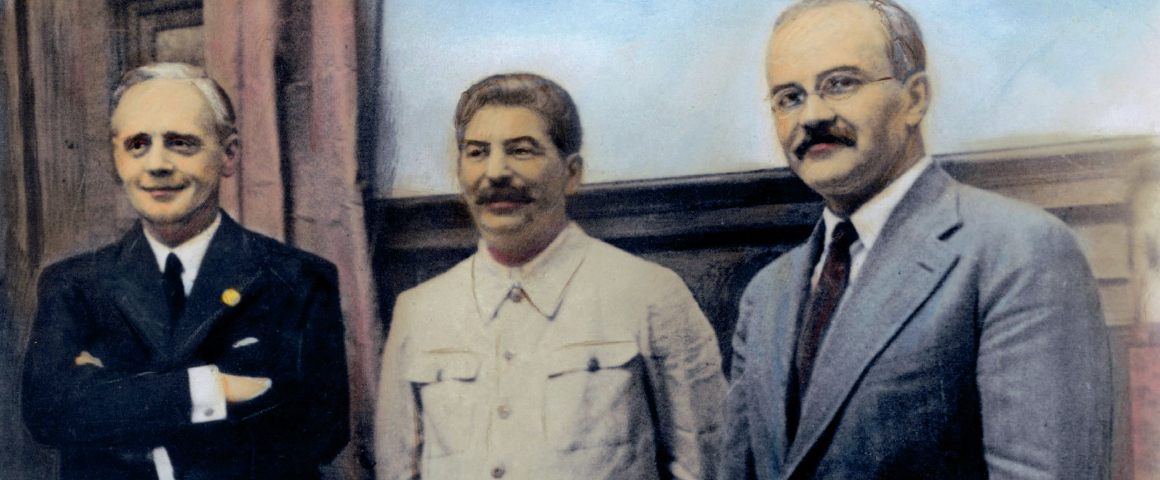
In September 1939, the government of the Soviet Union and the government of Nazi Germany signed what was known as the Molotov-Ribbentrop pact. This was, importantly, a non-aggression pact – a treaty in which each country would refrain from attacking the other.
In recent years, as part of the ongoing and increasing attack on communism and the history of socialism, the imperialist powers led by the US have been at pains to falsely portray this pact as a treaty between allies, between friends, between blood-brothers; as if communism and Nazism were variations on the same theme.
Nothing, of course, could be further from the truth. The Communist Party of the Soviet Union and communist parties throughout the world were the greatest enemy of Hitler and of fascism. Italian communists were the first targets of Mussolini, and upon seizing power Hitler immediately attacked the German Communist Party. During World War 2, in every country in Europe, it was communist partisans who led the resistance, and it was the Battle of Stalingrad that began the final defeat of Hitler.
But history and truth are of little importance to imperialist powers. What matters to them is to spread a sufficient amount of lies about the past to try to blunt the class struggle which is intensifying in the present.
Few remember now, or were ever taught in school, the real history of the period leading up to the invasion of the Soviet Union by the Nazi-fascist hordes.
The true place to begin is in 1917, the year that changed everything.
No sooner had the October Revolution triumphed in Russia, than more than a dozen western imperialists powers, led by Britain and including Canada and the US, invaded the new Soviet republic and engaged in two years of bloody slaughter that knew no bounds. It was an open attempt to overthrow the revolution – to, as Winston Churchill put it, “strangle at its birth” the workers’ state.
A mere twenty years later, with WW2 looming on the horizon, can anyone imagine that the imperialists had changed their minds? The Soviets knew exactly what was going on; it was hardly a secret.
Churchill, a rabid anti-communist, was full of praise for fascism. In Rome in 1927, he congratulated the fascists on their “triumphant struggle against the bestial appetites and passions of Leninism,” and that Mussolini had demonstrated the “ultimate means of protection against the cancerous growth of Bolshevism.”
When Mussolini planned to invade Ethiopia, he approached then British Prime Minister Ramsey MacDonald to seek his approval. MacDonald replied, somewhat bizarrely, “England is a lady. A lady’s taste is for vigorous action by the male, but she likes things done discreetly – not in public. So be tactful and we shall have no objection.” A few months later, fascist Italy slaughtered hundreds of thousands of Ethiopians in what is widely recognized as a genocide.
In 1936, when Franco’s fascist troops attacked Spain’s democratic government, Hitler and Mussolini sent air and ground forces to his aid. Britain and the US, while not sending troops, nevertheless sided with the fascists, with interests in both countries sending motor oil, fuel oil, bombs, ammunition, trucks and aircraft. The Nazi planes that leveled Guernica were powered by US gasoline. Only Mexico and the Soviet Union sent arms to defend the legitimate, elected government in Madrid.
Assistant US Secretary of State Sumner Welles put it plainly: “Business interests in every one of the democracies of Western Europe and of the New World welcomed Hitlerism.”
All this collaboration with fascism, this twenty-year assault on the Soviet Union and on communist parties everywhere, was perhaps most clearly presented in the signing of the Four-Power Pact in July 1933. At Mussolini’s behest, representatives from Britain, France, Fascist Italy and Nazi Germany signed a treaty in which they agreed to mutually assist each other in controlling power in Europe.
As late as November 1938, the Four-Power Pact continued to be referred to in the British House of Commons. Labour Party politician Stafford Cripps remarked: “People would not tolerate the foreign policy of the Government if it were to be frankly and bluntly stated, that is, the foundation of a Four-Power Pact with the fascist countries.”
For the Soviet Union, the situation throughout the 1930s became clear as crystal: the enemies of the workers’ state had gathered together for a single, unspoken purpose: with the rise of Hitler, the Western imperialist powers encouraged Nazi Germany to invade the Soviet Union.
In September 1938, the Anglo-German Declaration was signed – a non-aggression pact between Britain and Nazi Germany. Why, then, should not the Soviet Union sign a similar agreement?
In August 1939, they did just that. Ribbentrop flew from Berlin to Moscow and the Soviet-Nazi non-aggression pact was signed.
Was the agreement successful? When it was obvious that the imperialist powers were encouraging Hitler to move against the Soviet Union, was Stalin’s delay in confronting the Nazis head-on in 1939 the correct decision? When the war did eventually break out, almost 30 million Soviet lives, both soldiers and civilians, were lost in the struggle against fascism – would the numbers have been less if Stalin had acted sooner? It is impossible now to know.
Fidel Castro, in a wide-ranging interview with Frente Sandinista co-founder Tomás Borge shortly after the collapse of the Soviet Union, had much to say about the Molotov-Ribbentrop pact. He prefaced his remarks by saying “I believe Stalin committed an enormous abuse of power.” He was particularly critical of Stalin’s policy in the years before the Second World War, a policy which he felt was “totally erroneous.” Castro understood that the Western powers were promoting Hitler and encouraging him to expand towards the Soviet Union, which led Stalin “to do something I will criticize all my life, because I believe that it was a flagrant violation of principles: seek peace with Hitler at any cost, stalling for time.”
Castro maintained that the Molotov-Ribbentrop nonaggression pact did not gain time for the USSR; on the contrary, it reduced it. During the period from 1939 to 1941 – at which time the Nazis invaded the Soviet Union – while “the USSR could have rearmed itself, Hitler was the one who got stronger.” According to Castro, “Stalin’s character, his terrible distrust of everything, made him commit several other mistakes: one of them was falling into the trap of German intrigue and conducting a terrible, bloody purge of the armed forces and practically beheading the Soviet Army on the eve of war.”
It should be noted, parenthetically, that in Castro’s view, despite the grievous errors that Stalin made regarding the Soviet-Nazi nonaggression pact, “Stalin led the USSR well during the war. According to many generals, Zhukov and the most brilliant Soviet generals, Stalin played an important role in defending the USSR and in the war against Nazism.”
Whether or not one agrees with Fidel’s position on the Soviet-Nazi pact is beside the point; other points of view are certainly defensible. The central point is that the imperialist powers, the US above all, want to turn a nonaggression pact – a pact where both parties simply agree not to invade each other – into some sort of friendship treaty. All the while, they ignore or downplay the significance of several other pacts, and in particular the Four-Power Pact, a true alliance of imperialism with fascism.
The history of communism is being erased before our eyes. A false and distorted version of our successes – and our failures – is being spread through every medium and on every political platform. Laws are being passed making our parties and our ideology illegal. The monstrous lie that communism and Nazism were equally responsible for starting the Second World War is becoming increasingly common.
We must not allow these lies to continue unchallenged. We must resist. We owe it not only to the future, but to those many who now are rising to join us in revolution.
Support working-class media!
If you found this article useful, please consider donating to People’s Voice or purchasing a subscription so that you get every issue of Canada’s leading socialist publication delivered to your door or inbox!
For over 100 years, we have been 100% reader-supported, with no corporate or government funding.