By Jeanne McGuire
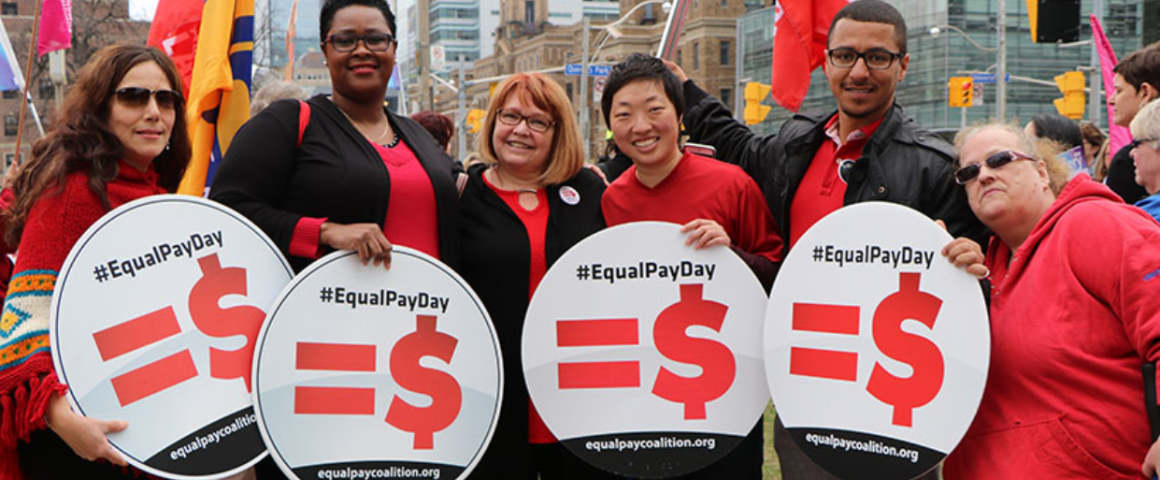
This year, April 14 was designated Equal Pay Day. That is the day when the wages that women earned from January 1, 2025 would equal what men earned by December 31, 2025 – in other words, it takes an extra three and a half months of work for women to make the same amount of money as men. What an indictment of Canada that is.
Why do women in Canada earn 32 percent less than men? One reason is they earn less for doing the same job. According to the Equal Pay Coalition, in 469 out of 500 occupations across every sector of the economy, women are paid less than men. On average, in 2018 women were earning $4.13 less per hour than men.
However, that is not the whole story. Sixteen percent of working women work part time, compared to 4.8 percent of men. Clearly part-time work has more consequences than just less pay – it comes with reduced benefits, fewer holidays, less or no sick days, no family days, and reduced or no pension plan. In every way, part-time work reduces the quality of life of those who perform it.
Women also work in occupations that are lower paying – in the ten lowest paid occupations, 75 percent of the workforce are women. By contrast, in the highest full-time positions, women represent only 20 percent of the workforce. In general, the higher the concentration of women, the lower the pay.
The longer women work, the bigger the gap becomes between their wages and that of the men in the same category. The clear implication of that fact is that women’s wages do not increase at the same rate as men’s once they have been hired, and women do not get promoted at the same rate as men within the job.
Amazingly, men experience a “fatherhood premium” according to which, after becoming parents, they receive an average 15 percent increase in their pay within the private sector and a 7 percent increase in the public sector. On the other hand, according to the same studies, women who have children experience a 0.5 percent pay reduction in the private sector and only gain 1.3 percent in the public sector.
Higher education for women is no guarantee of equality. While it is true that the gender pay gap decreases with the amount of education, that is only the case for the first two years of work after the degree. A woman with a professional degree will earn 92 percent of what a man would earn, but within 2 to 5 years her earnings drop to only 86 percent of what he earns.
According to the HR Reporter, in sectors seeing the highest wage increases in 2025 – culture (10 percent), utilities (4.7 percent) and professional services (3.4 percent) – men’s wages went up more than women’s wages, thereby increasing the gap between them.
It is important to remember that we are not talking about individual earnings here. These figures are about something far more important – average annual earnings. They describe a social reality that reflects a range of factors that highlight women’s economic status relative to men. This is a social reality that affects the lives of individuals, those who suffer the consequences of those factors as well as their children, their families, their communities.
And, of course, it is also important to remember that there are many women who face even worse forms of discrimination in the workforce. The average annual wage of women is 32 percent less than men’s. Women with disabilities will earn 56 percent less than men’s earnings, and immigrant women will earn 55 percent less. Indigenous women will earn 45 percent less, and racialized women will earn 40 percent less.
These differences in wages allow employers to bank more than they would if equal pay were a reality. Working people are the ones who are losing.
What is needed to tackle this question?
First, we need the government to implement the Canada Wide Early Learning and Child Care System – the $10 per day childcare program. An important impediment to women working full time, earning full time wages and benefits, is the lack of affordable childcare.
We also need to overcome the segregation of women into low paying jobs. Part of that task is to open up higher paying occupations to women. But another part is to overcome the prejudice that if it’s “women’s work” it isn’t as valuable as the work done by men. Childcare is as important, if not more so, than truck driving; moreover, it requires much more training. Underpaid “women’s work” reflects the attitude toward women, not the value of the work.
We need mandatory pay transparency. Paying women less for the same job would be far more difficult if the women knew they were being paid less.
We need a full employment policy. More women would work full time if there was more full-time work.
We need more unionization, which is an immediate benefit to working women. It provides pay transparency – it’s called a collective agreement, wherein the wages for each position and the criterion for pay increases is written out and available for all to see.
Unionization also overcomes another hurdle that women have faced, which is trying to negotiate their own pay increases with the employer. Negotiating for yourself is difficult if you don’t know what others in the same or similar jobs are being paid. A collective agreement overcomes that obstacle. Arguing for your individual worthiness is more difficult than arguing for the worthiness of the position, and collective bargaining overcomes that hurdle as well.
Unionization provides better benefits, standard holidays, sick days, family days, pension plans, health and dental benefits, maternity and or family leave.
We need a militant, mobilized women’s and gender equity movement that can articulate what women today need to achieve equality – in the workplace and in society. As we watch governments across Canada move increasingly towards austerity and social service cuts – a job sector in which women are highly represented and providing services women need – a revival of those movements which advocated and fought for women’s rights and gender equality are once more needed. Women’s voices still need to be heard, women’s rights still need to be recognized, women’s equality still needs to be won.
A major step towards that equality is equal pay.
[Photo: Equal Pay Coalition]
Support working-class media!
If you found this article useful, please consider donating to People’s Voice or purchasing a subscription so that you get every issue of Canada’s leading socialist publication delivered to your door or inbox!
For over 100 years, we have been 100% reader-supported, with no corporate or government funding.