By Sean Butler
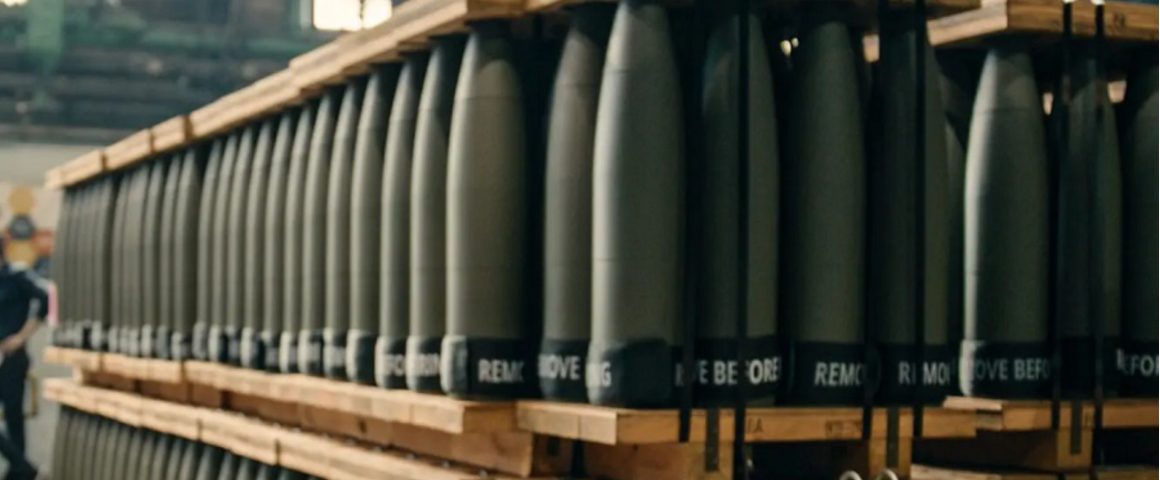
General Dynamics, a weapons manufacturer whose 2025 profit was $4.2 billion against $52.6 billion in revenue, is the sole source provider of the M31A2 propellant used by the US military to launch artillery shells.
The M31A2 propellant is manufactured exclusively at General Dynamics’ factory in Salaberry-de-Valleyfield, Quebec – just southwest of Montreal. In September 2024, the contract for its sale was updated with a transaction description for a $55 million spending increase that indicated it was an “effort in support of Ukraine & Israel.”
According to the US Army’s Joint Project Executive Office for Armaments and Ammunition, the M31A2 propellant is used in the M232A2 charges, which power the 155mm artillery shells that the Israel Defence Force (IDF) uses against the people of Palestine.
Protests against expansion
As the death toll in Palestine rises to 73,000, General Dynamics is proposing a dramatic expansion of the Salaberry de Valleyfield facility. The $682 million project has drawn waves of public protest from people who want Canada to stop contributing to Israel’s aggression.
Environmental groups, pro-Palestinian groups, anti-war groups and others have travelled to the facility on multiple occasions to protest the company’s war profiteering.
Arms export loophole
Critics of this country’s arms export industry point out that Ottawa attempts to mystify and obfuscate Canada’s role in atrocities abroad by claiming they cannot be certain how or where the arms are used.
Paradoxically, they also claim that arms contracts are meticulously vetted to prevent them being used in an unethical manner. As noted above, contracts between the Canadian government and the US military explicitly state where the arms are to be used.
The federal government has responded to criticism on this point by citing the various existing arms export legislations and control regimes. However, arms shipments to the United States operate under a separate and much less rigorous framework than any other trading partner, creating a loophole in which Canada can functionally sell arms to any buyer so long as the materials pass through US supply chains first.
In March, a federal bill seeking to close this loophole (Bill C-233, No More Loopholes Act) was defeated in the House of Commons. The Liberals, Conservatives and Bloc Quebecois voting overwhelming in favour of maintaining Canada’s military supply relationship with Israel, via the US.
Liberal government war mongering
One of the Carney government’s signature policies thus far has been the dramatic expansion of military expenditure and deepening ties with the US military industrial complex.
Citing the need for “defence” in an increasingly dangerous world, Carney plans to expand military spending from roughly $60 billion per year to as high as $156 billion by 2030. Of course, the true source of danger is the very country to which Canada exports most of its arms, for profit.
This deepening military-finance relationship between the US and Canada highlights the profound contradictions of the Liberals’ “elbows up” messaging. Despite his florid language at Davos, Mark Carney does not seek to make Canada a more independent “middle power,” but is rather ensuring that Canada is more entangled, more complicit and more guilty of participating in US imperialist aggression than ever before.
The Liberal government is not trying to prevent war, or even protect Canada, but to ensure the private sector can profit from as much blood money as possible.
It is not enough to simply speak in support of Palestinians as a concept. People in Canada must insist that the government stop allowing the provision of and profiting from the munitions required to perform Israel’s ongoing genocide against Palestine.
Support working-class media!
If you found this article useful, please consider donating to People’s Voice or purchasing a subscription so that you get every issue of Canada’s leading socialist publication delivered to your door or inbox!
For over 100 years, we have been 100% reader-supported, with no corporate or government funding.