BC Labour Committee
On August 4, the BC Labour Relations Board issued a decision ordering Amazon Canada Fulfillment Services and Unifor Local 114 to determine their first collective agreement through binding arbitration.
This decision was made after numerous legal disputes throughout the certification and negotiation process. An independent mediator determined that Amazon procedurally delayed negotiations and created an artificial impasse during their first-contract negotiations with Unifor Local 114.
The Board certified the union to represent approximately 800 workers at the Amazon YVR2 warehouse in Delta, BC on July 10, 2025. The YVR2 Fulfillment Centre is the only certified unionized Amazon location in Canada, achieving this historic outcome after a lengthy and contentious organizing campaign resulting in an order for remedial certification.
The parties have yet to negotiate their first collective agreement on the heels of a certification drive marked by Amazon’s misconduct.
For background, in 2025 the Board found that Amazon engaged in a “lengthy and pervasive anti-union campaign” during the organizing campaign and certification drive. Amazon deployed a “specialized field team which increased managerial presence and who conducted one-on-one meetings,” displayed anti-union messaging, and engaged in other improper actions and violations of the provincial labour code. Most severely, the Board reviewed evidence that Amazon’s “list padding” sought to artificially inflate the number of employees in the bargaining unit and undermine the union’s organizing drive.
In another earlier decision, the Board determined that Amazon violated the statutory freeze provisions of the labour code by not performing a wage review for bargaining unit members at YVR2 and applying it across all sites of its business. The Board ordered Amazon to provide the union members with pay increases arising from their typical wage review process.
It was in the throes of this frustrated litigious history that Unifor served notice to bargain the first collective agreement in October 2025. Negotiations ran up to February 2026, when a mediator was appointed and joined the bargaining sessions until March 2026. Mediation broke down on May 7, when “the mediator advised the parties that he could not issue recommendations to conclude a first collective agreement that he believed would likely be accepted by both parties.”
The Board’s August 4 decision outlines the proposals in dispute when the parties reached impasse:
First, Amazon sought to introduce a union security proposal reminiscent of US-style right-to-work legislation. Amazon wanted union membership to be voluntary instead of a condition of employment, which any union in Canada would wholly and reasonably reject. This “open shop” clause was described by the Board as “a clause exceedingly few unions in the province would be willing to accept, and it is credible that the union, in the context of this dispute and in light of Amazon’s past conduct, has perceived it as inflammatory and designed to further undermine its reputation with the bargaining unit.”
Second, Amazon proposed productivity and attendance management proposals that would maintain the “status quo” on all policies across the unionized warehouse and other distribution centres. Effectively, Amazon sought to restrict the right of the union to challenge the reasonableness of current and future policies. As the mediator put it, these proposals were “over and above what would typically be contained in a management rights clause.”
Finally, while seeking the “status quo” in policy applications, Amazon stated that it would not agree to a proposal by the union for wage rates and a me-too clause on wage increases other warehouses and distribution centres receive. The August 4 decision identified that the mediator found “on the one hand the employer wants the union to agree to provisions that are driven by what occurs in other centres; but on the other hand, it is not prepared to take the same approach with wage rates.”
The mediator and the Board both found that Amazon did not make a reasonable effort to table wage proposals; Amazon first did so three days into mediation. The union argued that this delay to produce monetary proposals “unnecessarily impeded and delayed bargaining and demonstrated that the employer did not make a reasonable effort to conclude negotiations.”
As such, the mediator issued a report advising that a strike or lockout would not resolve negotiations due to the “entrenched positions [… and] the litigious adversarial relationship after the remedial certification.” The mediator recommended that the first collective agreement be resolved through binding arbitration. The union agreed to this process, and Amazon rejected the recommendation.
The Board found that Amazon’s actions during the organizing drive, breaches of the labour code through the anti-union campaign, and violations of the statutory freeze provisions were sufficient to demonstrate that Amazon affected the union’s effectiveness and reputation with its members. The Board determined that Amazon’s “conduct before and after certification has impacted the ability of the parties to reach a first collective agreement and this favours a direction that the first collective agreement should be determined by an arbitrator.”
The Board also determined that this “bitter and protracted dispute” would not result in a mutual settlement of differences. Amazon made charter arguments regarding the right to strikes and lockouts. Relying on the employer’s conduct and the effect it had on the union’s relationship with its members, the Board denied granting Amazon the right to lockout its employees, or the union the right to strike, stating that “there is a real risk that a strike or lockout is more likely to exacerbate the worst features of the parties’ relationship and yield further conflict and litigation.”
The Board thus ordered that the parties conclude their first collective agreement through arbitration by a single arbitrator.
Unifor called the decision “another legal setback” for Amazon’s anti-union conduct.
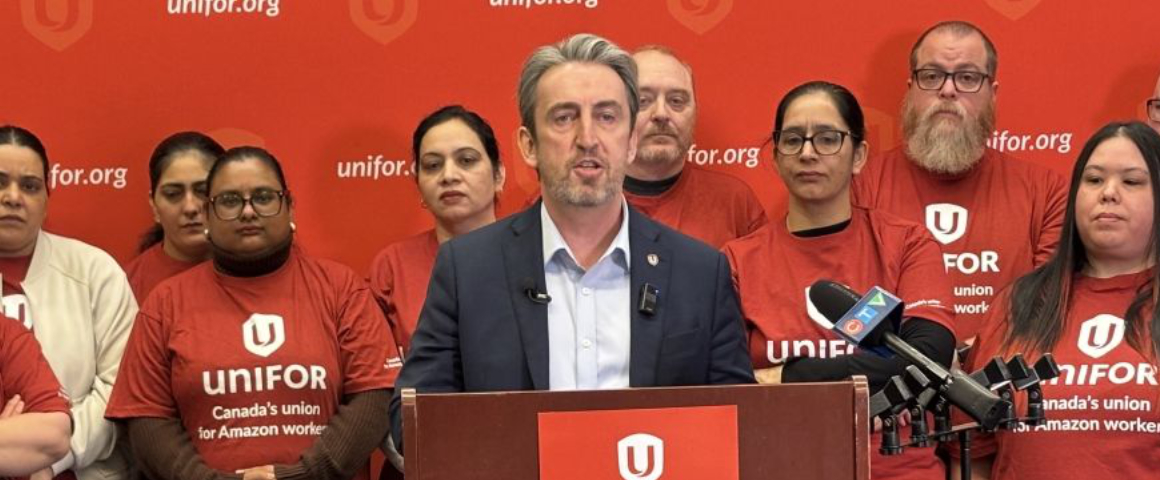
“Even though Amazon’s tactics have been beyond the pale at every step, the BC Labour Board has now ordered a first collective agreement that will be binding on Amazon,” said Unifor Western Regional Director Gavin McGarrigle. “Amazon’s behaviour has been so bad because it knows what we know: unions build worker power. Amazon sees unions as an existential threat to ruthless and unsustainable workplace management.”
For the 800 workers at the YVR2 warehouse in Delta, this ruling is a lifeline. As the union agreed to all along, an independent arbitrator will now step in and order the first collective agreement. The arbitrator will set out the specific proposals that the parties could not agree on, including wage rates and me-too clauses, the productivity and attendance management policies, and the union security clause.
Given Amazon’s history of anti-union conduct and the current excessively litigious environment, the Board denied the parties the right to strike or lockout. Amazon has been stripped of the ability to outlast the union by forcing a prolonged lockout.
Importantly, the decision identified that Amazon’s past conduct does not stay in the past. This decision flows from Amazon’s behaviour throughout the organizing campaign into negotiations, sending a signal throughout BC that when an employer engages in a “lengthy and pervasive” campaign to frustrate organizing and bargaining, the Board is willing to step in and impose a process that cuts through delay tactics.
Unifor’s fight is not over, but it has now been made abundantly clear that Amazon’s behaviour has consequences and Amazon cannot simply stall its way into a favourable agreement.
[Photo: Unifor]
Support working-class media!
If you found this article useful, please consider donating to People’s Voice or purchasing a subscription so that you get every issue of Canada’s leading socialist publication delivered to your door or inbox!
For over 100 years, we have been 100% reader-supported, with no corporate or government funding.