By Stéphane Doucet
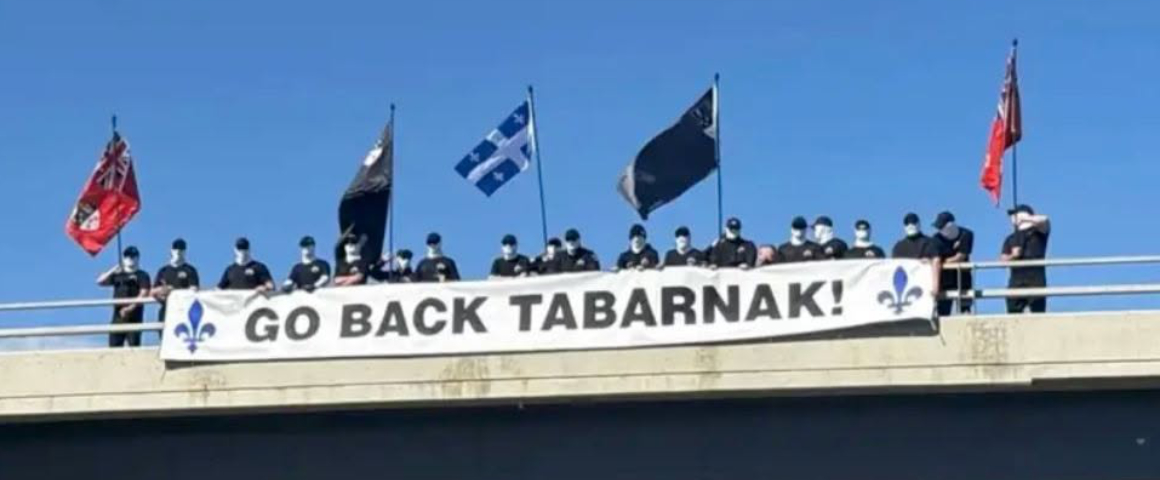
A white supremacist gathering in a park in Shawinigan, QC on May 30 has grabbed headlines, with people far and wide expressing outrage at the racist and fascist display in a public space. Many have drawn a connection between the provocation in Shawinigan and the outpouring of hateful messages directed at Quebec’s Muslim community following an Eid celebration in Trois-Rivières, attacks which also drew sharp condemnation.
These and other incidents raise the question of whether we are witnessing a rise in hatred, extremism, racism and even fascism – and, if so, what can be done?
In the prevailing media and political discourse, the usual response to this kind of situation is to denounce the “polarization” of society, to denounce the influence of social media, to denounce individuals who lack civility. The key word tends to be “denounce” – but with little or no action.
Yet, we have laws against inciting hatred, and have had them for over 50 years. Incitement to hatred can lead to prison sentences of up to two years, confiscation of property and other penalties. We saw the government and police flex those legal muscles earlier in May, in response to the mock guillotine execution of Quebec’s Labour Minister Jean Boulet – in addition to unanimous condemnation by the National Assembly, police opened an official investigation and Boulet said he would be filing charges.
Returning to the question: of whether there is a rise in hatred, several indicators suggest that there is. Last year, for example, authorities dismantled an extremist and highly militarized network within the armed forces in the Quebec City region. Whether it’s increased negative sentiment towards immigration, the rise of misogyny and homophobia among young people, or the increased support for far-right parties (although this fluctuates considerably), we are witnessing, at the very least, a shift to the right.
This stems from several factors including the continuing and sharpening economic crisis, the dominant narrative that seeks to deflect people’s anger against minorities rather than those truly responsible for hardship, and the global geopolitical context of increased militarism and the drive to war.
And what about the link between the rightward shift in society and extremist hatred? We know that historically, the ruling class has fueled the far right to counter the working-class movement, especially in times of crisis. This is still the case today – we need only consider who financed the rise of Donald Trump in the United States, Modi in India, or Mieli in Argentina.
In Quebec, this situation includes the added complexities of the national question, involving issues of language, independence, demographics, etc. Even without going into too much detail, it is clear that the Parti Québécois (PQ) and the Coalition Avenir Québec (CAQ) are competing to see who can push anti-immigrant rhetoric to its most radical form, as they compete for votes from Éric Duhaime’s Parti conservateur du Québec in what is shaping up to be a three-way race between the PQ, CAQ and Liberal Party for the top spot in the October 2026 election.
This ethno-nationalist escalation helps mobilize the far right, which is gaining confidence. Social media plays a significant role in this, as conflict generates participation and therefore revenue. With media and political elites bringing reactionary ideas to the forefront of public debate, the racists and extremists are undeniably empowered.
Many people say that the white supremacist gathering in Shawinigan was the work of a so-called “active club,” a kind of micro-sect of racists. In Trois-Rivières, the social media hatred was unleashed by fans of Jeff Fillion, a host on Radio X in Quebec City. Clearly, we are often dealing with people who are very easy to identify, some of whom don’t even try to hide. In all these cases, the police could quickly intervene, question, sanction, prosecute and send a firm message.
But they don’t. Why?
For years, the Communist Party has called on governments to actually use their powers to repress hate speech. Some argue that these powers of repression will instead be directed against the labour and progressive movements, such as the solidarity movement with Palestine. But the fact is, this is already the case.
Justice is not neutral, and it is important to fight to ensure these laws are used correctly, to protect minorities (sexual, ethnic, cultural, religious, etc.) instead of the ideologies widely defended by the ruling class (Zionism, militarism, capitalism). We should not hesitate, for example, to exercise our right to protection against extremists when we organize an event in support of Cuba.
When authorities respond to hate speech with empty, moral pronouncements, they display their contempt for the people – this includes the communities targeted by hate, as well as the significant number of people who find this behavior unacceptable. What are they waiting for – another murderous attack like the Quebec City mosque in 2017?
We need to reiterate our historic demands for indictments into hate speech – including against immigrants, Black people, Muslims, Jews and 2SLGBTIQ+ people – investigations into far-right terrorist networks, and the dismantling of all fascist or paramilitary groups.
Support working-class media!
If you found this article useful, please consider donating to People’s Voice or purchasing a subscription so that you get every issue of Canada’s leading socialist publication delivered to your door or inbox!
For over 100 years, we have been 100% reader-supported, with no corporate or government funding.