“We won’t forget the not forgetting”
PV Cultural Bureau
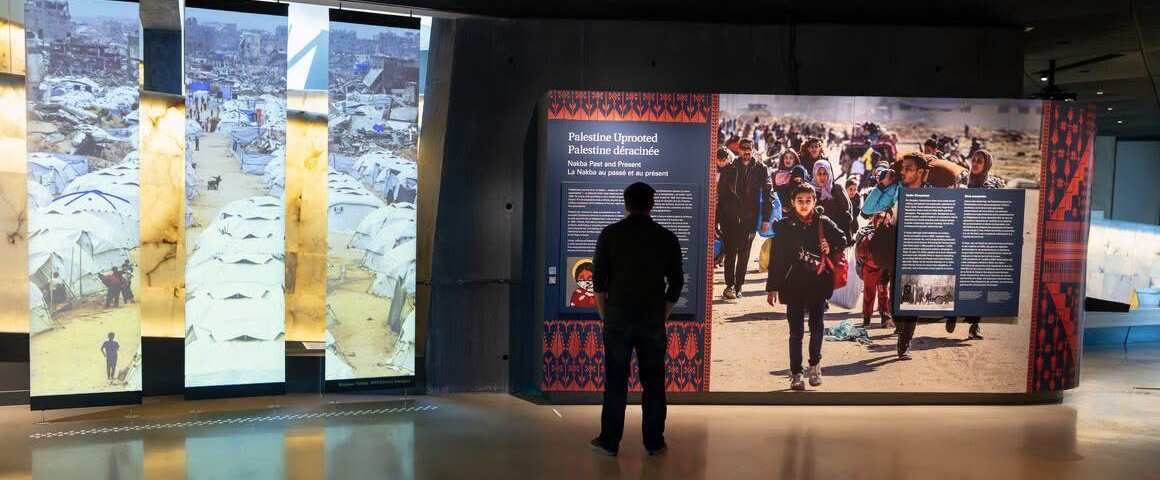
After over a decade of concerted lobbying by the Palestinian community, and four years of development with Palestinian Canadians including the Canadian Palestinian Association of Manitoba and the Palestinian Canadian Academic and Artists Network, Palestine Uprooted: Nakba Past and Present officially opened on June 27 at the Canadian Museum for Human Rights in Winnipeg.
The exhibition’s existence is an extremely important development in the midst of an ongoing genocide against the Palestinian people, and it follows the Palestinian-Canadian community’s longstanding efforts to have Palestinian experiences – including the Nakba reality of brutal multi-generational ethnic cleansing enacted by the British and Israeli states – featured within the institution’s narratives.
Palestine Uprooted also offers up the most jarring of contradictions: an exhibition that confronts Israel’s genocide, mounted and supported by an institution of the Canadian state, while the Canadian state is itself still actively supporting that genocide.
In an early morning press release, CMHR CEO Isha Khan stated that the story of the Nakba “belongs in the collective memory of Canadians.” To the museum’s credit, and as the exhibit’s title and location in the “Rights Today” gallery reflects, the ongoing nature of the Nakba is a particular point of emphasis. This despite the fact that ongoing Zionist efforts to shut down the exhibit reached unprecedented heights in the weeks and days ahead of the opening. Amplified by mass media, Zionist groups in Canada and the US, as well as the Israeli state, pressure on the museum to suspend the exhibit even before anyone had seen it was intense, but could not overcome the immense public support.
“Civil society ahead of governments”
The exhibit itself contains five thematic testimonials from Palestinians addressing the displacement and its impacts, and features accompanying deeds, artefacts, artwork and broader framing materials. These include projections of the current destruction of Gaza, photographs of displaced Palestinians, a didactic panel on the occupation, and the 2001 poem “Think of Others” by Palestinian poet Mahmoud Darwish.
Among the featured objects are original iron keys that have become a central symbol of the Palestinian struggle, in this case from the family of testimonial contributor Rana Abdulla. Palestinians driven from their homes have held these keys to the houses they were forced from, and have passed them down through families for generations. Not only are they a powerful symbol of return, but they are also a material assertion of its potential realization.
The testimonials movingly describe the uprooting of Palestinian families from their lands, the destruction of communities and the multi-generational impacts of this trauma, as well as the resistance to cultural erasure that Palestinians have faced. Recorded in 2022, they make up the heart of the exhibition; as intimate narratives of displacement, separation, violence and, notably, reflections on the broader cultural experience, they emphasize the direct personal costs of violent colonization and its refractive impacts throughout diaspora communities.
What is abundantly clear from all the words and statements, is that the shattering displacement, violence and cultural erasure have never stopped.
People’s Voice spoke with Fouad Sahyoun, one of Palestinians contributors who appears in the exhibition, and asked what impact he hopes Palestine Uprooted will have on the Canadian public consciousness.
“I enjoy that type of question. Allow me to thank the museum for allowing us to tell our story. It took 78 years, and as you probably heard me saying here, they [Israel] expected that the old people would die but that the young would forget. And there he was wrong – we won’t forget the not forgetting. So, the mass demonstrations that you see in the streets is mostly young people, not only of Palestinian origin, but they were able to recuperate the interest in the last three years of youth all over the world, like Vietnam was and like all of those wars. And the museum here came to culminate an effort that’s very popular, in an institutional way.”
Dignitaries and supporters of all stripes travelled from across Canada and beyond to be in attendance for the launch and grand public opening, and museum staff confirm that the exhibit’s existence has already garnered considerable public support. CBC’s coverage of the opening reflects a tone more favorable to Palestinian perspectives than would have appeared in its news pages even a year ago.
Rising public support reflects the reality that, although the fight is far from over, a cultural shift is underway that recognizes the Palestinian experience and the brutality of the Israeli state. And even though Palestine Uprooted does not name the Canadian government among forces at the heart of this brutal reality, it will nonetheless go a distance to bring important truths to the fore.
Sahyoun also expressed positive surprise over the strength of some of the exhibit’s chosen testimonial statements. “So that has given me a further hope that, like we saw in South Africa, it’s a popular mass. It’s the civilian population that push government. Civil society is always ahead of governments. And what the museum is doing here, it’s culminating an effort of interest in Palestinian tragedy, and we hope that government will eventually embark on, and will be able to allow us to go back home.”
PV also spoke with the exhibition’s curator Isabelle Masson, who said that the museum came into the project with a clear awareness that “Palestinian voices are often marginalized, silenced, and with the awareness that Islamophobia and anti-Palestinian racism impact whose voice is heard and impact whose suffering is recognized.” Speaking about some of the artworks and the prominent visual motif of tatreez, a centuries-old Palestinian embroidery practice that carries elaborate geographical, social and cultural details, she said that the emphasis was not exclusively on trauma and rupture, but also “the beauty of the culture, the continuity of Palestinian identity, the continuity of belonging, that is carried across those five generations that have been displaced.”
Masson emphasized the connection: “It’s also about what’s going on internationally and bringing it to the conditions of a longstanding military occupation, the expansion of settlements, the control, the restrictions to what’s going on in Gaza, to the 1.9 million people again forcibly displaced and the thousands of people killed and injured, and in reference to the International Court examining allegations of genocide, war crimes and crimes against humanity.”
Desperate backlash
Palestine Uprooted’s potential to advance truths about the Palestinian reality – and by extension, the culpability of Israel, the US, Canada and other capitalist powers – is exactly why the small exhibit has come under virulent attack by Zionist detractors who view even the slightest humanization of Palestinians as a threat.
Zionist groups have historically opposed Palestinian content at the CMHR, and their hostile declarations against the museum have proliferated since the announcement that the exhibit would go ahead, painting false pictures of its direction and intent as antisemitic and claiming its historical and factual grounding to be ill-researched, incomplete and erasing Jewish voices.
The Zionist Jewish Heritage Centre for Western Canada cut ties with the museum, and attacks intensified as the opening drew nearer. These including condemnatory statements from Gail and David Asper of the Asper Foundation, whose media magnate father Israel Asper was also the CMHR’s founder.
Media outlets amplifying such complaints have roundly ignored the fact that such groups haven’t seen the exhibit, and that several anti-Zionist Jewish groups including Independent Jewish Voices Canada, the United Jewish Peoples Order and the Jewish Faculty Network have supported the creation of the Nakba exhibit. Those organizations issued a joint public letter of support and gratitude to the museum for proceeding with Palestine Uprooted.
Recently, Tel Aviv-based Israeli legal organization Shurat HaDin issued a letter to the museum, claiming that the exhibit might violate federal law in the form of the Museums Act. This was followed by absurd claims by Zionist groups including B’nai Brith of “foreign interference” on the part of Palestinians, due to a visit from the Palestinian Ambassador Mona Abuamara in 2024. Israeli claims of Palestinian foreign interference in Canadian affairs are all the more rich in light of evidence of Israeli interference into Canadian affairs, as documented in a recent report from Canadians for Justice and Peace in the Middle East.
The National Council of Canadian Muslims has assured that if a motion is filed to stop the exhibit, they will intervene in court.
The National Post published a flurry of hit pieces against the exhibit in the days before opening. One extensively quoting Israeli Ambassador Iddo Moed’s letter to Prime Minister Carney, claiming that the exhibit “delegitimizes the existence of the State of Israel,” that it risks transforming the museum into a venue for “political advocacy and social intolerance,” and telling Carney “to intervene to prevent this exhibition from proceeding.”
Another Post article, likewise demanding the exhibit’s suspension, explicitly takes up Palestine Uprooted’s very existence as a justification to cut the funding of public institutions. This latter screed exposes how the right wing has weaponized antisemitism, by falsely equating it with anti-Zionism, and is using it to attack the public service. It holds the hallmarks of the rising reactionary tide reflected elsewhere in the Carney policy direction.
In light of this reality, Khan’s statements that the exhibit does not challenge the legitimacy of the state of Israel is no great surprise.
Demonstrating the Liberal government’s hypocrisy, Heritage Minister Marc Miller implied that the exhibit’s content is inaccurate and criticized the museum for not identifying Hamas as a terrorist group that sought to kill Jews, while also stating that it isn’t his place to comment on the curation of the exhibit.
Altogether, the attacks demonstrate the desperate effort to hold together an increasingly isolated Israeli state, and an occupation that attempts to erase the entirety of Palestinian reality – people, culture, and control over land and political autonomy. The flailing attempts to control narratives around Israel’s genocide and restore the false perception of Israel as a “liberal democracy,” rather than a murderous apartheid state, have become increasingly obvious.
In a moment of urgency, support is paramount
The need to pressure governments to sanction and sever ties with Israel is urgent. Just last week, the UN released yet another report detailing the fact that the Israeli state explicitly targets Palestinian children for killing. Palestinians, including children, continue to be starved, beaten, tortured in prisons, denied medical treatments, displaced and otherwise brutally mistreated myriad ways by the Israeli state with Canada’s support in this very moment.
So, despite the powerful testimonial statements and other content that speak directly to the Nakba reality, some might argue that the limitations of Palestine Uprooted’s small footprint and brief framing risk softening the brutal reality that Palestinians face today. While museum CEO Isha Khan and other representatives have repeatedly explained that the exhibit’s focus is not on the entire historical scope of the Nakba, nor on Palestine-Israel relations, some will point out that as Israel’s genocide continues, a Nakba exhibit in a human rights museum should convey the enormity of atrocity committed by that state, and name the forces that support it including Canada.
Throughout the past 12 years, the museum has faced ongoing criticism for its minimal inclusion, and at times total omission, of Palestinian narratives despite an illegal occupation, apartheid conditions and ongoing genocide. Few mentions of Palestine elsewhere in the museum reflect the fact that there is a great distance to go in public education to bring about awareness of the scope of the catastrophic multi-generational crime against the Palestinians.
Israel is unquestionably committing a genocide against the Palestinian people, and criticism will undoubtably be lodged against the museum for coming close, but short of explicitly recognizing the genocide as such, despite an international consensus that includes hundreds of genocide scholars world-wide. But as Masson points out, the exhibit does name genocide by stating up front that the question of genocide is before the International Court of Justice. This fact, and its impact on public consciousness shouldn’t be underestimated.
It can also be said that while valid, the principled critiques fail to consider the position and attendant restrictions of the CMHR. Limitations of the exhibit’s scope are not a reflection of individual failures, but rather cultural reflections of a broader Western capitalist society whose worldview still refuses to acknowledge the fact of the US-Israeli, Western-backed genocide. Such acknowledgement would stand in the way of its (currently crumbling) material interests, and collapse longstanding narratives that help to keep capitalist economic systems in place. This is clearly evinced by the museum’s omission of many people’s revolutionary struggles around the world against capitalism and for socialism.
The CMHR is both a product of and a context for mainstream narratives of contemporary history, and the fact that it largely reproduces official history can come as no surprise. So, while the museum asserts its claim of curatorial independence, until a broader change rejecting Zionism takes place within Canadian society, federal institutions will continue to reflect (and be constrained by) the dominant hegemony on the matter of Palestinian liberation, just as it is in other matters. Despite being unable to encompass the full reality, Palestine Uprooted is an unprecedented development that offers an opportunity to help shift the public conversation in Canada and beyond.
Capitalist cultural narratives’ inevitable clash with reality
The CMHR has frequently been a site where contradictions within the Canadian state rise to the surface, in the form of public controversies that inevitably result from the clash between the museum’s stated purpose and its programming and practices.
The most glaring of these being that the museum was itself built upon land stolen through Indigenous dispossession, and against the explicit wishes of some Indigenous groups. Its construction was undertaken in violation of the cultural integrity of sacred First Nations grounds and an important First Nations and Métis gathering place at the confluence of the Red and Assiniboine rivers.
Despite the 2015 Report of the Truth and Reconciliation Commission and the accompanying 94 Calls to Action, the CMHR did not recognize Canada’s genocide against Indigenous peoples until 2019, after the findings of the National Inquiry into Missing and Murdered Indigenous Women and Girls were released. Changes to exhibition content, such as those on residential schools in Canada slowly followed only after scrutiny brought various conflicts to public eyes through the agitational efforts of Indigenous communities, movement activists, staff and the broader public. In the case of Palestine Uprooted, its existence was hard-won, and would never have come into being without committed long term efforts of the Palestinian community.
Canada is in regular violation of UNDRIP and files to fulfill numerous other international legal obligations including the UN General Assembly’s 2024 call upon member states to take “measures to prevent their nationals, companies and entities under their jurisdiction from engaging in activities that support or sustain Israel’s occupation,” and to “cease importing products originating from Israeli settlements and to halt the transfer of arms, munitions, and related equipment to Israel.”
In January 2024, several months into Israel’s most brutal genocidal campaign to date, the Museum chose to host an event organized by then CHMR board member Gail Asper of the Zionist Asper Foundation, platforming a skewed and heavily critiqued narrative of the events of October 7, 2023 and Israel’s response. 1832 Asset Management, an investor in Israeli arms manufacturer Elbit until just this past February, is still listed as a $500,000+ donor on the museum’s investors page – and Zionist donors the Azrieli Foundation and the Asper Foundation continue to be listed as “champion” funders.
Again, the CMHR is a federal institution of a capitalist state, and it is therefore no surprise that it currently falls short of explicitly condemning the Israeli state when the Canadian state continues to support the ongoing genocide through continued trade, including the arms trade, and with diplomatic relations with Israel.
Only public mass pressure will bring about an end to that relationship that is in explicit violation of the terms of international law and an outrage to humanity, but in this critical moment the Nakba exhibit tells stories that cannot be erased and cannot be forgotten. As one tool in the long battle for Palestinian liberation, Palestine Uprooted deserves our unwavering support.
Support working-class media!
If you found this article useful, please consider donating to People’s Voice or purchasing a subscription so that you get every issue of Canada’s leading socialist publication delivered to your door or inbox!
For over 100 years, we have been 100% reader-supported, with no corporate or government funding.