
By J-P Fortin
When the strike at Canada Post began in November 2024, one of the Canadian Union of Postal Workers’ main objectives – in addition to wage and benefits demands – was to roll back the Separate Sort from Delivery (SSD) project.
Under this new work method, gradually implemented in several regions, sorting was now performed by the mail handler while delivery was handled by the mail carrier. After a year and a half of conflict, the CUPW executive finally accepted SSD in the negotiated agreement, thereby ending the national grievance.
How can such a turnaround be explained?
Government interference
For a union that is long accustomed to special anti-labour legislation and government interference, an agreement negotiated and ratified by the members is, in itself, a significant event – this fact alone speaks volumes.
But this conflict is far from free of government interference, with the most serious instances appearing in two ways. The first was through the December 2024 invocation of Section 107 of the Canada Labour Code, which forced a return to work for five months. The second was through the unilateral amendment of Canada Post’s mandate in September 2025, without public consultation.
By its very existence as a means of resolving conflicts, Section 107 acts as an anti-strike insurance policy for companies under federal jurisdiction. Canada Post’s complete lack of seriousness at the bargaining table from November 2023 to the present is the clearest proof of this.
In the aviation, port and rail sectors, the government invoked Section 107 within hours of strikes breaking out, to rescue the profits of large private monopolies. But the situation at Canada Post was different – for the government and management, the strategy was to drag out the conflict. This allowed them to win on three fronts: fueling Canada Post’s financial crisis and the anti-union narrative that accompanied it, transferring revenue to the private sector, and financially exhausting the members and the union. All of this before invoking Section 107.
The Kaplan Report, commissioned under Section 107 and published in May 2025, now appears in hindsight to have been a commissioned study prepared for a hypothetical Poilievre government. It revives and updates the old objectives of Harper’s Conservatives: ending home delivery, closing post offices and implementing massive job cuts.
This report became the roadmap for the Carney government, which turned these recommendations into confidential decrees as early as September 2025, thereby triggering the second general strike of the conflict.
In the summer of 2025, workers rejected Canada Post’s “final and best offer” by a margin of nearly 70 percent. We now better understand the importance of this victory, in light of the agreement put to a vote this month. The rejected offer was a program to “Amazonize” work practices and organization, and it brought an end to job security. Even in the face of immense media pressure, the union was able to strengthen member mobilization by taking advantage of the errors and disconnect of the Canada Industrial Relations Board, Canada Post and others interested in dismantling the postal service. This vote was the most significant victory for postal workers during this conflict.
From collective agreement dispute to political struggle
After years of attempted negotiations and more than a year of continuous labour conflict – marked by overtime strikes, rotating strikes and two general strikes – the ratification vote this month could bring an end to the current labour dispute between CUPW and Canada Post.
Postal workers will need to consider all of these factors as they evaluate the offer that has been negotiated and on which they are voting, as well as on the simultaneous vote for strike action should the tentative deal be rejected.
On the one hand, it falls short in many respects, and these shortcomings do justify opposition. On the other hand, a negotiated deal is preferable to the option of binding arbitration – a double-edged sword which CUPW called for through much of the conflict.
One thing is certain: the strike vote attached to the agreement must be strong. It serves both as a guarantee and as a clear message to the employer.
On a broader scale, we can see that the very ground on which postal workers’ demands were formulated has shifted. This, of course, was the goal of the government’s interference in the conflict. Key demands like rolling back SSD, a project which poses significant health and safety challenges during door-to-door delivery, make less and less sense in an environment without home delivery. Is abandoning this demand a concession by the union, or is it a concession imposed by the balance of power in a negotiation sequence?
As is the case with all public services, major structural changes to the postal service lead us to the question of political struggle. It would be a mistake to believe that the fight for public services, unlike struggles in the private sector where labour confronts capital more directly, rests solely on the shoulders of public sector workers. The future of home delivery, as well as the projects that a strengthened public postal service could revive – think of last-mile delivery or postal banking – are issues for working people as a whole. Canada Post’s mandate must remain public and transparent.
Related to this, we need to recognize that there is a big difference between individual opposition based on idealized notions of principles, and organized resistance rooted in the grassroots and capable of expressing itself as a collective and material force.
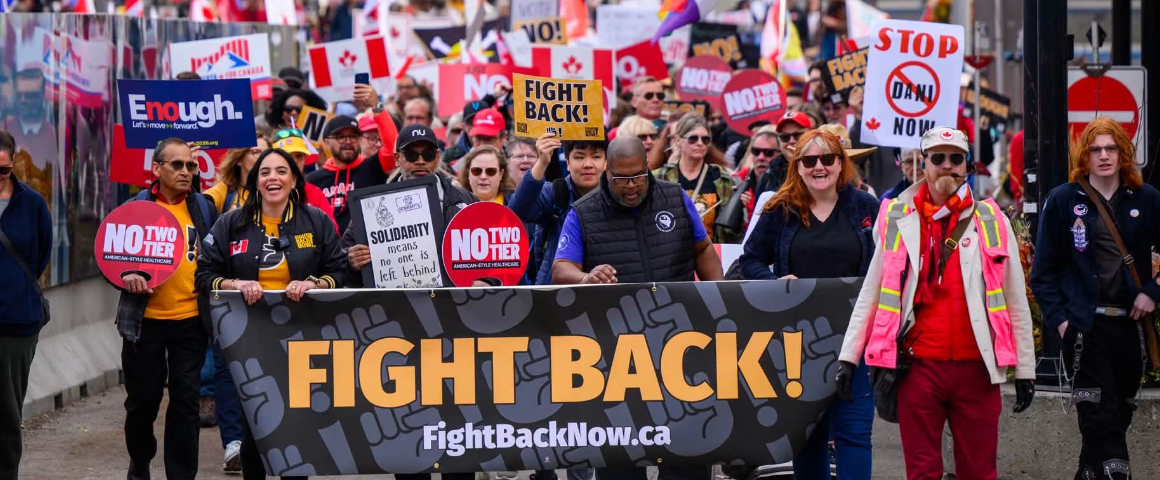
Regardless of the outcome of the CUPW vote on the agreement, the struggle must spread and grow in neighbourhoods, on the streets, in town halls and at city council meetings, so that when we do return to the picket line at the local post office, we are that much stronger.
Support working-class media!
If you found this article useful, please consider donating to People’s Voice or purchasing a subscription so that you get every issue of Canada’s leading socialist publication delivered to your door or inbox!
For over 100 years, we have been 100% reader-supported, with no corporate or government funding.