By Rob Crooks and Cam Scott
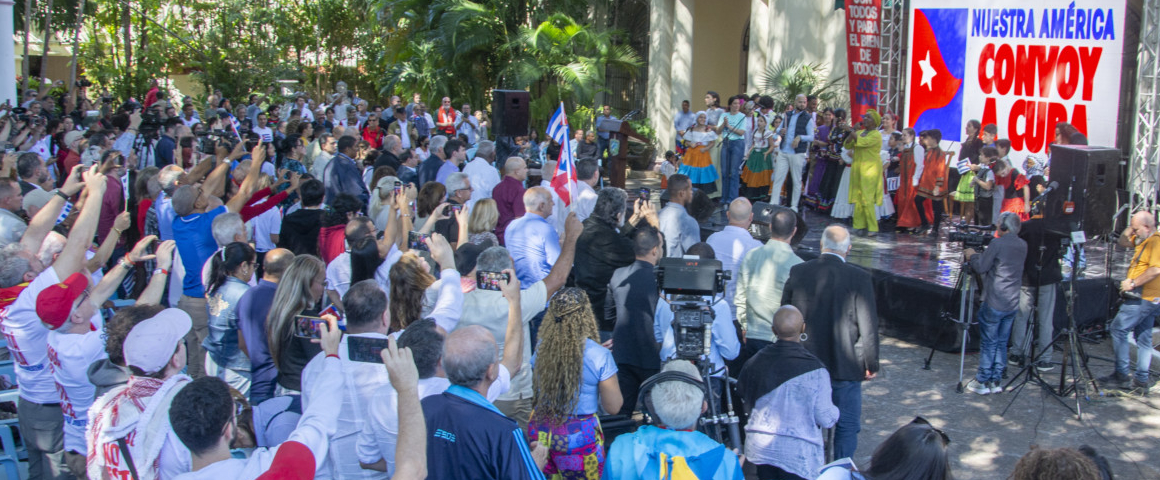
From March 19 to 23, members of the Canadian Network on Cuba were in Havana for meetings and activities convened around the Nuestra América Convoy. The Convoy is an international humanitarian escort bringing both material aid and an influx of eyewitnesses to Cuba during an increasingly desperate chapter in the history of US aggression in the region.
This was a difficult but necessary time for us to return – not only have Canadian airlines conspired to cancel all flights to Cuba until June, but the island’s life systems are beginning to show signs of collapse under imperialist pressure.
Since Donald Trump’s January 29 announcement of a total blockade of fuel to the island, the Cuban people have been plunged into a state of life-threatening privation, facing frequent blackouts, food shortages and spoilage, lack of sanitation and every kind of uncertainty. Even Cuba’s world-renowned healthcare and education systems have been pushed to the brink. Important surgeries are paused and many universities and secondary schools have reduced and cancelled classes. Public transportation is all but halted.
These shortages are the culmination of more than six decades of economic warfare by the United States, and by all accounts today’s conditions are the worst that Cubans have yet faced in the course of their movement for independence and socialism.
By their own account, Marco Rubio and Donald Trump intend to replace the leadership. But as the US escalates its maximum pressure campaign against the Cuban government, all Cubans suffer. This is an unambiguous instance of collective punishment, prohibited by the Fourth Geneva Convention, and within view of the whole world.
That said, mass media coverage has long failed Cuba, distorting the multi-pronged blockade and blaming its outcomes on the revolutionary government. Even amid a present surge of interest in Cuban reality, lurid photojournalism and unsubstantiated rumour predominate across all major outlets. Under these circumstances, the urge to see for oneself is powerful – but the many contradictory effects of the blockade are not simply disclosed to sensory experience. These outcomes require greater investigation and yes, politics, on the part of every well-intentioned interloper.
Many such onlookers appeared in Cuba this past weekend alongside the solidarity movements, and a quick survey of the stories filed from Havana by professional journalists reveals a persistent anti-government narrative that’s perfectly in keeping with the emphasis of right-wing outlets who encourage the blockade. While Kate Linthicum, writing for the LA Times, spent her visit to Havana seeking out pro-Trump voices from a small and disaffected stratum, Nathan Robinson’s Current Affairs eloquently condemns the US blockade but only as a counterproductively cruel means of a regime change that he eventually endorses.
Cuba’s bustling tourist industry has always risked exposing the task of socialist construction to uncharitable observation, and any influx of large personalities from social media cannot but hazard the same. However well-intentioned, self-motivated and sensationalized interviews with passersby cannot distill the essence of the present disruptions, even if they help to apprehend an anxious mood and to catalogue the extreme behaviours to which many Cubans have been pushed.
The correct interpretation of this US-instigated crisis requires not only solidarity, but organization.
Friendship with the peoples
Crucially, the international guests associated with the Nuestra América Convoy were hosted by El Instituto Cubano de Amistad con los Pueblos (ICAP, Cuban Institute of Friendship with the Peoples) who guided more than 600 delegates from over 30 countries through dozens of events with magnanimity amid straitened conditions.
These activities began with a meeting at the Palacio de las Convenciones, where attendees from the United States, Colombia, Chile, Italy, the São Paulo Forum and the European Parliament gave solidarity greetings before President Miguel Diaz-Canel addressed the Convoy directly. In his remarks, Diaz-Canel prosecuted the US blockade at length, extolling the strength of the Cuban people and the continuity of their revolution.
At separate events spanning multiple days, both Diaz-Canel and ICAP Director Fernando González Llort highlighted Cuba’s gratitude before this wave of international support. Notably, the gathering was only the social accompaniment to a flotilla from southeastern Mexico carrying more than 20 tons of essential supplies, as well as a chartered plane with 3,000 kilograms of medical aid.
Organized by Progressive International, CODEPINK and others, the humanitarian portion of the Nuestra América Convoy should not be underestimated, nor the political clarity of many participants within an urgent broad front formation.
At a welcoming event, Progressive International co-coordinator David Adler spoke of the Nuestra América Convoy as defending the idea of Cuba – one of egalitarianism and social welfare, principles lacking from those societies organized chiefly for profit. This broad appeal helps to combat a sense of hopelessness that pervades these same societies, where almost all Convoy participants live and work. In such circumstances, an idea can flare as a light in the darkness, guiding one toward a righteous stand.
In a crisis such as Cuba faces today, it becomes a tactical necessity to build a broad humanitarian movement. This is particularly true given the instigating role of a deeply unpopular figure such as Donald Trump and the significance of Cuba to his administration’s plans. People of conscience from all sectors of society must stand up and defend the right of a small island nation to live free of collective punishment by sanctions, blockades and military threat. Beyond this negative, strictly legal demand, however, we mustn’t forget what we’re defending and why.
What we defend in Cuba is not just an idea: it is a material reality. In standing up for Cuba, we are defending economic democracy and popular power. We are defending the right of working people everywhere to the fruits of their labour, and against the predations of capitalism. The struggle is not only one of ideas – it is an international class struggle for the benefit of all but a dispossessing few.
We defend Cuba not only because Cuba needs us, but because Cuba leads. If Cuba falls, it will spell disaster for the world – not by analogy, which is no basis for solidarity, but by example. In Adler’s words, “a century of anti-colonial struggle is at risk.”
In his address, Diaz-Canel spoke of the enormous burden placed upon the present generation, who now confront one of the gravest tasks in Cuban history: “to save the homeland, socialism, and to give continuity to Fidel’s revolution.” As we imagine what it means to move in solidarity with these inheritors, we must be ready to receive our own equivalent instructions.
“When you go back to your countries,” Diaz-Canel said, “you must multiply the force of the people.” This international strength will not transpire by storytelling, nor by the multiplication of image, nor the amplification of rumour. Fidel Castro emphasized the importance of the Battle of Ideas in the twenty-first century; and Fernando González, a national hero and veteran of the Cuban Five, implored those attending to take part in “digital activism” and to counter corporate lies with truth.
This work is essential, but the determination of truth also requires trust – not only in one’s sources, but in the revolution underway. The truth in Cuba is not an appearance but a process, and its very telling commands participation.
The view from Havana
With this involvement in mind, what did we experience on this most recent visit to Cuba? At ICAP, Fernando also spoke of the arrogance and cynicism of US imperialism; and while we were in Havana the US Treasury Department announced that it would not allow Russia to deliver oil to Cuba – an infantilizing order that presumes to wedge itself between old friends.
At the time of writing no oil has entered Cuba for three months, and on day two of our visit the national power grid went down entirely for the second time this month.
The fuel shortage in the country was apparent. Automobiles were scarce and traveling by taxi required US dollars and a day’s notice to schedule. The streets were full of motorized tricycles with passenger carriages, a kind of rickshaw run by solar-charged batteries, and the classic cars for which Havana is so photogenic were few and far between or still. Infrequent transit stops were crowded with people, unsure of whether a bus would ever arrive. Individuals stood on the side of the road to hail rides, often waving Cuban pesos in the air to indicate their willingness to pay any driver that would pick them up.
We spent time with an established musician who told us that the cost of transporting his gear so greatly exceeded the fee that he could no longer afford to perform.
The most reliable way to get around was by foot, and walking to our destinations took up much of each day. We cautiously stepped down sidewalks that were crumbling and at times treacherous to pass. During evening blackouts, we strolled down dark and narrow streets, passing families who had moved their activities out into the cool night air. Older gatherings played dominoes by moonlight while younger people sang along to their car radios.
Despite the unfamiliar and dimly lit paths we ventured down, our safety was rarely if ever of concern. This is noteworthy, where the blockade explicitly intends to set desperate people to war with themselves. In almost any US city, a half day of the difficulties that the Cuban people face would instigate far greater social turmoil than is apparent here.
Other concerns presented themselves, however. Trash had piled up on corners, waiting for garbage trucks to refuel and resume collection. We were regularly approached by people with curiously similar stories designed to elicit donations of USD. It was heartbreaking when they felt the need to apologize for having asked, flashing a look of wounded dignity.
We also walked by people greeting each other joyously, laughing and joining in song. We saw the colonial-era mansions that have been turned into headquarters of Committees for the Defence of the Revolution, into polyclinics, schools and housing for the people. These staples remain despite obvious dilapidation, fulfilling crucial functions at reduced capacity.
While earlier visits might have furnished a less worrisome appraisal, one feels the strain not only of the blockade itself, but of a collective heave against its unacceptable conditions. Cuba is fighting – not just for survival, but to protect its very real achievements. As such, the stark contradictions one sees in Cuba do not indicate a “failed state,” but a nation’s resolve to continue its sovereign development in the shadow of history’s most powerful empire.
That said, the ingenuity by which Cubans work around the blockade creates a patchwork feeling, and particularly in the dark. Many small businesses, from bars to bodegas, have their own backup generators and power supply. These often use home generators linked to solar panels, or batteries that can be charged from the grid while the power remains.
The relative autonomy of these small enterprises from Cuba’s electrical system, rocked as it is by shortages, means that even in a blackout, every street is pocked with lights. Such urban constellations could be said to visualize an increasingly uneven social fabric; but this too is only half the story.
We were also told of how small businesses with their own modest systems frequently lend power to nearby polyclinics and plug gaps in essential services – not to undermine or to evade state control but to protect their neighbours in a crisis, without fanfare or condition. To put it plainly, the collective spirit of Cuban society, instilled over decades of superior education and heightened struggle, can’t be extinguished half so quickly as the US hopes.
Let Cuba Live!
The Cuban reality is complex, but our task is clear. As the Convoy departs Havana and the media binge begins, we must redouble our efforts at solidarity. This means linking our material aid to political campaigns, and refusing to speak of desperate conditions without identifying the causes and denouncing the US blockade.
This means working through the appropriate channels so that relief never arrives with compromising conditions or places unacceptable demands on Cuban sovereignty. This means increasing the pressure on the government of Canada to assert our economic and political independence of US monopoly and to break the blockade, and advancing these demands through the trade union movement where we wield maximum strength.
Anything short of this work would be a merely charitable contribution to an island that continues to give all, as seen from the hospitality that it extends during the darkest hours.
Hasta la victoria siempre! Cuba must live!
Support working-class media!
If you found this article useful, please consider donating to People’s Voice or purchasing a subscription so that you get every issue of Canada’s leading socialist publication delivered to your door or inbox!
For over 100 years, we have been 100% reader-supported, with no corporate or government funding.