ICE out of Minneapolis!
PV Manitoba Bureau
On January 6, the White House ordered 2,000 additional Immigration and Customs Enforcement (ICE) officers to Minneapolis. Following a year of record ICE funding and escalating state terror, the Twin Cities were targeted for the “largest immigration operation ever.”
The January 7 murder by ICE agents of Renee Nicole Good – a white US citizen involved in growing networks and grassroots initiatives defending migrant communities from ICE – is further confirmation that the attacks on migrants are a pillar of a larger war targeting racialized people, progressive forces and the entire working class in Minneapolis and in the US.
As this war increasingly relies on brute force by law enforcement agencies effectively acting as paramilitary forces with functional impunity from the government, resistance has intensified in turn. This interplay between repression and resistance played out in flashpoints in Los Angeles, Chicago and Charlotte last year. Now, Minneapolis has once again been thrust into centre stage in the struggle against the racist state terror that is so integral to US capitalism.
In Minneapolis, ICE has been forced to confront the resistance infrastructure built since the uprisings of 2020, themselves part of a longer lineage of peoples’ struggles that have shaped the Twin Cities. From the militant labour movement that produced the 1934 general strike to the history of Indigenous resistance that led to the founding of the American Indian Movement in 1968, patient and dedicated organizing by progressive forces in Minneapolis has played a major role in shaping US political life. This legacy includes decades of organizing against racist policing in the city, where the police murder of George Floyd in 2020 sparked the largest protest movement in US history.
With masked, armed ICE agents routinely using brute force to arrest migrants, citizens, Indigenous people, children and adults alike from their homes, cars, workplaces, schools, mosques and beyond, grassroots resistance grew quickly.
Good’s death was a catalyzing moment as these forms of resistance exploded into a sustained, militant, mass mobilization demanding ICE out of Minneapolis.
This shift was not merely spontaneous. Rather, peoples’ organic desire to protect their neighbours from ICE terror was consciously and deliberately built into a potent political force as the organizational infrastructure developed in the wake of George Floyd’s murder was reinvigorated, built upon, and adapted to siege conditions.
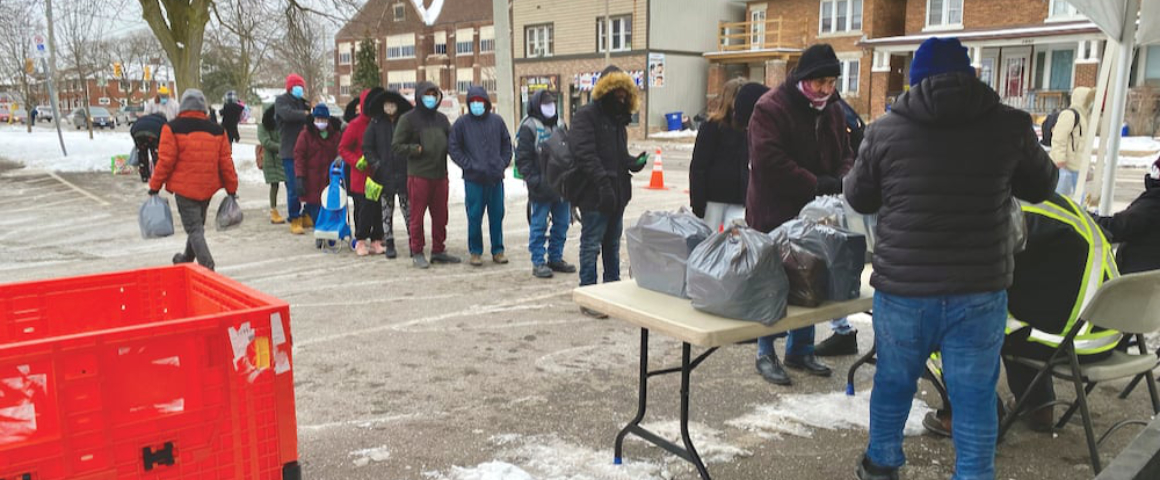
This resistance infrastructure includes rapid response networks with patrols at schools, mosques and other targets for ICE raids, witness and response practices, food and supply deliveries, transportation arrangements, and networks to support the relatives left behind after ICE abductions – all coordinated in networks made up of many formal and informal organizations.
This infrastructure is expanding in real time as new organizers are trained in non-violent direct action, with the director of organizing and growth at the Minnesota AFL-CIO reporting they have trained more than 1,200 people over six weeks.
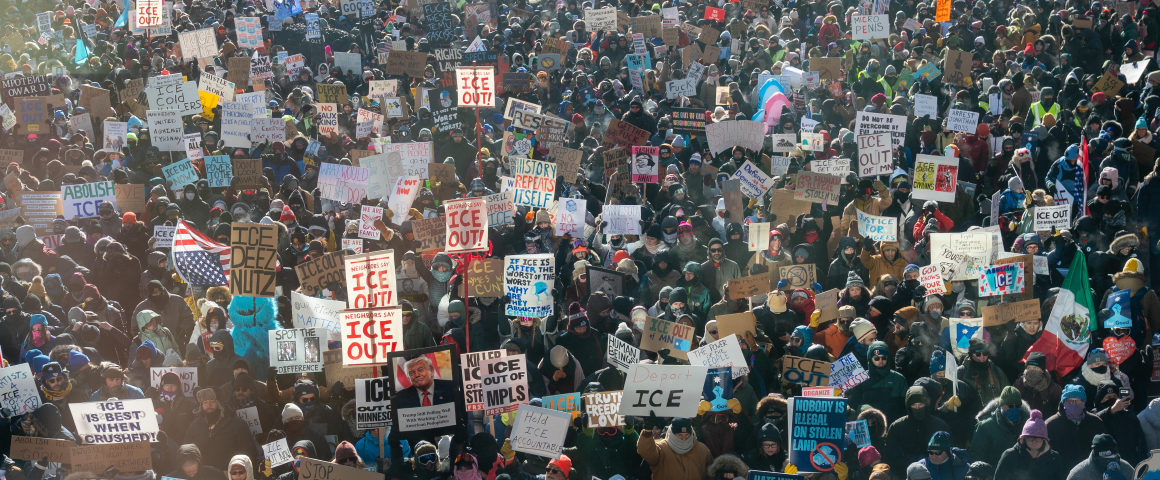
On January 23, this resistance infrastructure produced a massive show of power in the ICE out of Minneapolis: Day of Truth and Freedom. This day of action saw tens of thousands of people take to the streets on a cold winter day under the directive of “no work, no school, no shopping.” This mass mobilization demonstrated the movement’s organizational capacity as immigrant rights organizations, faith groups, organized labour, socialist parties, abolitionist organizations, climate justice organizations and more united behind the core demand of ICE out of Minneapolis.
The next day, ICE murdered Alex Pretti, an ICU nurse and a union member acting as a legal observer. This galvanized further outrage in the streets and nationwide, putting the indispensable role of organized labour in this resistance into stark relief.
The January 23 day of action was endorsed by dozens of trade unions and working-class organizations, including the AFL-CIO Minneapolis. Despite not being in a legal strike position, these unions promoted the day of action and pledged to protect workers’ rights.
Amalgamated Transit Union 1005 President David Stiggers captured the stakes of the resistance to ICE for the working class: “Working people cannot stand aside while our neighbors are terrorized and our families are fractured, because those are our families. Those are our neighbors. They are us.”
On January 30, the resistance scaled up to a national day of action. Reprising the call for “no school, no work, no shopping” and the demand to abolish ICE, many thousands took to the streets in hundreds of actions across the country, this time endorsed by thousands of organizations including union locals, migrant rights’organizations, faith groups and many more.
The power of the resistance can be seen at the level of official politics. Minnesota-based Democratic figures have issued fiery denunciations of the Trump regime and sued the federal government in an attempt to end ICE’s siege. Nationally, the Democrats are also pursuing impeachment of Department of Homeland Security (DHS) Secretary Kristi Noem. Senate Democrats were threatening to shut down the government contingent on what they have called “common sense reforms” to ICE operations, but they have agreed to extend DHS funding for another two weeks of negotiation.
Faced with growing street-level resistance and national outrage, the Trump administration has been forced to recalibrate its operations. On January 27, the federal government announced the withdrawal of some ICE forces from Minneapolis, including Border Patrol commander Greg Bovino. The withdrawal of 700 ICE agents from Minnesota in the first week of February must also be read in relation to the strength of resistance forces.
These developments come with their own potential dangers: Democrats’ proposed reforms aim to curb the violent excesses of ICE operations while preserving the core of the administration’s anti-immigrant crackdown. Amid this tactical retreat, Trump’s ostensibly constructive talks with Mayor Jacob Frey and Governor Tim Walz could result in a negotiated compromise between the Democrats and the Republicans that undercuts the powerful movement demanding the abolition of ICE. The administration’s withdrawal of 700 ICE agents is owed in part by saying increased cooperation between federal forces and Minnesota’s own law enforcement agencies, such that the anti-migrant crackdown could be carried out with a “softer touch,” to use Trump’s words.
Nevertheless, each of these developments demonstrate the movement’s role in shaping reality on the ground. Make no mistake: the power is in the streets.
The view from Canada
Winnipeg is a sister city of Minneapolis. Like Minneapolis, the city has been shaped by Indigenous and working-class struggles that have reverberated across the country. Social, economic and political ties between the two cities are strong, and people in Winnipeg have watched the events of Minneapolis in horror and in search of ways to support. The Manitoba Nurses Union lit a candle and issued a statement commemorating the life and sacrifice of Alex Pretti, while businesses and communities have raised funds to support on-the-ground organizations in Minneapolis.
The escalation of racist state terror, the momentum of popular resistance in Minneapolis, and the related dangerous international situation calls for deepening ties between progressive movements across this geography.
Campaigns against ICE collaborators in Canada are growing as well. Vancouver-based billionaire Jim Pattison was quickly forced to reverse a real estate deal with the US Department of Homeland Security by popular pressure, including a statement from UFCW 1518 on behalf of workers at the Pattison-owned Save-On-Foods.
The Arms Embargo Now coalition, which came together to demand Canadian divestment from Israel’s genocide in Gaza, has called attention to a $10 million contract between ICE and Canadian arms manufacturer Roshel, who have committed twenty armoured vehicles to the US agency. As footage circulates of ICE barreling through ranks of protesters in tank-like machines, it is imperative that we make (and break) these trade connections, by pressuring the government to reject all export permits to companies supplying ICE.
At the same time as we are watching ICE’s rampage in the US, anti-migrant racism is on the rise across Canada and has been embraced by the Carney Liberals. Our movements should be clear-eyed: the siege of Minnesota is a possible outcome of the anti-migrant politics growing in Canada at this very moment.
Expanded and intensified exploitation of migrants has been a key pillar of accumulation and class warfare by the Canadian ruling class in the neoliberal era. Now, as the whole of Canadian politics shifts to the right, we are seeing these heavily exploited migrant communities scapegoated for a cost-of-living crisis caused by this same ruling class.
The distance from Minnesota to Manitoba doubles as a corridor for hundreds of refugees facing deportation from the US. These dangerous passages peaked during Trump’s first administration; but discriminatory immigration policy, coupled with disastrous foreign intervention, ensures that someone will always be willing to make this journey.
Many of those migrants who risked their lives to make a refugee claim in Canada had previously arrived in the midwest from East Africa and Somalia, where thirty years of US interference has contributed to a permanent state of civil war. (According to the Council on Foreign Relations, Trump carried out more bombings of Somalia than the Bush, Obama, and Biden administrations combined last year alone.)
Minneapolis is home to the largest Somali community in the US, and Trump’s compulsive rants against this diaspora have paved the road to the present ICE attacks. Our politicians may reject this racist rhetoric – but when Trump spent the early days of his second term demanding that Canada fortify the border against such refugee claimants and further crack down on immigration, our provincial NDP and federal Liberals all-too-happily obliged. Among other dangerous reforms to Canada’s immigration system, Bill C-12 – currently working its way through the Canadian Senate – reinforces the Safe Third Country Agreement with the US, which denies refugees who arrive in the US to apply for asylum in Canada on the assumption that the US is a “safe” country for refugees.
At present, there are five ICE field offices operating in Canadian cities with the full cooperation of local law enforcement, and Migrante Canada continues to report on surprise workplace raids by the Canada Border Services Agency.
Rather than retreat into a complacent “this-could-never-happen-here” Canadian chauvinism, working-class and social movements in Canada must take the worsening conditions south of the border as an opportunity to redouble our solidarity with, and defence of, migrant communities. Let us learn from the lessons of resistance in the Twin Cities and build organizational power strong enough to prevent the far-right, anti-migrant forces in Canada from getting anywhere near the positions of power that would enable such an escalation here. Let us learn from the powerful mobilization we are witnessing, and from the years of dedicated, humble, behind-the-scenes organizing that has made it possible.
If the Trump administration sees Minneapolis as a testing ground for repression and paramilitary violence, it must also be read as a test for the forces of resistance. As we write, a popular movement against ICE is shaping reality on the ground in Minnesota, and has shifted the balance of forces in the process. As a result, the outcome of this domestic siege is far from guaranteed. Working people everywhere can learn from the powerful example of unity on the streets of Minneapolis.
[Photo of January 23 march in Minneapolis by Lorie Shaull, CC by 4.0]
Support working-class media!
If you found this article useful, please consider donating to People’s Voice or purchasing a subscription so that you get every issue of Canada’s leading socialist publication delivered to your door or inbox!
For over 100 years, we have been 100% reader-supported, with no corporate or government funding.