Left-centre disunity allowed a right-wing sweep by ABC Vancouver in 2022 – will 2026 be the same again?
By Kimball Cariou
Since the Great Fire of 1886 which burnt the first Vancouver townsite to the ground, the city has become famous for many reasons. Some are good (a frequent shortage of winter weather, outstanding views of the mountains and ocean, vibrant cultural life, powerful Indigenous, labour and radical traditions), and some not so good (deeply embedded anti-Indigenous and anti-Asian racism, wild business profiteering, deep poverty, staggering rents). Each list could go on, but I’ll skip the details.
Since 2026 is a year of municipal elections across BC, let’s look at one of the most fascinating and frustrating reasons for Vancouver’s infamy – the almost unbroken string of domination by a tiny fraction of the population, i.e. the business pillars of resource extraction and real estate. As the city grew from an outpost of an arrogant British colonial elite to a financial and economic site of the Canadian ruling class, these business interests were always favoured over the needs of the working class majority.
Yes, this perpetual business domination of City Hall has occasionally been rudely interrupted by the election of progressive, left, labour and even Communist candidates to city council, school board and the parks board. But political power at the municipal level has remained firmly in the grasp of business cliques.
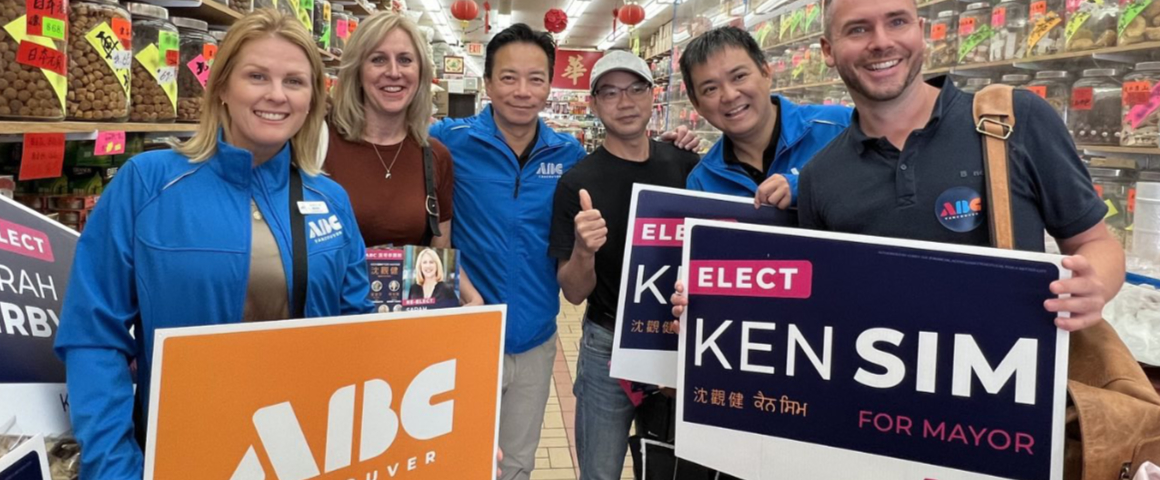
One of the bitter ironies of Vancouver history is that current mayor Ken Sim, the first non-white politician elected to that post, is among the most staunchly right-wing and anti-working class. Sim and his ABC Vancouver party swept into office in 2022 on a wave of anger over the failure of their centrist predecessors to deal with the cost-of-living crisis, which has become steadily worse for working people since around the time of Expo 86, when Vancouver began fancying itself a “world class city.”
The ABC crowd immediately upheld the tradition of expanding the power and the profits of developers and other business interests. They have boosted the police budget while slashing social programs, libraries, schools and community centres, and attacking plans to build social housing.
The results have been devastating for lower-income residents, and ABC’s grip on city hall appears weak as the October 2026 election approaches.
Last year’s byelection for two vacant council seats saw ABC defeated by Coalition of Progressive Electors (COPE) candidate Sean Orr, a Zohran Mandami-style socialist who was not endorsed by the Vancouver and District Labour Council but still topped the polls, and One City’s Lucy Maloney who, along with a Green candidate, was officially backed by the VDLC.
However, another Vancouver tradition now haunts the city – the spectre of competing slates of left and centre parties, allowing the main right-wing party of the moment to snatch triumph from the jaws of defeat.
A brief stroll through history may be instructive. In the mid-1980s, COPE scored some impressive wins in school board and council byelections. But these were followed by the badly flawed COPE decision to run firebrand councillor Harry Rankin for mayor in 1986. Rankin lost badly.
After winning its only city council majority in 2002, COPE soon fractured. At first, it reluctantly participated with the new Vision party and One City in joint electoral lists through the efforts of the VDLC. Vision eventually imploded after losing any credibility for its pro-developer policies.
In the 2018 and 2022 campaigns, the Communist Party (which does not run municipal candidates in its own name) advocated support for all socialist-oriented candidates regardless of affiliation. But the overarching tendency has been for COPE, One City and the Greens to compete rather than cooperate.
Disunity was the biggest reason for the electoral disaster of 2022, which left the most right-wing party in recent Vancouver history in full control of City Hall. At first, it appeared that COPE, One City and perhaps even the Greens and other smaller progressive groups would accept the need for greater tactical electoral unity.
Instead, as this year’s campaign draws closer, the temptation to seize an apparent opening to topple Sim and his ABC gang has become apparent. While backroom negotiations continue, OneCity, the Greens and COPE are all preparing to run candidates for mayor as well as for council.
On one level, this is a game of trial balloons to see which candidate might catch the interest of voters. It’s true that Sean Orr’s socialist campaign proved that a candidate with a solid working-class outlook can defeat an ABC rival. COPE has again become the party of choice among the city’s sizable contingent of advocates for social justice, labour rights and defence of tenants, while One City appears to have lost some of its initial popular enthusiasm.
But it’s also true that a civic election marked by a frantic scramble for votes by a range of parties will likely open the path to another right-wing majority at City Hall. Progressives working for COPE should keep reminding the party’s membership and leaders that unity of left and centre forces on the ballot is the only way to defeat ABC when the votes are counted. The Communist Party and its members will urge to make cooperation at the strategic and tactical levels the priority as parties move towards the nomination stage of what promises to be a tough campaign.
(The author is a long-time member of the leadership of the Communist Party in British Columbia. He was a COPE activist for many years before divisions in that party became too sharp, and has recently rejoined COPE.)
Support working-class media!
If you found this article useful, please consider donating to People’s Voice or purchasing a subscription so that you get every issue of Canada’s leading socialist publication delivered to your door or inbox!
For over 100 years, we have been 100% reader-supported, with no corporate or government funding.