By Manden Murphy
What could ordinary, working-class people do with the money Ottawa is promising to military spending, if government spending were prioritized differently?
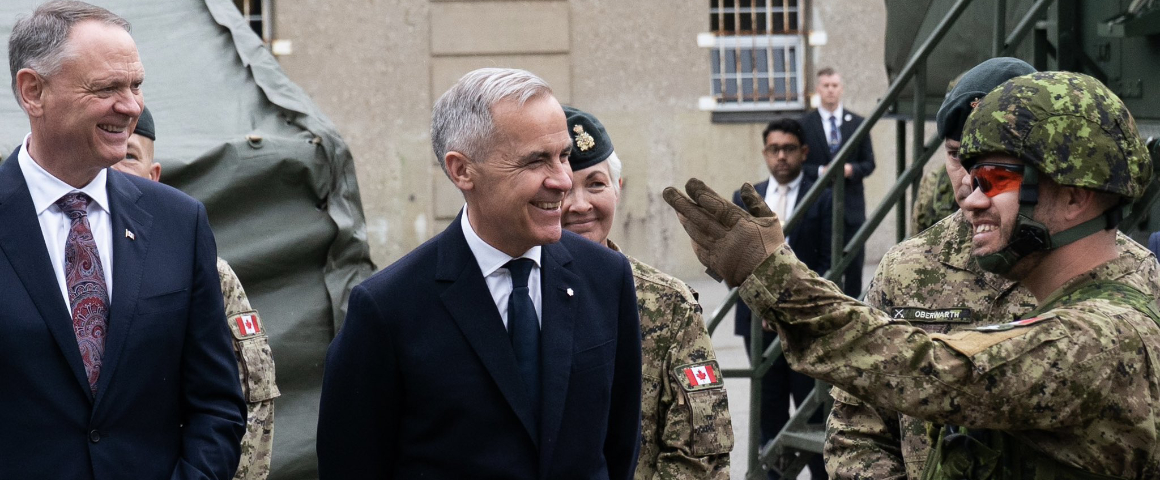
This is a simple yet critical question, given the government’s announcement that it will commit five percent of Canada’s GDP – around $150 billion based on 2025 figures – to military spending by 2035.
Even Ottawa’s prior commitment to meet NATO’s two-percent target in the name of “individual and collective security” is utterly nonsensical. Working people are still experiencing a cost-of-living crisis – with the costs of food, fuel, and housing skyrocketing – resulting in a dramatic drop in real wages and take-home pay. All the while education and healthcare continue to be chronically underfunded, and the public is worse for it.
So, we are forced to ask: Just whose “security” is being considered here?
The international situation
Turning on the news or scrolling through social media feeds, we are bombarded with looming threats from beyond our borders. Canadian sovereignty and our way of life – whatever that means exactly is left undisclosed – is in jeopardy, we are told. Specifically, we hear about the “existential” twin threats of Russia and China.
Whatever one’s assessment of these countries, it is fundamentally important to reflect on how Canada and its NATO allies contribute to tensions and how they have responded to these “existential threats.”
Ottawa and its allies have unleashed an economic war against Russia and China. Rather than diplomacy, elected officials have opted for unilateral sanctions and tariffs, often targeting products that would be beneficial to people in Canada, such as affordable Chinese made EVs. Rather than engaging in diplomacy to find political solutions, we lay down economic penalties like a global police force.
Militarily, NATO’s 32 member states have responded by agreeing to set aside 5 percent of their GDPs for new military hardware, ammunition and weapons of mass destruction. GDP estimates for NATO members last year totaled $54 trillion, so the new 5-percent target would see those 32 countries spend $2.7 trillion on military expenditures – equal to the entire world’s current military spending.
In what universe does this seem like a sensible plan to ensure collective security? On what planet does this sound like a model for peace? And in whose head does this conquer thoughts of prosperity for working people the world over?
This spending is less about our “collective security” and more about economic security, narrowly defined for the few: profits for arms manufacturers and energy corporations, and the protection of trade routes favouring huge monopolies.
Canada’s shameful support for the genocide in Gaza can in part be explained is these terms, as the development of Canadian foreign policy toward Israel and Palestine generally corresponds to the significant growth of Canada’s economic interests in the Middle East and North African region. Global Affairs Canada identifies the region as an economic priority for Canada, noting that trade with the area is growing at a pace that exceeds Canada’s overall global trade growth.
Regional instability and changing zones of influence have created an urgent need for a stable base of operations in the region, and Israel – with a well-developed, Western-oriented economy and a longstanding political interdependency with the West – fits that role. “Stability” means, of course, protection and expansion of corporate interests in the region.
These imperialist geopolitical games, designed to shore up corporate interests, are also deeply anti-democratic. Canada’s military spending is not determined by careful debate in the House of Commons that takes into consideration the genuine needs of working people domestically (and ideally abroad) but rather through NATO’s Parliamentary Assembly which acts as a forum to ensure that governments implement policies that reflect its priorities, and since its creation, the policies of the United States.
NATO spending targets, including the recent two percent and new 5 percent of GDP, are not linked to a specific budget plan or strategy. They are simply a commitment to spend.
The domestic situation
So how will we pay for all of this new military spending and who will be fronting the bill? This is a key consideration when trying to find $150 billion – which for the record represents a 333 percent funding increase from 2024, when military spending was around $34.6 billion.
The Carney government is promoting its military spending as a way to produce good jobs, but a study just released by Brown University in Rhode Island demonstrates that military spending is inefficient for job creation. The study, an update on a report from 2023, shows that military spending (including both government defense spending and various private military industries) produces an average of five jobs per $1 million in spending, including both direct jobs and jobs in the supply chain. By contrast, thirteen jobs are created for every $1 million in education spending – nearly three times as much employment. Healthcare spending creates 84 percent more jobs than military spending, while infrastructure and clean energy create from 24 to 64 percent more.
Ottawa has repeatedly said that making the military spending targets will require a series of “tough decisions,” one of which is to slash 15 percent from almost all federal departments by 2029. Two areas not included in these cuts are the Royal Canadian Mounted Police and Canada Border Services Agency.
These massive cuts are the direct result of military spending, and the “tough decisions” will be made by working people: how to pay the rent or mortgage, childcare considerations, whether or not to pay for medications, whether or not to pursue higher education. All while public services continue to see massive cuts.
What we should be doing is making easy decisions.
$150 billion could build around 430,000 publicly owned and delivered social housing units each year. That’s more than 2 million truly affordable units in the space of five years, which is precisely what is needed to confront the housing crisis across the country.
That amount could also be used to build around 3,600 new schools, or 60 new hospitals, each year. Or it could create in the area of 1.7 million full-time jobs paying $40 per hour.
Instead, NATO and the federal government want to put that money into new military hardware, ammunition and weapons of mass destruction including NATO’s nuclear weapons arsenal. The result will be to fuel more aggression, more global insecurity, more war and more destruction.
This spending increase is simply unconscionable given what working people are facing here on the domestic front, and also in the context of increasing international tensions and the drive to war, to which this spending directly contributes.
Plainly, it is not possible to commit $150 billion of deeply antisocial spending without having a profoundly negative impact on desperately needed social spending that we all rely on. These things are inextricably linked.
That link is the silver lining to an otherwise horrendous political decision. There is a basis of unity here that can bring together a huge range of labour, housing, social justice and community organizations, to say a resounding “NO” to $150 billion to ratchet up the drive to war and “YES” to social spending for people’s needs.
Recognizing the interconnectedness of international and domestic issues, such a united movement can also fight for an independent Canadian foreign policy based on peace, disarmament and solidarity instead of war and aggression, a foreign policy based on mutual respect that rejects unjust unilateral economic warfare.
This is the way to protect security for working people – in Canada and around the world.
Manden Murphy is co-chair of the Toronto Association for Peace and Solidarity
This article is based on remarks delivered to the Toronto People’s Hearings on Military Spending on September 21
Support working-class media!
If you found this article useful, please consider donating to People’s Voice or purchasing a subscription so that you get every issue of Canada’s leading socialist publication delivered to your door or inbox!
For over 100 years, we have been 100% reader-supported, with no corporate or government funding.