By Cam Scott
Globally and across Canada, the far right is on the rise. This pattern is well-observed, as are the marked similarities and connections between right-wing groups the world over.
But this overall pitch to the right is not limited to typical conservatives, and many of its signature policies – including privatization of state-owned enterprises, wage suppressive and prejudicial immigration controls, and punishing austerity – have been delegated to the centre where it still governs. Here in Canada, Mark Carney’s Liberal Party seems content to fit alongside MAGA’s demagoguery and Europe’s heightened xenophobia.
As the global weather changes, one might ask: what does this widely observed pitch to the right look like from an environmental standpoint?
In Canada’s Parliament, Liberals and Tories align on controversial legislation such as Bill C-5, intended to fasttrack resource-intensive projects of “national interest” with little regard for environmental assessment or Indigenous consent. And regardless of how the Liberals choose to market this to their base, Carney’s pet legislation closely follows the timing of Trump’s executive orders to “unleash American energy,” backed by the comprehensive reconsideration of the mandate of the US Environmental Protection Agency.
This drive for “government-by-corporation” is visible throughout resource-abundant regions of the world and particularly those countries where the libertarian right has captured the regulatory offices of the state.
In Argentina, President Javier Milei’s near-total defunding of environmental agencies has opened the country’s forest regions to violent clearcuts, as his attempt to order the “forced disappearance” of more than one thousand glaciers sacrifices a whole bioregion and its water reserves to mining companies.
In Ecuador, the government of President Daniel Noboa – scion of a regional logistics empire – has collapsed the Ministry of Environment into the Ministry of Energy and Mining on direct orders from the International Monetary Fund.
In Brazil, where Workers’ Party leader Luiz Inácio “Lula” da Silva has reclaimed the presidency from far-right climate nihilist Jair Bolsonaro, an opposition-controlled Congress has nonetheless advanced a controversial omnibus bill meant to gut environmental licensing. Lula has since managed to veto several clauses that would omit Indigenous consultation, but dangerous legal provisions for “strategic” projects in the Amazon remain.
Incentive regimes
However distinct, these regional sequences clearly share both language and intent with recent developments in Canada, where (often scant) environmental protections of the recent past are smoothed over or removed before the interests of transnational monopolies.
In this respect, the deregulation of resource development appears to mirror the reversal of progressive gains in nearly every area of society during a reactionary spasm. But legislation tells only half a story, where capital dictates these laissez-faire moves from above.
In Brazil, for example, the state-owned Petrobras company has finally obtained clearance to drill for oil off the coast of Amapa, impacting the Karipuna, Palikur, Galibi Kaliña and Galibi-Marworno peoples, while Exxon Mobil and Chevron have snapped up oil-rich blocks in the Amazon basin at state auction.
Beyond these household names, Canadian corporations are uniquely set to benefit from relaxed licensing and the cutting of green tape. Canada has more mines in Brazil than in any other country, with up to three dozen companies operating consistently including Belo Sun, Jaguar, Aura Minerals and Yamana Gold.
Belo Sun’s Volta Grande Gold Project in Pará State was recently mired in legal controversy, where the corporation sought to circumvent environmental licensing for its project and proceed with subfederal approval. (Belo Sun prevailed in court, and their stocks spiked as a result.) This September, Jaguar mining announced an ambitious plan for the so-called “Iron Quadrangle,” a mineral-rich region of Minas Gerais, only weeks after settling an enormous environmental fine for its activities nearby.
Behind these extractive corporations are the typical financial interests including RBC, a notable financier of Belo Sun, and Scotiabank, the only fully licensed Canadian bank in Brazil. The retail presence of Scotiabank in Brazil closely follows its investment in the mining sector throughout Latin America, and it’s telling that the bank continues to expand in Brazilian debt markets even as it withdraws services from Colombia, Costa Rica, Panama and other nearby countries.
Journalist Gabriel Leão has called the Toronto Stock Exchange “the financial heart of the global mining industry,” and Canadian corporations motivate and benefit from government deregulation everywhere they operate, including those markets briefly discussed above.
Canada’s McEwen Mining runs an advanced-stage porphyry copper exploration project in Argentina’s Andes Mountains – a $2.5 billion operation solicited by the country’s new Incentive Regime for Large Investments.
In Ecuador, the Canadian firm DPM Metals Inc. operates the Loma Larga mine project in spite of more than 80 percent of the Indigenous peoples and affected communities rejecting the proposal in multiple referenda.
Recycling risk
These patterns apply to activity within Canada’s own borders as well. This summer, a Scotiabank Economics team published a telling report on the “generational opportunity” of Bill C-5, framed as carte blanche encouragement of “inherently high-risk, high-reward ventures that demand early government investment to clear the path for private capital.”
The key to this opportunity, according to Scotiabank’s experts, is for Canada to “play offence with public infrastructure assets” through a practice known as asset recycling. This practice, where a government borrows against its tangible assets in order to invest in new development, is a polite way of broaching privatization – and a standard framework for World Bank directives in so-called “emerging markets and developing economies” or EMDEs.
This financing arrangement opens up public infrastructure to private investment as it evades widespread suspicion of such practices and permits even further penetration of debt-strapped economies by foreign monopoly capital.
In the Canadian instance, the Scotiabank brief more or less duplicates a longstanding Liberal plan to hasten privatization of public infrastructure through public pension funds. Notably, for example, the highly financialized Ontario Teachers’ Pension Plan invests extensively in Latin American infrastructure, assuming full ownership of six power lines across ten Brazilian states.
The Canadian model
For all the differences between any two countries, it’s alarming to see how similarly imperialism proceeds. As The Mining Observatory founder Maurício Angelo notes, “it’s important to say here that the Brazilian mining business sees Canada as a role model. The way mining works in Canada from the point of view of investments, markets, and even mining on Indigenous lands in Canada is seen as a model for Brazilian mining – for how mining would work on Brazilian Indigenous lands, which is not permitted today. However, several bills and political maneuvers have been introduced to change this, and Canada is an example.”
On September 10, Carney announced the first five “nation building” projects for referral to his Major Projects Office, with a focus on liquefied natural gas expansion, gold and copper mining, increased logistics capacity on the St. Lawrence River, and small modular nuclear power.
In addition to this unsurprising statement of priorities, the PM nominated an eleven-person Indigenous Advisory Council, evidently meant to rubber stamp the financial offensive ahead. Grand Chief Kyra Wilson of the Assembly of Manitoba Chiefs spoke unsparingly of the selection process: “While Canada speaks of equity ownership and resource management, the exclusion of Manitoba First Nations from this Council demonstrates a continuing pattern of disregard for Treaty rights and First Nations jurisdiction.”
As global mining companies look to Canada for legal precedent, it’s not difficult to see Bill C-5 for what it is: a document of continental imperialism, and part of a transnational project to reverse the few environmental protections that progressive movements have been able to win from the outgoing liberal order.
Within this context, there is a broad basis of unity from which to resist such sweeping attacks. But the quality of our resistance depends upon our active solidarity across communities and jurisdictions that the ruling class would sooner disregard.
From an investor’s point of view, it seems we have an example to set.
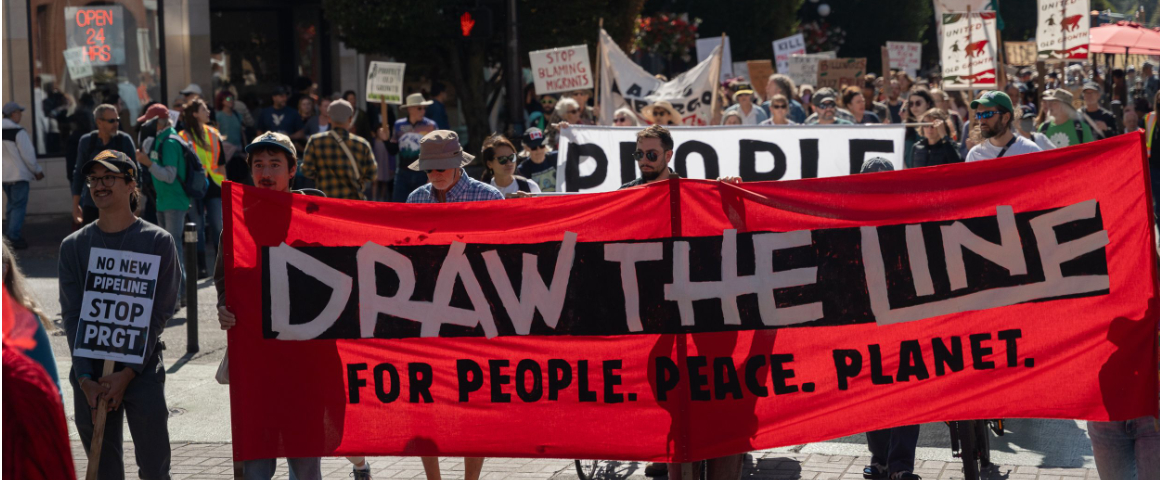
[Photo: Karissa Chandrakate, DrawTheLine.world]
Support working-class media!
If you found this article useful, please consider donating to People’s Voice or purchasing a subscription so that you get every issue of Canada’s leading socialist publication delivered to your door or inbox!
For over 100 years, we have been 100% reader-supported, with no corporate or government funding.