Investments to address environmental pressures suffer from chronic underfunding, while trillions of dollars fuel arms buildup and war
By María Julia Mayoral
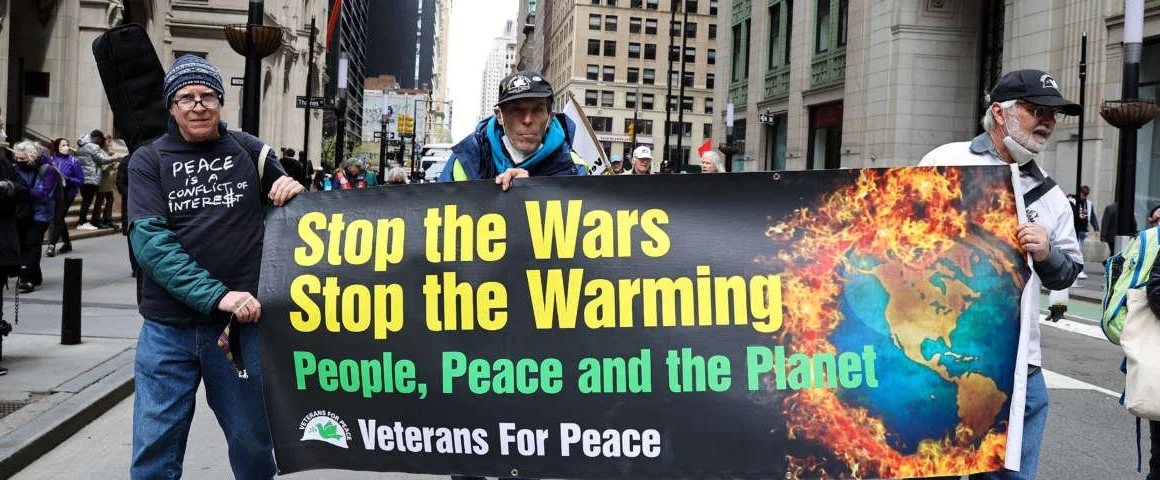
Global military spending is rising rapidly, regardless of the ecological damage and despite the knowledge that the arms race intensifies greenhouse gas (GHG) emissions, which exacerbate global warming.
According to the Stockholm International Peace Research Institute (SIPRI), the amount rose to more than $2.7 trillion in 2024, representing a 9.4 percent increase in real terms compared to 2023.
The top five countries – the United States, China, Russia, Germany and India – accounted for 60 percent of the total with combined spending of $1.6 trillion, the report said.
According to the agency’s calculations, the global military burden – that is, the proportion of global gross domestic product (GDP) allocated to such purposes – rose to 2.5 percent last year.
In the case of the US, the figure rose to $997 billion due, among other reasons, to the interest in “modernizing military capabilities and the atomic arsenal to maintain the strategic advantage over Russia and China,” according to SIPRI.
Other members of the North Atlantic Treaty Organization (NATO) also increased their budgets, resulting in a combined total of more than $1.5 trillion, equivalent to 55 percent of global military spending during the previous fiscal year.
On this issue, the Transnational Institute (TNI) drew attention to the effects in a 2023 report entitled Climate Crossfire: How NATO’s 2 percent military spending targets contribute to climate breakdown.
The report noted that mitigation and adaptation measures to combat climate change suffer from a chronic funding deficit, as “the richest countries, which are primarily responsible for environmental collapse, have not been able to fulfill even their limited promises.”
However, they are increasing budgets for defense and direct incentives to private companies linked to the sector, including high-tech firms whose products have dual use (civilian and military).
As a result, NATO’s military carbon footprint, TNI noted, rose from 196 million metric tons of CO2 equivalent (tCO2-eq) in 2021 to 226 million tCO2-eq in 2023, an increase of 30 million tons in two years.
When the research came to light, the bloc had 31 members, all of whom promised to allocate amounts equivalent to 2 percent of their respective national GDPs to defense.
Achieving this goal could generate an additional 467 million tons of carbon dioxide emissions in eight years, the TNI research revealed.
If the members of the transatlantic alliance fulfill their 2 percent commitment, between 2021 and 2028 their collective military carbon footprint will be 2 billion tCO2-eq, higher than the annual GHG emissions of Russia, one of the world’s leading oil producers, the study said.
But the latent risk continues to grow: in June 2025, NATO announced that the vast majority of its current 32 members intend to raise the proportion to 5 percent of GDP by 2035.
In this regard, the Centre Delàs d’Estudis per la Pau argued that all stages of the military economic cycle are linked to specific damage to the environment, from the consumption of energy and resources necessary for normal military activity, weapons testing and production, as well as their transport, to post-conflict reconstruction, which includes pollution caused by toxic waste, deforestation and the loss of habitats and ecosystems as a result of militarization and conflict.
The Spanish institution argued that ecological transition necessarily involves “processes of disarmament and demilitarization: reduction of global military spending, conversion of the arms industry into a renewable energy industry, and dismantling of the nuclear arsenal.”
Every eight hours, humanity spends the same amount of money on military matters as the World Health Organization has for an entire year, denounced the organization’s director-general, Tedros Adhanom Ghebreyesus.
According to the United Nations, 8.2 percent of the world’s population – some 673 million people – went hungry in 2024; therefore, there is also a need to distribute more food and fewer weapons.
Granma (English)
[Photo: Climate Reality Project]
Support working-class media!
If you found this article useful, please consider donating to People’s Voice or purchasing a subscription so that you get every issue of Canada’s leading socialist publication delivered to your door or inbox!
For over 100 years, we have been 100% reader-supported, with no corporate or government funding.