
By Stéphane Doucet
On May 15, dockworkers at the Port of Quebec finally returned to work. The dispute began when they were locked out on September 15, 2022, and ended 973 days later. But Stéphan Arsenault, president of CUPE Local 2614 which represents the workers, told People’s Voice that the struggle is not yet over.
During a previous interview in April 2023, six months into the lockout, Arsenault stated that the main dispute was over work-life balance, with the 81 longshoremen required to be available seven days a week, with one day’s notice. The employer, the Société des Arrimeurs de Québec (SAQ), demanded a significant rollback in this area, wanting to impose 12-hour shifts instead of eight. The union voted for an indefinite general strike, but the employer imposed a lockout.
Arsenault now says that what he takes away from all this is that “this conflict was a direct attack on the local union.” He recounted a series of police blunders, incidents of harassment and threats, management intransigence and contempt, and government indifference, before summarizing that “we experienced a 1960s-style labour dispute in the 2020s.”
Clearly, the combination of employer and police violence and the pro-employer bias of various levels of government prolonged the conflict, causing the dockworkers hardship reminiscent of key moments in Quebec’s union history such as the fights at United Aircraft, Robin Hood and La Presse. But they held out until the end.
During the nearly 1,000 days of lockout, scabs stole the dockworkers’ jobs. From start to finish, the port operated normally, much to the delight of the bosses who didn’t care about workplace and environmental accidents caused by lack of training and union protection. The federal anti-scab law comes into effect on June 20, barely a month after the workers returned to work. “We saw the anti-scab law pass, but it didn’t do anything,” Arsenault laments. “We couldn’t take advantage of it!”
Government intervention on the bosses’ side
While they’re back at work now, the story of the dockworkers’ return is worth telling.
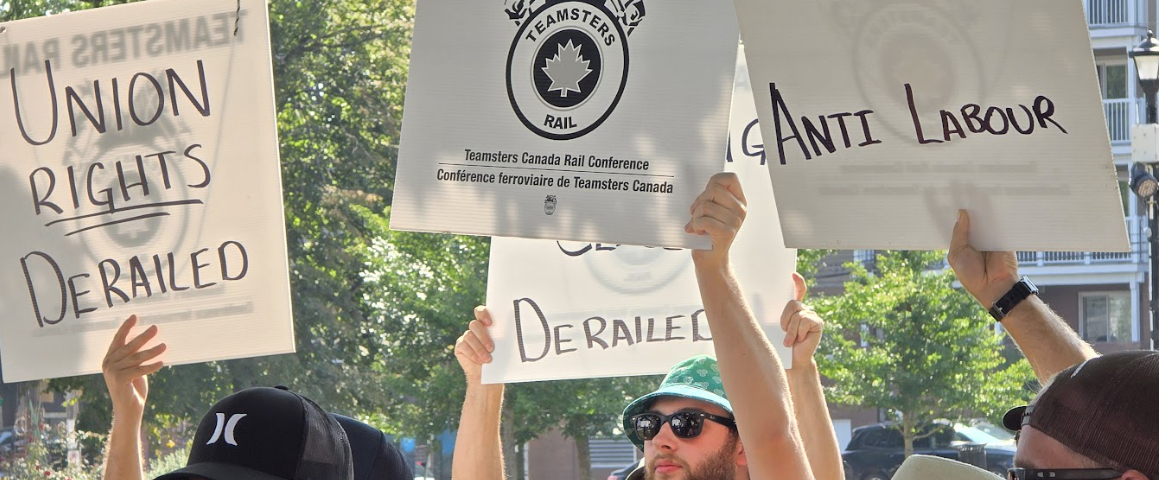
Justin Trudeau’s Liberal government repeatedly and enthusiastically used Section 107 of the Canadian Labour Code to force striking workers under federal jurisdiction back to work: mechanics at WestJet, railway workers at CN and CPKC, postal workers at Canada Post and of course, longshore workers in Montreal, Quebec City and Vancouver.
On November 13, 2024, more than two years after the lockout began in Quebec City, the Port of Montreal employer declared its own lockout and the federal government quickly ordered binding arbitration to end the dispute. Just three days later, the port reopened. The same fate befell the longshore workers in Vancouver, who had been locked out around the same time.
Ottawa ordered the same treatment for the Port of Quebec City. But unlike the ports of Vancouver and Montreal, there was no return to work for the Quebec dockworkers. They had to continuing having their line crossed by scabs who hurled even more abuse at the union members.
In fact, they had to wait four months before the boss offered them a gradual return to the workplace and a minimum number of training hours, and another two months before the official return on May 15. The employer did everything it could to slow down the return to work, taking advantage of the scab labour and humiliating and provoking the union.
But when the dockworkers did return, they did so with their heads held high and accompanied by a guard of honour from the Quebec City labour movement, “proud and happy to be back at work.”
Arsenault calls the binding arbitration a profound injustice to his union: “It takes away all bargaining power.” Despite the protracted conflict, locked-out workers saw the effective date of the anti-scab law approaching and knew they could hold out until June.
At the same time, Arsenault notes, “all of this destroyed the momentum for negotiation.” The employer walked away from the table, knowing that it had just been offered months and months of cheap labour.
The attacks and blows came from all sides. “The police broke the picket lines – that was the hardest part. Members who worked elsewhere during the conflict lost their jobs when S107 was enforced because their bosses assumed they would return to the port. It was a finale that left terrible scars, a government that really sides with the bosses.”
Employer didn’t acknowledge deaths of two picketers
Two veterans of the union and the Port died during the conflict: Yvan Martin and Jacques Poirier. Martin, known as Quin-Quin and “loved by all, an incredible worker,” was just over 60 years old when he died of a heart attack in January 2023 while returning home from the picket line. Arsenault recalls Martin confiding in him, “I have never stopped working in my life” and that he was having a hard time coping with the lockout. According to Arsenault, the stress of the lockout had a considerable effect on his health and was at least partly responsible for his premature death.
Jacques Poirier, who came from a family of longshore workers, joined the union in 1989 at the same time as his brother and Arsenault. “He didn’t talk much, but when he did, it mattered.” He was a trainer on the job site and director of training for the union. “It was largely thanks to his work that we were able to establish the union in the face of a difficult employer,” said Arsenault.
During the conflict, Poirier was diagnosed with advanced cancer and given six months to live. “But Jacques was a warrior, a true unionist, a guy who stood his ground, and he fought his cancer to the end, just like he fought the conflict.” It was only after he returned to work, well beyond the six months he had been given, that he entered palliative care and finally passed away a week later.
Despite their many years of service, the boss never acknowledged or marked their deaths.
The community, on the other hand, rallied to support the locked-out workers with Christmas baskets, Christmas parties for families and direct donations on the picket line. The same was true of the union, which supported members even during the phased return to work, as the employer tried to prolong their humiliation and financial hardship by minimizing work hours. Arsenault sums it up: “The SAQ couldn’t break our legs like they wanted to.”
Anti-scab legislation an important weapon for workers
The conflict is far from over. The union has accumulated more than $60,000 in legal fees fighting for dockworkers who were imprisoned, criminally prosecuted for trivial matters, and inundated with tickets from the Quebec City police who acted as agents of the SAQ. Workers suffered police brutality during support demonstrations, they were followed home when they left the picket line, and they were filmed 24 hours a day by the police, security guards and the employer. They suffered all kinds of indignities and now have to defend themselves in court.
Meanwhile, the binding arbitration process has not yet begun, with the first meetings with the arbitrator scheduled for the end of June. The imposed agreement will remain in effect until May 2027, so a new round of negotiations will have to begin almost immediately. Arsenault is optimistic about the content of the collective agreement, hoping that “the arbitrator will help improve working conditions, but we have to be realistic, especially when we look at Montreal.”
He adds that the federal anti-scab legislation, while not directly benefiting the workers in this struggle, “is a very important change; one of the union’s greatest sources of pride.” He notes that, without the union, this legislation would not have come about. And while it does not protect against Section 107, it is a formidable weapon for the next round of negotiations.
The 2022-2025 conflict at the Port of Quebec will certainly go down in the history of the Quebec labour movement as one of the longest, most contentious and most violent lockouts in recent years. The small handful of longshore workers held out, against all odds, against a coalition of employers who had made it their mission to break the union and subjugate the workers.
The story is not over, but the conflict is proof that these comrades know the value of their work, solidarity and struggle – we have not heard the last of them.
Support working-class media!
If you found this article useful, please consider donating to People’s Voice or purchasing a subscription so that you get every issue of Canada’s leading socialist publication delivered to your door or inbox!
For over 100 years, we have been 100% reader-supported, with no corporate or government funding.