Broad coalition of labour, parent and community groups needed to confront and fix crisis
By Helen Kennedy
A recent report by the Elementary Teachers’ Federation of Ontario (ETFO) reveals that the Doug Ford government’s cuts to special education programs are contributing to the failing economic and social health of Ontario.
The extensively researched report, Promises Unfulfilled: Addressing the Special Education Crisis in Ontario, was released in April and contains 27 recommendations to begin to fix the problem.
Using first-hand research, and collaborating with other organizations including People for Education, the Ontario Autism Coalition and the Canadian Centre for Policy Alternatives, ETFO has laid bare, once again, the anti-equity agenda of the Ontario government. The crisis in special education continues to exacerbate the growing inequities in the province, leaving children with disabilities and their families far behind.
For decades, government policy has cut funding to public education under many guises, attacked bargaining rights of education unions and put a hard focus on writing, reading and arithmetic. Former Premier Mike Harris dramatically switched the school board funding formula in 1997 to disguise drastic austerity measures. Included in these changes was a new, complicated special needs funding formula which resulted in a new emphasis on inclusion.
This sounded good, but made budgets for specialized resources and one-on-one assistance to those students with complex needs disappear. Teachers received training on universal design for learning and differentiated instruction, with the goal of mainstreaming children with special needs into regular classrooms. The problem, of course, was the extra help students needed was dramatically reduced, sometimes to an hour or two a month. The rest was up to the classroom teacher, with a class size much larger than was legislated or manageable.
Class size is a major deterrent to being able to manage the diverse needs of any student, let alone those with a disability. Class size reduction was ranked as the highest spending priority in seven of the eight Canadian Teachers’ Federation surveys conducted between 1995 and 2008. Currently, primary grades are funded for an average class size of 20 and secondary grades for an average class size of 23. Funding for grades 4 to 8 supports a class size average of 24.5.
While these are the funding numbers, the reality in the classroom is much higher. The ETFO paper reports that Ontario has lost funding for 5000 teachers since Doug Ford was elected in 2018. In addition, the special needs funding grants are not indexed to inflation, so every year means an additional cut to the school’s budget.
At the heart of identifying children with a disability in the school is the development of an Individual Education Plan (IEP), ideally after the student has undergone a psychological assessment done by the Identification, Placement and Review Committee (IPRC). The latter identifies the student’s “exceptionality” and determines the placement and special education supports that are needed.
According to People for Education, there are currently an estimated 37,000 children in Ontario waiting for a professional assessment from an IPRC so that they can be placed and receive the support they need. Some families have to wait over two years to receive an assessment from the school. Those who can afford it are able to pay for private services to receive a psychological assessment. Those who can’t pay are forced to accept the dangers of waiting to begin interventions.
To counter the waitlist for IPRC’s, many schools develop an IEP to try and meet the needs of the student. While IPRC’s are absolutely essential to ensure students are matched to the correct resources, time constraints mean parents and teachers gamble on the IEP meeting their needs for the interim. Sometimes schools refuse to develop an IEP until a diagnosis is available.
Each September, teachers face the school year with a daunting challenge. Kindergarten teachers especially are faced with children who may have never participated in group instruction, and even those who have been in preschool programs or daycare don’t always bring a “diagnosis” with them. All teachers must identify children who may have special needs and develop an IEP within 30 school days of the start of the year.
ETFO estimates that over 75 percent of teachers write an average of seven IEPs per year, each one taking eight hours to complete. A total of 60 additional hours outside of school hours are needed during the first month of learning new names, personalities and needs of over 20 students. It’s a wonder most teachers last until Thanksgiving.
After the first major cuts and changes to the funding formula, there was a marked increase in private tutoring companies, as families whose students were falling behind looked for other resources to help their children. In 2022, the government introduced the “Plan to Catch Up” which offered parents $200 or $250 to offset costs of tutoring and other supports. The total cost of the program was $365 million – which would have gone much further if invested in the public boards.
In special education, we’ve already seen that those families with financial resources can skip to the front of the line in terms of getting an IPRC. Again, we see the insipid threads of privatization being woven into the school system.
In the meantime, the mothers of those waiting for an IPRC, tend to be the ones on-call if the school cannot meet the needs of their child. According to Inclusion Action in Ontario, mothers have “their workday interrupted frequently. Eventually, employers lose patience. Rather than fight a second human rights battle at work, mothers drop out of the workforce altogether, or radically alter their working life. The consequences to her and the family can be enormous.” Once again, as with cuts to homecare, long-term care and other social services, women are forced to pick up the slack.
One of the bright notes in the ETFO report is the gains the union won in central bargaining during 2022-26. The Ontario Human Rights Commission, as a result of their Right to Read Inquiry, found that the provincial public education system didn’t meet the needs of children with reading disabilities. But of all their recommendations, the province chose to implement only those requiring the least amount of investment. ETFO was able to bargain for an additional 401 early reading specialist teachers to support the implementation of early reading screeners and early intervention for children at risk of having difficulty with reading.
One of the more jarring statistics from the report relates to the increase in violence in schools. The rate at which ETFO members have experienced violence or witnessed violence against another staff person has increased 70 percent since 2017. The rate is higher – 86 percent – among members who work in special education.
School boards have also put pressure on special needs teachers to not report their injuries, telling them it won’t get them more assistance or resources. Many teachers don’t report, because they understand a student is trying to communicate and it’s a failure of the system that they act out. Only 13.2 percent of members file WSIB claims out of a total of 43 percent of lost time injuries due to violence.
The provincial cuts to education funding come with a negative opportunity cost that the government continues to ignore. If special needs education were to be fully funded, there could be different outcomes for students with a disability.
The Canadian Human Rights Commission and the Office of the Federal Housing Advocate published a report that people with disabilities’ fundamental right to housing is being violated.
The Canadian Mental Health Association reports that the prevalence of developmental disabilities in federal prisons is two times that reported in the general population. These inmates also serve more days in custody and are more likely to receive more serious discipline than those without disabilities.
Indigenous children are the most overrepresented in special education programs. Generational trauma is a large contributing factor, along with the experience of Indigenous parents in the residential school system. Specialized programs for Indigenous children with special needs, which take into account these factors, are urgently needed.
There are 27 recommendations in the ETFO report, most of which will likely be ignored by the current provincial government.
The public education unions at all levels should continue to fight for positive changes in bargaining – to reduce class size and increase funding through a transparent, needs-based funding formula for a single, secular public school system across the province. Parent and social justice groups, along with the labour movement, should take up the call and build a broader coalition to fight for these demands.
Students, especially those with special needs, deserve no less.
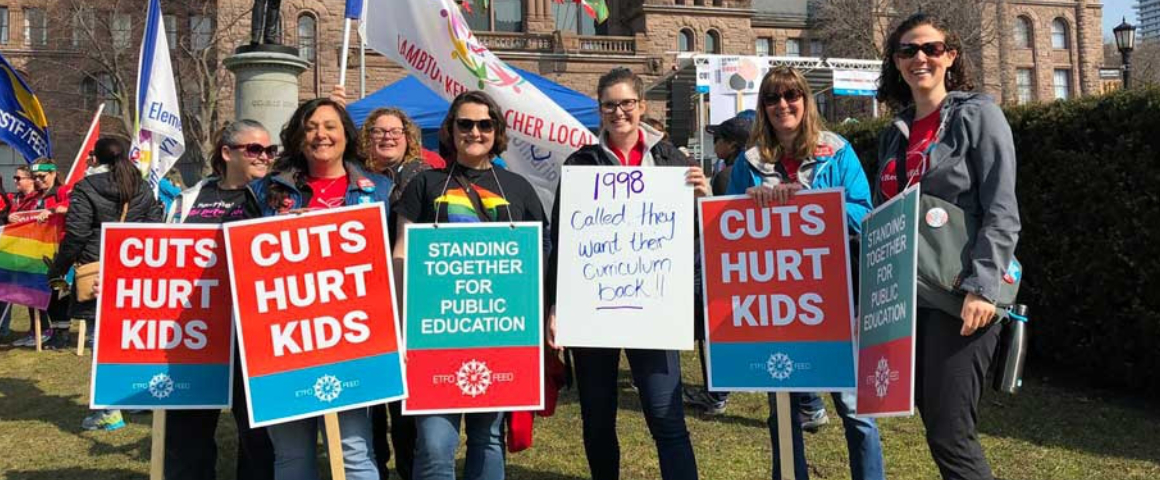
[Photo: ETFO]
Support working-class media!
If you found this article useful, please consider donating to People’s Voice or purchasing a subscription so that you get every issue of Canada’s leading socialist publication delivered to your door or inbox!
For over 100 years, we have been 100% reader-supported, with no corporate or government funding.