
By Dave McKee
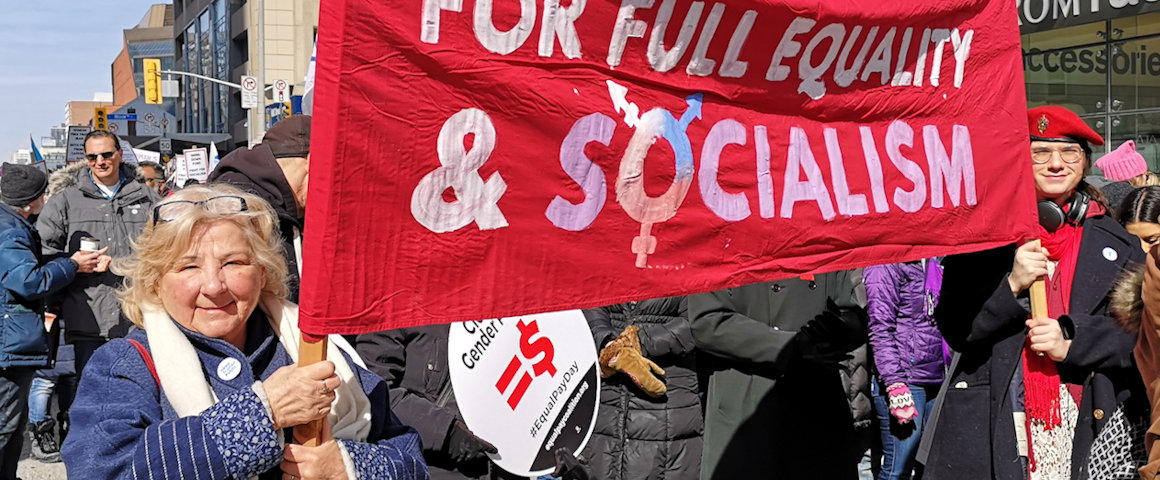
The struggle for trans rights – and for gender equality overall – was dealt a new setback on April 16, after Britain’s Supreme Court ruled that trans women are not considered to be women under equality laws.
It’s a ruling that will quickly have implications in Canada, where right-wing forces including Pierre Poilievre’s Conservative Party are using reactionary versions of women’s rights as a weapon against trans people and 2S/LGBTIQ+ people in general.
The British court’s 88-page decision affirms that trans people are protected against discrimination and harassment, but then states that “provisions relating to single-sex services can only be interpreted by reference to biological sex.” This means that trans women may be legally denied access to services such as advocacy, crisis intervention and shelter to women experiencing domestic violence.
The decision deals specifically with interpretations of British legislation, and will no doubt be the substance of many appeals, pushbacks and counter-legislation. But it seems like the kind of “separate but equal” argument which has been invoked in other times and places to maintain and systematize inequality, division and oppression, often with violent and even deadly outcomes.
While trans rights may not be a headline issue during the current federal election in Canada – the Conservatives likely prefer to let it sit idle, given the backlash they are already getting over their association with Donald Trump-style far-right policies – this is no time let the issue coast. In fact, this is precisely the time to press parties to commit their support for gender equality including trans rights.
After all, conservative parties across Canada have driven a spate of anti-trans bigotry over the past two years, ranging from laws requiring schools to “out” trans or non-binary students to parents, to declaring that there are only two genders, to adopting policies which severely limit gender-affirming care for young people and create “women-only” spaces that refuse access to trans and gender-diverse people.
Trans rights connected to women’s equality
This anti-trans wave is happening at the same time as concerted attacks, by those same parties, on women’s equality in general – and that speaks volumes.
Those attacks include wage freezes and restraint throughout the broader public sector, which disproportionately affects women who comprise a majority of workers in those jobs. Consider the fact that Ontario’s Bill 124, which limited wage and benefit increases in the broader public sector to one percent, forcibly reduced the incomes of so many women that the overall gender pay gap actually increased.
They also include efforts to limit childcare and even actively undermine the federal government’s $10-a-day plan, with conservative provincial governments delaying negotiating deals with Ottawa and insisting on heavy involvement of for-profit childcare operators.
Conservative parties and movements are undermining women’s hard-earned abortion rights. Sometimes this is through direct anti-choice campaigning, but it’s more often through a combination of funding cuts to hospitals providing abortions, rejection of safe access zones around clinics, or legislation to “protect the right to abortion” but which opens the door for anti-choice forces to lobby for restrictions and limitations.
Trans and gender equality are key to class struggle
The struggle for gender equality, including full equality for trans people, is critical to the class struggle. Throughout its history, capitalism has relied on institutionalizing the “sexual division of labour” – with defined roles ascribed to men and women – in order to constantly reproduce itself.
Key to this is maintaining this division is patriarchal notion of categorical distinctions between “men” and “women” – totalizing specific biological differences to the point that they become definitive in social, economic and political spheres. Any serious challenge to those strict roles and classifications, including through different gender identities or sexual orientations, is severely suppressed.
In Canada, the bulk of the labour movement has fought long and hard for many years to win concrete advances for women – pay equity, maternity leave, measures against harassment and violence, abortion rights and more. Labour is generally a strong and consistent advocate for trans and gender diverse people.
Now, working people are facing multiple threats – through Donald Trump’s vicious economic war, combined with an intensifying drive from corporations in Canada to reduce wages and eliminate labour rights. It’s no accident that this assault includes attacks on women’s rights and on gender equality in general. Corporate forces will be quick to use the British court’s decision to sow division among the ranks of the resistance.
This is the time to speak up for trans rights. Federal election candidates should be pressed to state where they stand on gender equality and on the issue of trans rights. To avoid doing so abandons many thousands of vulnerable people to increased attacks and hate, and it relegates the working-class struggle to a narrow and distorted patch of ground.
The program of the Communist Party of Canada, which rejects the gender binary and acknowledges that trans women are women, makes this clear: “Eradicating gender inequality will be crucial for putting capitalism altogether behind us and advancing to a higher stage of history.”
Support working-class media!
If you found this article useful, please consider donating to People’s Voice or purchasing a subscription so that you get every issue of Canada’s leading socialist publication delivered to your door or inbox!
For over 100 years, we have been 100% reader-supported, with no corporate or government funding.