
Public ownership of energy is key to halting climate change
Kimball Cariou
The past few years have taught us that the climate and environmental crisis will not be resolved through corporate-friendly policies. This current federal election campaign provides a key opportunity for people to push for real government action on environmental justice.
Such action begins with public ownership and democratic control of all energy and natural resources including extraction, production and distribution.
A report from Environmental Defence details the problems inherent in a climate strategy that is led by corporate interests:
“In 2023, the government of Canada provided at least $18.5 billion in financial support to fossil fuel and petrochemical companies. This includes $8 billion in loan guarantees for the TransMountain expansion pipeline, $7.3 billion in public financing through crown corporation Export Development Canada, and over $1.3 billion for carbon capture and storage projects.
“Over the last four years, federal financial support to the oil and gas industry was at least $65 billion, which could have fully funded every major wind and solar project in Canada from 2019-2021 twelve times over.
“The climate pollution created by oil and gas companies results in health costs, property damage from extreme weather events, and decreased agricultural productivity due to changing weather patterns. In 2023 the cost to society of the pollution from oil and gas companies operating in Canada is an estimated $52 billion.”
The tight connection between government policy and corporate interests is demonstrated by the fact that the former has facilitated and even guaranteed massive profits for the biggest energy companies. Economist Jim Stanford wrote about this for the Centre for Future Work:
“The [COVID] lockdowns resulted in low prices and losses for petroleum producers and refiners in 2020, but those losses were more than recouped as the pandemic waned. In 2021, profits reached $34 billion for oil and gas producers, and another $8 billion for the refining sector (both after-tax).
“In 2022, with soaring world oil prices (and rocketing gasoline and other fossil fuel prices in Canada), profits rose another 60% for the upstream (extraction) sector, and more than doubled in the downstream (refining) sector. That combined $70 billion flow of profits to the petroleum industry was a key cause of the spike in inflation in the same period.
“Since mid-2022, world oil prices have retreated, but profits remained elevated in both the upstream and downstream segments of the petroleum industry.”
In addition to placing the energy sector under public ownership and democratic control, the government needs to be pushed to replace cap-and-trade and carbon tax schemes with strict legal limits for pollution and hard caps on emissions, especially from industrial sources. This includes imposing strong penalties on corporations which break the law, including jail time for corporate executives.
This is particularly important as we learn more about the ongoing and longer-term impacts of energy production. This includes the use of newer technologies such as hydraulic fracking. In 2020, the Council of Canadians reported that the negative impacts of fracking include potential groundwater contamination, air pollution from chemical emissions, induced seismic activity (earthquakes), disruption of ecosystems and wildlife habitats, large water usage, and health risks to rural and Indigenous communities due to the release of potentially toxic chemicals.
Of course, in order to decarbonize the economy, it is critical to phase out the tar sands operations. This needs to be undertaken with an express commitment to compensate First Nations who have been affected. Recognizing that many energy industry workers will be displaced by phasing out the tar sands, the government must guarantee them jobs in the renewable energy sector and in other sectors of the economy.
One of the largest sources of carbon emissions in Canada – the biggest among any government department – is the Canadian military. This is not obvious to most people, since the military’s huge carbon footprint is deliberately excluded from official calculations of Canada’s emissions.
The government needs to be pushed to slash military spending – the Communist Party is campaigning for a 75-percent cut – to seriously reduce the massive carbon footprint related to deployment of fighter-bomber jets, the naval fleet and other military purposes.
According to the United Church of Canada publication Broadview, “Though Canada’s armed forces are much smaller than the US, the military plays a major role in Canada’s greenhouse gas (GHG) emissions. According to Canada’s GHG Emission Inventory for 2022-23, National Defence emitted 506 kilotonnes of GHG, the highest emitter by far among Canadian government facilities and fleet operations.
“Since the Paris Agreement in 2015, reporting military emissions to the United Nations has been voluntary. The UN says that military emissions are ‘non trivial’ and continue to be underreported. UN reports list Canada’s gap in emissions reporting as “very significant” and give it a poor data accessibility score.”
In addition to closing the tar sands, it is crucial to phase out coal-fired electricity generation. But this doesn’t mean moving toward nuclear energy – in fact, Canada’s reliance on nuclear should be terminated, and the government should invest heavily in renewable energy and conservation programs. Such an approach will help slow down climate change, create jobs and bring social benefits.
A good example of this is massive investment to substantially expand urban mass transit, while eliminating bus and transit fares. The Canadian Urban Transit Association (CUTA) wrote about this in a 2021 paper called “The Economic Impact of Transit Investment in Canada.”
CUTA found that the average annual cost of urban transit fares in Canada ranges from $800 to $1,500 per person. The economic benefit of Canada’s existing transit systems is at least $19 billion annually, with the transit industry directly employing 59,600 people, and transit capital investment creating an additional 65,000 jobs.
The association says that public transit reduces vehicle operating costs for Canadian households by about $12.6 billion annually and cuts the economic costs of traffic collisions by almost $3.2 billion per year. It reduces annual greenhouse gas emissions by 4.7 million tonnes, valued at $207 million, and saves about $137 million in annual healthcare costs related to respiratory illness.
There are several other strong policies that governments could implement, to make an immediate and long-term improvement to the climate crisis. These include:
- Building high-speed rail and creating a publicly owned bus service, fueled by renewable energy, to replace and expand the service previously provided by Greyhound and other for-profit operators.
- Imposing heavy fines and jail terms against polluters and destructive corporate practices, such as clear-cutting, in-ocean factory fish farming, and deep-sea draggers.
- Banning resource extraction in parks and halt urban sprawl.
- Enacting legislation to protect biodiversity.
- Rebuilding publicly owned and democratically controlled provincial electrical utility systems that include production, distribution, transmission and a bulk electricity system market.
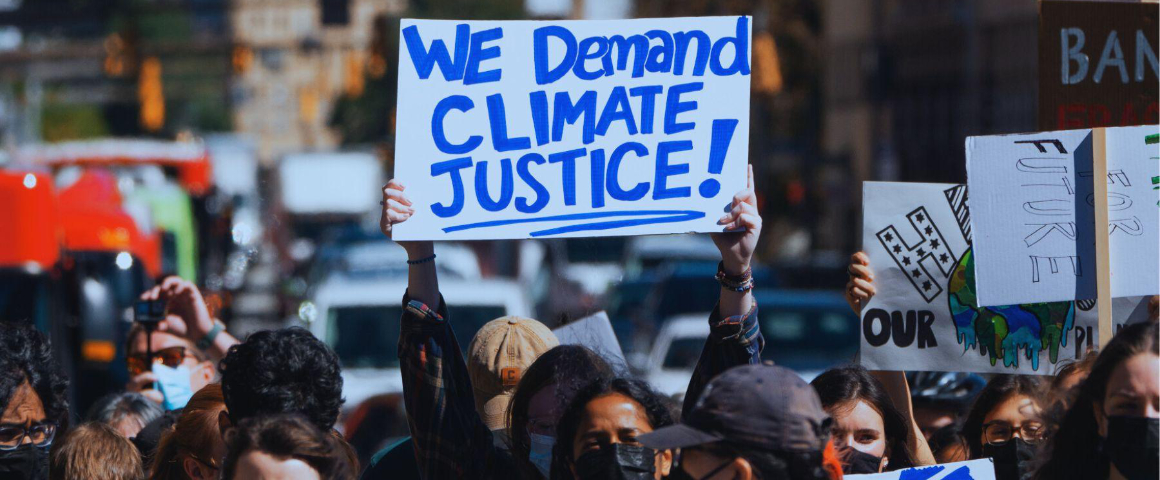
These kinds of policies can make a real difference – but the government needs to be forced to enact them, by a mass movement of the people which is committed to putting people’s needs and the planet before profit.
Support working-class media!
If you found this article useful, please consider donating to People’s Voice or purchasing a subscription so that you get every issue of Canada’s leading socialist publication delivered to your door or inbox!
For over 100 years, we have been 100% reader-supported, with no corporate or government funding.