By Karl Fluri
In early July, roughly sixty masked men gathered at Square Butte Hall, a volunteer-run community center tucked into the foothills near Millarville, Alberta.
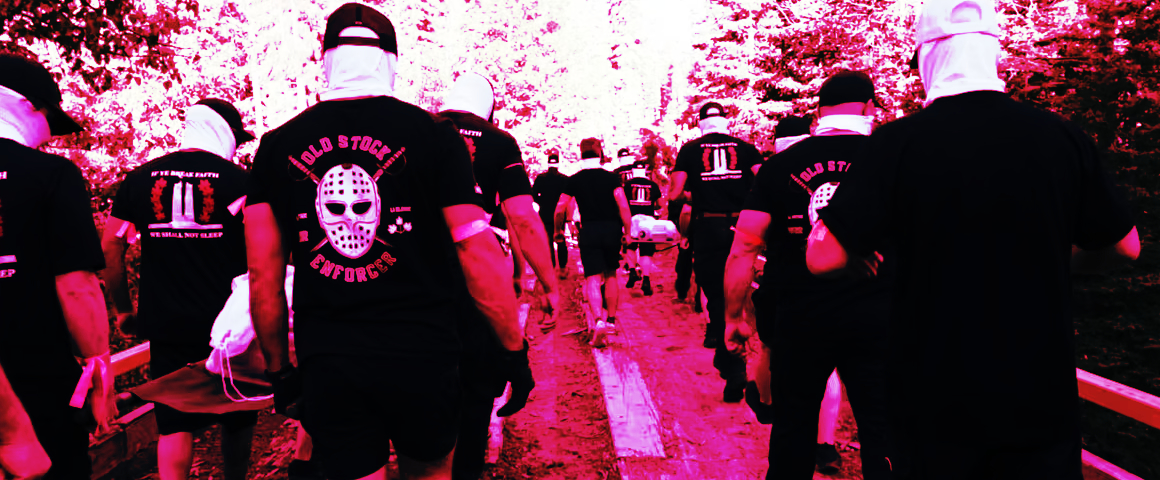
The hall usually hosts recipe exchanges, local dances and fire-prevention workshops. That weekend, it hosted Second Sons Canada, the country’s largest white supremacist group, for military-style combat drills and propaganda shoots. The event included activities like army crawls, column marching and combat training led by Jeremy MacKenzie, an Afghanistan war veteran who founded the group.
When the group posted video recaps online, they blurred their faces and tagged the location vaguely as the “foothills of Alberta.” They assumed the anonymity of rural space would shield them.
They were wrong.
Weeks later, local residents woke up to learn that neo-Nazis had been running tactical drills in their community. The Square Butte Community Association, which manages the hall, said members were “shocked” when approached by reporters.
The facility had been rented to an individual for what they were told would be a “retreat,” and the association stated that in its 67-year history, nothing like this had ever happened. Foothills County Councillor Laura Kendall also distanced the community from the group, saying, “To my knowledge, these aren’t local people” and that the hall does not represent those values.
But the only reason Millarville found out was that a network of online sleuths refused to let the footage vanish into the Telegram social media platform.
By matching a distinctive wooden welcome arch in a Telegram video to Google Maps imagery, and cross-referencing a banner drop over Highway 2 near Okotoks, researchers pinned down the exact location.
This is open-source intelligence (OSINT). It’s digital counter-surveillance wielded not by state intelligence agencies, but by a generation that grew up navigating the internet and understands that reactionary violence must be exposed before it takes root.
Unmasking the gym-cell model
The “active club” model was developed in 2017 by California neo-Nazi Robert Rundo through the Rise Above Movement. Operating from exile in Romania, Rundo designed a strategy suited for modern decentralized fascism: scrap the vulnerable, top-heavy political parties and replace them with small, local cells disguised as men’s martial arts and fitness clubs.
Rundo was eventually sentenced to two years in prison for planning and engaging in riots across California, with US Attorney Martin Estrada stating that “this defendant sought to further his white supremacist ideology by plotting riots and engaging in violence at political rallies.”
But the strategy has proliferated. The Global Project Against Hate and Extremism tracks 187 active clubs operating across 27 countries, representing a 25 percent increase in a single year.
According to a Public Safety Canada briefing document obtained by journalists, from more than 200 known active club chapters worldwide, a disproportionately large share is in Canada, with over 30 chapters. Second Sons Canada alone has more than 15 branches across the country.
As well as Jeremy MacKenzie’s Second Sons, that infrastructure is spearheaded by groups such as Hamilton’s Nationalist-13. While they present themselves publicly as fitness brotherhoods, their internal communications tell a different story. The Public Safety Canada briefing warns that the growing white nationalist active club movement in the country carries a risk of “extreme violence,” noting that these groups are capable of radicalizing participants to the point of justifying violence against Jews, racial minorities and 2SLGBTIQ+ people.
The document also notes that active clubs are increasingly moving from the online environment to offline activities, conducting training and appearing at public actions. “The minute you peel back even the slightest layer of this onion, it becomes far more insidious,” notes Mack Lamoureux, a researcher at the Institute for Strategic Dialogue. Lamoureux has warned that active clubs are “one of the fastest growing far-right extremist threats in Canada” and that members are “training for what they believe is to be an upcoming race war.”
Counter-intelligence network
The capitalist state, through its police apparatus, routinely treats these groups as isolated public nuisance issues rather than organized threats. While local officials issue hand-wringing statements about “serious public safety concerns,” law enforcement agencies typically monitor from a distance until forced to respond.
The RCMP has confirmed it is aware of Second Sons Canada, but emphasizes that it investigates criminal activity, not ideology.
The Public Safety Canada briefing notes that assessing the threat is complicated because active clubs generally do not publicly call for terrorism or the use of lethal force. Canadian Anti-Hate Network Executive Director Evan Balgord has called the situation record-dangerous, stating that “white nationalism is the biggest threat it has ever been,” and believes the government and law enforcement have not done anything significant to stop it.
Because the state apparatus offers no genuine shield to working-class communities, youth activists and investigative researchers have built their own counter-intelligence infrastructure. Grassroots volunteer monitors spend months mapping encrypted networks.
They traced Nationalist-13 members to public parks in Hamilton and identified training grounds at a martial arts studio in Welland. They tracked Second Sons members travelling to Texas and South Carolina to coordinate with US active clubs, documenting the transnational flow of fascist organizing.
In one investigation, the team was able to uncover training locations by matching distinctive features of the inside of boxing clubs, such as padded walls and the specific shape and position of windows. They also identified prominent members through clearly visible tattoos that could be compared with other photos, even when faces were obscured. After these investigations were published, some participants were excluded from various organizations and businesses.
Similar grassroots tracking unmasked the Kernatium Division, a neo-Nazi accelerationist group on TikTok and Telegram targeting youth across Canada. Volunteer researchers uncovered channel administrators sharing surveillance imagery and access points of the Canadian Armed Forces armoury in Regina.
Global digital front
This digital resistance is inherently internationalist. Gen Z sleuths in Canada operate as part of a global, decentralized ecosystem using open-source tools to map reactionary networks across borders.
Throughout Europe, collectives established the standard for using publicly available data to track state and non-state violence, inspiring a wave of youth-run research collectives.
In Germany, anti-fascist researchers systematically map far-right disinformation campaigns, while activists at the Chaos Computer Club organize regular Antifa Recherche Meetups to share web-scraping scripts and digital mapping techniques.
Direct action has also crossed into the digital realm. When a German anti-fascist researcher operating under the pseudonym Martha Root breached WhiteDate, a white supremacist dating and networking platform, she wiped the servers and published the user data live at a cybersecurity convention, taking down three linked fascist domains simultaneously.
The attack was conducted at the Chaos Communication Congress, Europe’s largest hacking conference, with Root appearing on stage in a Pink Ranger costume and launching a Python script that deleted the websites’ databases and backups in real time. Each command was met with applause from the audience.
What made the operation particularly sophisticated was Root’s use of artificial intelligence. Before destroying the platform, she deployed a chatbot based on Meta’s open Llama model, specifically trained to conduct conversations in the spirit of traditionalism and far-right values to gain users’ trust. The bot was instructed to demonstrate interest in “traditional family roles and heritage,” communicate amiably,and avoid sharing contact details before a personal meeting.
Through months of infiltration using these AI-generated fake profiles, Root and her collaborators were able to interact with users, understand their ideology, and collect maximum information before the administration noticed the breach. WhiteDate’s security was described as “as bad as it gets,” with the full list of users downloadable simply by opening a specific URL. She obtained data from more than 6,500 accounts, about 86 percent of which belonged to men.
The investigation revealed a structured ideological network. WhiteDate gathered nearly 8,000 profiles from around the world, with users sharing fantasies of “white genocide,” antisemitic conspiracy theories, and explicit references to neo-Nazism. After the server deletion, an interactive map was published allowing visualization of a portion of the registered users, with profile photos showing references to Nazism including images of American Nazi Party founder George Lincoln Rockwell and Celtic crosses.
The data included many Americans, Germans, British and approximately 300 French users. Similarly, the anonymous release of the “Fash Pack,” consisting of over 1,400 unmasking documents and internal files, demonstrates how digital archives can permanently strip fascist organizers of their anonymity.
Organizing out of necessity
Fascist active clubs target alienated young men who feel squeezed by housing precarity, wage stagnation and social isolation under financialized capitalism. Reactionary organizers weaponize this economic despair, directing frustration away from corporate exploitation and toward marginalized groups. The Canadian Anti-Hate Network notes that the organized white nationalist movement in Canada is the biggest it has been in modern history, with a major driver of that growth being social media, which makes it easier for like-minded people to find one another.
However, the same material conditions producing these reactionary movements are forcing a generation of young working-class people to organize. Gen Z OSINT researchers do not engage in this work out of academic interest; they do so because fascists are recruiting in their neighborhoods, their gyms and their digital feeds. As Lamoureux has stated, “They’re winning, they’re growing, and there needs to be pushback.”
The older model of anti-fascist resistance, which relied heavily on reactive street mobilizations, is being augmented by a distributed, data-driven methodology. By tracing a single tree in the background of an overpass photo or identifying a unique light fixture inside a rented hall, young researchers expose these networks to their employers, their schools and their communities before they can consolidate local power.
When Square Butte Hall was unknowingly rented out for a neo-Nazi retreat, the organizers believed they could train in secret. They failed to realize that every digital trail leaves a footprint, and a new generation of working-class researchers is actively watching.
[Photo of Second Sons gathering, retrieved from Telegram]
Support working-class media!
If you found this article useful, please consider donating to People’s Voice or purchasing a subscription so that you get every issue of Canada’s leading socialist publication delivered to your door or inbox!
For over 100 years, we have been 100% reader-supported, with no corporate or government funding.