PV Ontario Bureau
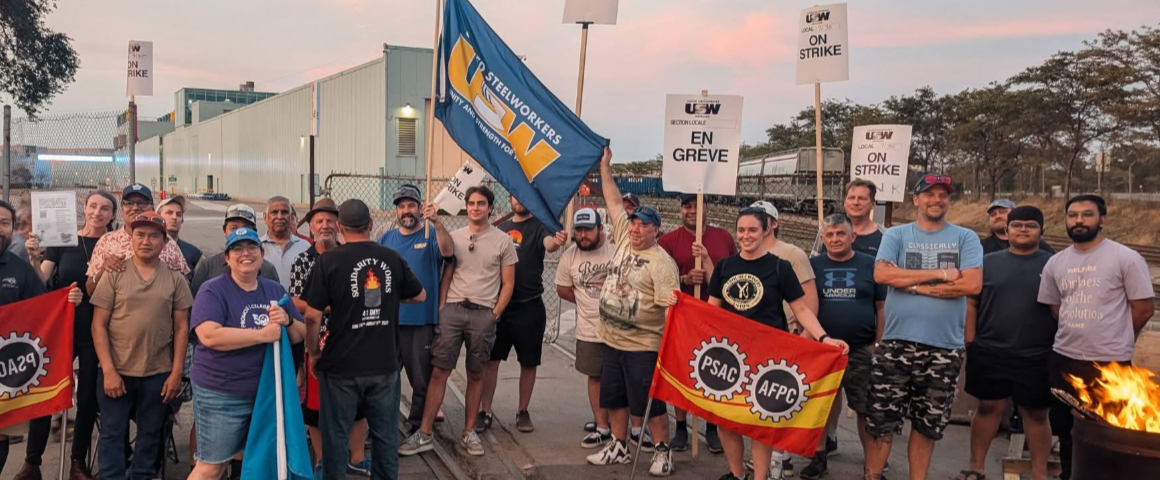
For the second contract in a row, workers at National Steel Car (NSC) in Hamilton, Ontario are on the picket lines as they fight for safe working conditions and decent wages. The 1,200 workers, members of USW Local 7135, have been on strike since August 12.
National Steel Car, Canada’s largest manufacturer of rail cars, has a notorious history of workplace accidents, many of them very serious. Ahead of the union’s 41-day strike in 2023, the company had three workplace deaths over a 21-month period.
The key issue in the ongoing struggle is wages, which are tied up with NSC’s peculiar pay system that has been in place since before the company was first unionized in the 1940s. Under the program, about 75 percent of production workers, especially welders and painters, work on an “incentive program” which combines a base wage with a piecework rate that amounts to about 25 percent of their pay.
But the employer has set production targets too high for workers to achieve. Furthermore, the program only extends to what NSC deems to be production time, which excludes prep time or cleanup – these excluded periods could amount to two or more hours, meaning workers’ pay is effectively cut by 25 percent during that time.
As a result, workers are “incentivized” by the boss to cut corners, rush, take risks, start their shift early and work through lunches and breaks. It’s a ticking time bomb that has repeatedly gone off with deadly consequences.
The program is also a tool for NSC to divide the workforce while cashing in on productivity. The 25 percent of workers who are not part of it, such as crane operators, still have to keep pace with those who are, but without additional compensation for their own sped-up work.
The union has not been involved with developing, modifying or implementing the incentive program, which is also not grievable or arbitrable. Local 7135 has tried to address this through several rounds of bargaining, with the same demand: NSC should either scrap the program and bring wages up to a decent level, or involve the union in implementation including time studies and setting the rates.
National Steel Car, however, is hostile to this kind of approach, and so workers are now on strike for the second consecutive contract.
NSC is a privately held company, so its financial information isn’t publicly available but recent estimates from financial websites put its annual revenue at around $540 million annually. That works out to $450,000 in revenue from each of the 1,200 production workers currently on strike.
The unionization of National Steel Car in the 1940s was one of the first big industrial organizing victories in Canada by what was then called the Steel Workers Organizing Committee. The significance of workers’ struggles at NSC in the decades since has not diminished, and Local 7135 is receiving strong support from labour and community organizations in Hamilton and beyond.
All workers deserve good wages and pensions, and a safe work environment. Securing these basics involves struggling at the workplace, but also fighting for legislative changes.
Specifically, working people need strong plant closure and plant safety legislation which requires an employer to answer publicly for relocation or workplace injury, with stiff consequences like jail time for executives or nationalization of their plants. Furthermore, governments should rescind all public contracts from companies that don’t provide fair wages and pensions, benefits, working conditions and union rights for their workers.
The Westray Law – which treats critical injuries on the job under the Criminal Code, not just the Labour Code – has been in force since 2004 but it remains poorly enforced. This can and must be fixed.
Working people also deserve a shorter work week with no loss in take-home pay, so that they get both jobs and leisure time.
[Photo: PSAC]
Support working-class media!
If you found this article useful, please consider donating to People’s Voice or purchasing a subscription so that you get every issue of Canada’s leading socialist publication delivered to your door or inbox!
For over 100 years, we have been 100% reader-supported, with no corporate or government funding.