By Rob Crooks
Premier of British Columbia and provincial NDP leader David Eby has announced that he will be introducing legislation to suspend sections of the Declaration on the Rights of Indigenous Peoples Act (DRIPA) for three years. This announcement comes in the wake of fierce backlash received by the premier over recent comments that amending the Act is “non-negotiable.”
The plan to suspend sections of DRIPA was introduced by the premier to provincial Indigenous leaders via a private Zoom meeting on April 2. The transcript of the meeting has since leaked. While at least one attendee to the meeting warned that public criticism of Eby could pave the way for a Conservative government that wants DRIPA stricken from the books altogether, the majority of those in attendance expressed deep frustration over the betrayal of the current provincial government.
The BC NDP currently holds a single seat majority in the legislature. If they vote in a block, the proposal to suspend DRIPA will pass. This government has been disciplined in that regard; however, one wonders how long Eby will be able to rely on his party’s loyalty. For example, NDP MLA Joan Phillp is married to Grand Chief Stewart Phillip, one of the most vocal critics of Eby’s treatment of Indigenous issues.
The Declaration of the Rights of Indigenous Peoples Act was passed unanimously by the BC legislature in 2019. It was the result of centuries of struggle by Indigenous peoples in the province, and marked a truly progressive step towards reconciliation.
In 2021, BC’s Interpretation Act was amended in line with DRIPA to declare “that every provincial statute and regulation be construed as being consistent with UNDRIP” and Section 35 of Canada’s Constitution. This meant that the right of Indigenous nations to free, prior and informed consent over projects that could affect them or their ancestral lands was now part of British Columbian law.
This hasn’t stopped the capitalist government from encroaching on this right, however. Bill 14, the Renewable Energy Projects (Streamlined Permitting) Act and Bill 15, the Infrastructure Projects Act were introduced into provincial law last year to expedite the approval of projects that would give ownership rights over land and resources to private corporations. The Union of BC Indian Chiefs warned at the time that these bills “appear to be designed to turn back the clock on all of the progress we have made together toward reconciliation in this Province.”
The NDP government’s reaction to two 2025 court decisions only deepened this concern.
In August, the BC Supreme Court (BCSC) agreed that the Cowichan Tribes have the right to Aboriginal Title over a large swath of land that was thought to be owned by the federal Crown, the Vancouver Port Authority, the city of Richmond and a handful of private citizens who own property on the territory.
The land had been set aside for the Cowichan peoples by Pre-Confederation British Governor James Douglas in the mid nineteenth century but was stolen and sold off by BC’s first Chief Commissioner of Lands and Works, Richard Moody. The BCSC made a ruling based on the facts presented and in doing so corrected a historical crime that has had intergenerational impacts.
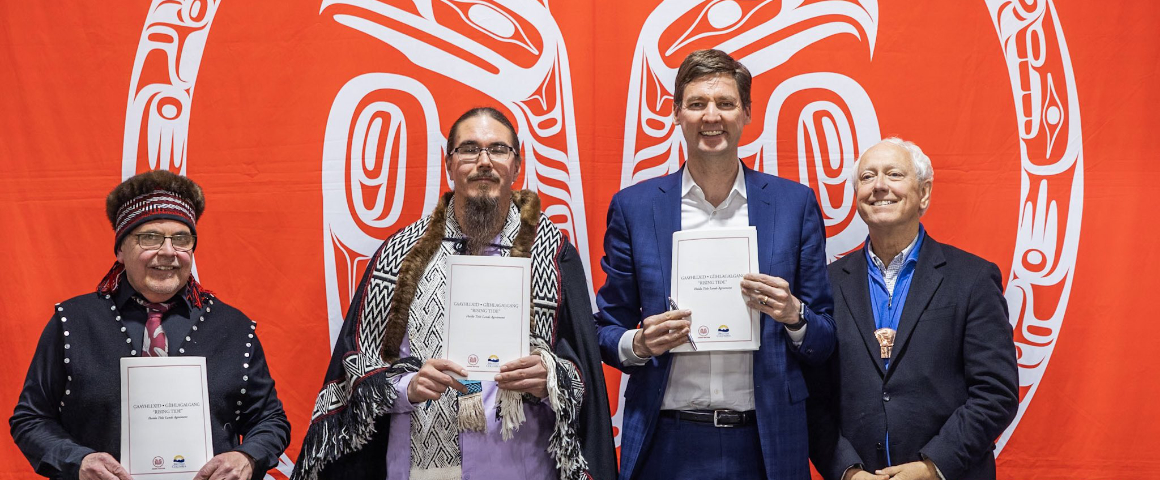
Provincial Attorney General Niki Sharma, however, made it clear that the BC NDP “strongly disagree with the decision.” She went on to claim that Aboriginal Title and fee simple (private property) “cannot coexist,” a claim that is not only legally but also empirically incorrect. These two forms of ownership co-exist currently in BC, as outlined in the Gaayhllxid/Gíihlagalgang “Rising Tide” Haida Title Lands Agreement – signed by the province and the Haida Nation in 2024.
Sharma also said, “the Province prefers to resolve land claims through negotiation – where we can protect property rights directly – rather than risk considerable uncertainty through court decisions.” This statement obfuscates the fact that Indigenous nations have been trying to negotiate on equal footing with governments since first contact. It’s probably safe to say that taking legal action was not the preferred approach of the Cowichan Tribes either.
In December 2026, the Gitxaała and Ehattesaht First Nations successfully argued in the BC Court of Appeals that the province’s Mineral Tenure Act violates the right to free, prior and informed consent. The online portal for granting mineral rights allows practically anyone to claim ownership over resources without consulting those to whom the land containing those resources actually belongs.
Premier David Eby responded to this decision by calling it “overreaching and unhelpful” and promising to amend DRIPA. Criticism from First Nations and legal organizations was swift. By openly undermining the courts in BC, Eby exposed his belief that he and his government are above the law and that Indigenous rights should only be upheld when they don’t interfere with business.
David Eby is currently one of Canada’s least popular premiers, with a 37 percent approval rating; only Doug Ford and François Legault rate lower. His party, the BC NDP, has failed to deliver on promises such as electoral reform, tax reform and $10/day childcare. Healthcare is a disaster in the province, with a recent study published in the Canadian Medical Association Journal demonstrating that this summer’s upcoming FIFA World Cup tournament could collapse the whole system should there be an influx of visitors requiring medical attention.
While BC’s cost-of-living crisis continues to deepen, the government is making major cuts to public sector jobs. The NDP has promised the elimination of 15,000 public service positions over three years, on top of the 40,000 federal public jobs losses promised by Carney’s government. The province lost 20,200 jobs in February alone.
Eby has used Trump’s tariffs as an excuse for the province’s poor economic performance and as justification for his attacks on DRIPA. However, BC’s economic troubles predate the current US administration, and can be attributed more so to corporate tax cuts implemented by Liberal premier Christy Clark almost a decade before Trump’s second term. These tax cuts have resulted in school closures, privatization in healthcare, disinvestment in public housing, selling of public lands and widespread austerity.
The NDP have been in power since 2017, giving them nine years to change this trajectory by reversing these tax cuts, but have refused.
Eby has instead banked on Carney’s promise to make Canada a world market for raw materials. The demand for BC’s lumber isn’t what it used to be, but LNG and critical minerals are abundant in the province. Eby is hoping that the federal strategy will position BC advantageously along global supply chains to bring investment into the province that will in turn create jobs.
Even if this gamble pays off, however, the province will have replaced permanent unionized employment with temporary private sector jobs while keeping BC at the bottom of the value chain. Eby’s focus on courting foreign investments will only further entrench our dependency on our southern neighbour, all in the name of sovereignty.
David Eby’s call to suspend DRIPA is a move to eliminate any barriers to this strategy. In January, Eby struck a different tone, telling the BC Natural Resources Forum in Prince George that overriding Indigenous rights would destabilize the investment environment. “The nations will file court actions, injunctions based on their title rights,” he warned, which will scare off capital.
More nuanced observers are predicting that Eby’s reversal on this position will cause more instability and doubt for potential investors. Eby’s government is currently challenging court decisions on the Cowichan case and the Mineral Tenure Act, and is hoping to suspend DRIPA until these legal challenges are resolved. In the meantime, Indigenous rights will be left in limbo and effectively gutted.
These undemocratic actions won’t go unchallenged, however.
All of this only reveals the contradictions of pursuing reconciliation under capitalism. Reconciliation cannot only be about land acknowledgements – it must address the question of the right to the land. The land, transformed by labour into everything from food to cell phones, is the source of all wealth. To deny a people access to their land is to deny them the right to self-determination and economic development.
As Grand Chief Stewart Phillip said on CBC TV, addressing the Cowichan case, “We need to commit to serious negotiations, that does, in fact, recognize the reality, the legal reality, the constitutional reality, of Aboriginal Title in British Columbia. The Richmond residents have been living on Aboriginal lands ever since they first purchased those properties, as did the previous owners. That’s the reality that British Columbians refuse to accept, but it’s the reality we need to work with.”
[Photo: David Eby X]
Support working-class media!
If you found this article useful, please consider donating to People’s Voice or purchasing a subscription so that you get every issue of Canada’s leading socialist publication delivered to your door or inbox!
For over 100 years, we have been 100% reader-supported, with no corporate or government funding.