
PV Labour Bureau
With the recent announcement that Canada lost a whopping 100,000 jobs in the first two months of 2026, working people are becoming increasingly anxious about employment security. This latest job loss news – described by CBC as “one of the worst monthly job losses seen in years outside of the pandemic” – can’t be dismissed as a one-off, either, as it comes on the heels of 12 months of virtually no job growth across the country.
Government response to the jobs crisis has been thoroughly inadequate. While some 27,000 workers in Ontario have lost jobs in the softwood lumber, steel and automotive sectors, the Workforce Tariff Response, a joint program with the Ontario government, provides paltry funding for re-training and job search. Across the country, Employment Insurance applications are skyrocketing; they jumped by more than 13 percent between December 2024 and July 2025 alone. But rather than improve EI – by making it non-contributory, by extending coverage to all unemployed workers benefits, and by increasing benefits to 90 percent of previous earnings for the entire period of unemployment – Ottawa’s reply has been merely to waive the waiting period and extend the benefits period by up to 20 weeks for select workers.
At the same time, Mark Carney has doubled down on the USMCA trade agreement as the vehicle of choice for Canada’s economic stability and development, in the face of Donald Trump’s trade war. The prime minister claims that the agreement, which is coming up for review this summer, is “the best trade deal [that Canada has] with the United States” and that it is “better than that of any other country.”
When USMCA was negotiated in 2018 – the result of Donald Trump’s drive to re-write NAFTA – labour leaders in Canada were generally receptive. While identifying some problems, then CLC president Hassan Yussuff welcomed what he called “key gains” and opined that “workers across the country will be happy” with much of the USMCA content. Similarly, Unifor wrote in 2018 that “while there are areas of legitimate concern, the USMCA is an improvement over the original NAFTA with quantifiable gains for workers.”
So, is USMCA really the best path forward for working people? A look at the deal’s impact suggests that the labour leadership’s initially positive response was naïve at best, and that the agreement has had a similarly devastating impact on the working class as its predecessors, NAFTA and the Canada-US FTA.
USMCA proven to be bad for workers
When USMCA was negotiated in 2018, official unemployment in Canada was 6 percent. It spiked during the pandemic, of course, and then briefly hit a low of 4.8 percent in July 2022, due largely to people leaving the workforce entirely. If the USMCA were truly an effective method for, as its proponents claim, “stabilizing and expanding the economy and jobs,” we would expect to see unemployment decline and remain below its pre-pandemic levels.
But in fact, after the brief low of 4.8 percent, unemployment rose and passed its pre-USMCA level to over 6 percent. It hit 7 percent in November 2024, before Trump elected, and has remained in that area since. According to Statistics Canada, a one-percent change in unemployment or employment levels is equivalent to around 210,000 workers.
At the same time that unemployment rose, the employment rate – representing the proportion of the workforce that actually has jobs, whether or not they are looking – fell. It was 62.5 percent in 2018 and, after a collapse around the pandemic, returned to same level in late 2022. This corresponds to over 7.8 million workers who are in the workforce but without work.
Here again, a trade deal that serves the interests of working people should be expected to create jobs in timely fashion and to provide them to lot more than 60 percent of the workforce. But by the fall of 2023, the employment rate dipped downward to under 61 percent and has remained there since. This reduction corresponds to around an additional 380,000 unemployed workers.
So, since the USMCA came into force, net job loss is at least 500,000 workers – 380,000 from declining employment between 2018 and 2025, plus 100,000 lost jobs in the first two months of 2026. Structural unemployment, based on the employment rate, has risen to affect around 8.2 million workers.
At the same time, underemployment is rising – this is measured by comparing the proportion of full-time to part-time jobs. Data from Statistics Canada show that in 2018, 81 percent of jobs in Canada were full-time and 19 percent were part-time. That ratio steadily fell in the years after USMCA came into force, and by 2025 just 76 percent of jobs were full-time and 24 percent were part-time.
This suggests that underemployment has grown by 26 percent in the less than 8 years than USMCA has been in force.
There’s little point analyzing jobs without looking at the wage picture as well. At first glance, the picture isn’t bad: workers’ wages rose from approximately $27 in 2018 to $34 by 2024, a 26-percent increase in gross earnings. But when inflation is taken into consideration, it becomes far more sobering: real wages only rose 6 percent.
The big reason behind this is the increase in the consumer price index, which rose by over 30 percent between 2018 and 2025
While have workers struggled with the impact of USMCA, one sector of Canadian society has benefited mightily: corporations.
In 2018, corporate profits in Canada were $500.3 billion. While they took a hit during the pandemic, they quickly rallied and spiked to record levels in 2022. From then, they have continued to grow, reaching a new record high of $677 billion in 2025.
So, corporate profits have grown by over 35 percent since USMCA came into force, despite net job loss of around a half million workers. By comparison, corporate profits have grown nearly 600 percent more than real wages.
Clearly, like its predecessors NAFTA and the FTA, USMCA has been a disaster for working people. Heading into a convention in May, and ahead of the USMCA review in July, union members need to press the CLC into engaging affiliates, provincial federations and labour councils in a cross-country campaign to mobilize all workers – organized and unorganized, inside the Congress and outside – in the struggle for trade policies that truly put workers first.
For a labour campaign on trade and jobs
At the beginning of 2026, the CLC issued a call for “a workers-first trade policy that preserves and expands Canadian jobs, strengthens domestic industry, and regulatory space to invest in domestic manufacturing, supply-chain resilience and future industries.” This call, issued in anticipation of the USMCA review, was echoed by several union affiliates and reflected similar demands in Unifor’s Protect Canadian Jobs campaign.
The statement is a good starting point – but it’s only that. It has to be brought into force through an action campaign based on specific demands.
A worker-first trade policy needs to start with the call for a full employment economy. Two keys to this are a shorter work week with no loss in take-home pay, combined with public ownership and operation of key industries.
Public ownership of industries is expressly restricted in the USMCA: state-owned enterprises and monopolies must operate on a commercial basis and not create unfair competition for private firms. This provision drives the few publicly owned enterprises that exist in Canada to operate in exactly the opposite manner to what workers need – by competing with private, often huge transnational firms, they constantly seek to reduce employment, diminish wages and casualize work.
The crisis at Canada Post – which is under extreme government and corporate pressure to be split up and privatized – is a prime example of how membership in corporate trade deals like USMCA distorts publicly owned industries and prevents them from being democratically operated in working people’s interest. This is one clear illustration among many of why the CLC needs to call for Canada to get out of corporate trade deals like the USMCA.
Instead of promoting side deals in the USMCA or parroting anti-communist rhetoric in response to potential trade with China, working people in Canada need the labour leadership to champion mutually beneficial trade policies with the world, based on full employment, respect for Indigenous rights and environmental protection.
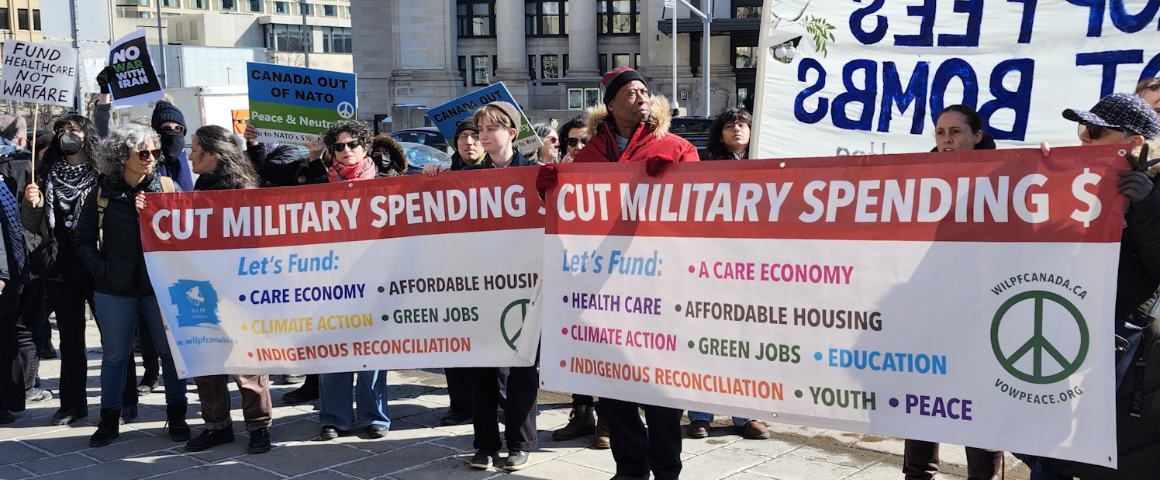
They need labour to fight for government procurement policies that serve and defend these same goals, not the goal of increasing profits for the biggest private monopolies. They need unions to oppose Mark Carney’s military economy, and instead to call for cuts to the skyrocketing arms budget and for those funds to be invested in public infrastructure and services that serve people’s needs while creating jobs.
And they need escalating action campaigns that engage workers from the grassroots and bring them into the streets, not lobbying campaigns by hired professionals who meet behind closed doors with politicians who then ignore them.
CLC convention – a decisive moment
After reviewing the impact of USMCA, it’s no surprise that workers are calling for more action on jobs and trade – what’s surprising is that the labour movement isn’t doing that.
But in the lead-up to the CLC convention in May, labour activists across the country have been promoting resolutions calling on the Congress to mobilize a mass campaign for trade policies that truly put workers first. Several labour bodies – from union local to labour councils – have submitted these resolutions to the convention.
It is critical that the CLC come out of this convention with a commitment to leading this kind of action campaign on trade and jobs. There is a broad basis for building this struggle, but delegates will need to make sure that the resolutions hit the floor and that they are passed with strong and widespread support.
They will also need to ensure that the CLC commits to concrete policies and actions. These include job creation by expanding social spending on healthcare, education and social programs, through construction of affordable social and public housing, and by nationalizing auto and steel and by building value-added jobs in manufacturing. And it includes cutting the military budget to fund these and more people’s needs.
Peace, jobs and public investment in health, education and social programs – this is what a good life looks like for working people. And that’s why the CLC leadership needs to take on this fight.
Support working-class media!
If you found this article useful, please consider donating to People’s Voice or purchasing a subscription so that you get every issue of Canada’s leading socialist publication delivered to your door or inbox!
For over 100 years, we have been 100% reader-supported, with no corporate or government funding.