By Cam Scott
By now, the significance of Ottawa’s Defence Industrial Strategy ought to be clear. Under cover of a movement for sovereignty, Prime Minister Mark Carney has embarked upon a thorough transformation of Canada’s economy, to the benefit of select capitalists with a stake in mining and military technology.
Equally clear is the austerity ahead, as the public service faces massive layoffs and the government attempts to recruit interdepartmentally to national defence.
But these trends didn’t begin with Mark Carney, however efficiently he has made his reputation from them in the present trade war. In many ways, the “nation-building” spree of Carney’s industrial strategy was anticipated by the premiers, whose coordinated campaigns for interprovincial deregulation and domestic free trade put a clear set of demands before the present Liberal government.
Before either Trump or Carney had won their most recent elections, Manitoba Premier Wab Kinew was busy organizing trade missions to the US and attempting to open a provincial office in Washington to facilitate the export of Manitoba’s critical minerals. And months before the Liberal pledge to more than double its tithe to NATO, Kinew was calling for Canada to increase its defence budget in order to preemptively placate an incoming Trump administration.
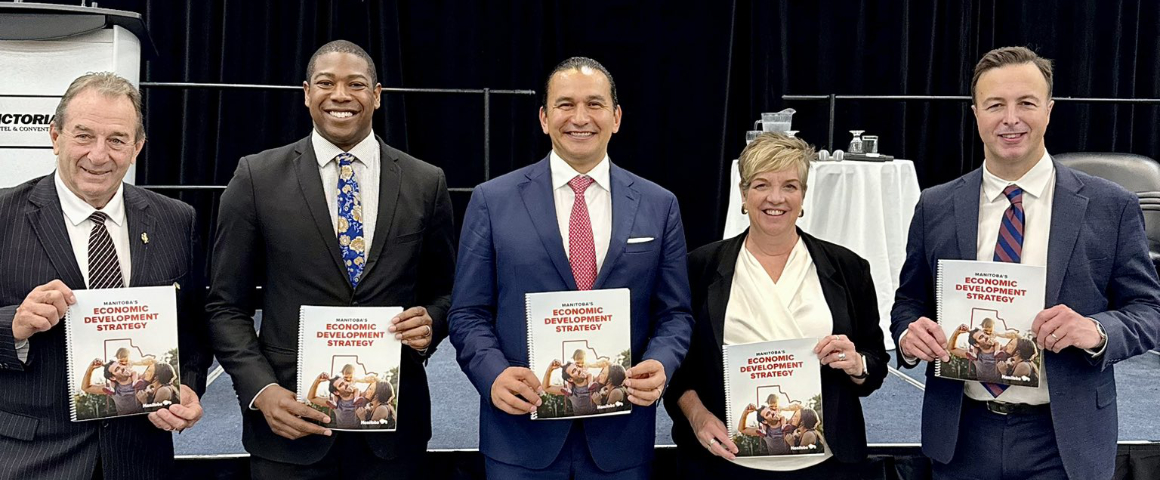
Today, Kinew’s wishes appear to have been granted, and with hardly any questions from his base. The deregulation of domestic trade is a crucial aspect of the Defence Industrial Strategy, which Minister of Industry Mélanie Joly presented to the Manitoba Chambers of Commerce at a Magellan-sponsored keynote last week. As the federal government promises quick procurement through new domestic supply chains, provinces are lining up for contracts in tech infrastructure, aerospace and the mining of critical minerals. And in Manitoba, the provincial NDP anticipates a number of high-profile capital projects as part and parcel to this strategy.
The Port of Churchill
In a March 5 interview with CBC, Kinew was enthusiastic about the potential for a NATO-activated Port of Churchill. “I know that the federal government has decided to lean into Churchill,” he boasted. “They’re really looking at defence spending and defence spending is going to be one of the big ways we promote our economy. I think (Joly’s) message effectively here is: Manitoba businesses, Manitoba workers, let’s figure out a way for you to pivot towards defence, then you can figure out how to bring more resources and more opportunity into Manitoba.”
Joly confirmed as much while in Winnipeg, emphasizing the significance of Manitoba’s role in the F-35 supply chain by way of firms such as Magellan and noting the potential of Churchill as an oil shipping hub. Although its facilities only operate during the summer at present, Ottawa continues to eye the Port of Churchill as a site of geostrategic interest due to its location between Canada and Europe. Just this month, Churchill’s Arctic Gateway Group, a partnership of Indigenous and northern communities, signed an agreement with the Port of Antwerp-Bruges International – one of the busiest logistical centres in the world.
The NATO Association of Canada has identified critical minerals as “the key to meeting Canada’s NATO contributions” in the Carney era, and the EU as “the clearest path for cooperation to push forward this industrial development.” Canada has reserves of all twelve “defence-critical” minerals identified by NATO for use in heavy artillery, and actively produces ten of these already. The Port of Churchill would then function as a key conduit for these exports, and a strategic asset in the military conquest of the Arctic.
While the Port of Churchill has not yet appeared on the federal government’s list of projects of “national importance,” Carney and Kinew have already pledged more than $262.5 million to the development which will include improvements to railway infrastructure, a significant critical mineral storage facility, and a wide range of aerial and atmospheric surveillance technology.
Developing Churchill for the sake of NATO supply chains poses an existential risk amid inter-imperialist competition for control of the Arctic. Whatever Kinew and his corporate allies claim, this cannot be reconciled with sustainable development goals or Indigenous sovereignty.
The goal of transforming Churchill into a year-round hub for the export of energy products has captured the attention of Western Energy Corridor, a group of energy and pipeline executives who wish to construct a crude oil pipeline between Alberta and Churchill, as well as an oil export terminal at the northern port. Such infrastructure would violate the rights of any number of Indigenous peoples along the path of its construction, regardless of its short-term benefit to those communities placed at its terminus.
Alberta Premier Danielle Smith has previously praised Kinew’s openness to a northern pipeline, using the same language as their coordinated assault on interprovincial trade regulations. “This is what a Team Canada approach looks like,” she wrote last year. “Provinces and their Premiers supporting other provinces in getting their products to market.”
Data mining
That’s not all that Team Canada is doing on the ground in Manitoba. In the community of Île-des-Chênes, an historically Métis enclave in the rural municipality of Ritchot, Kinew has vocally supported a controversial proposal for the construction of a sprawling AI data centre, covering more than three hundred acres of arable farmland. This hyperscale development would be one of the largest such facilities in the world and would devour an equivalent amount of energy to hundreds of thousands of homes, almost half of which would go towards the centre’s water cooling system alone.
This is an ecologically devastating project, and its impact must be measured alongside the irrelevance of this industry to any vision of common prosperity, as well as its profound indifference to working people. Kinew optimistically projects the creation of 1000 jobs, but the engineering and electrical trades required during construction are no part of the centre’s daily upkeep. (Most data centres of this scale employ fewer than 100 personnel once operational.)
AI poses serious ethical and economic concerns, and the government’s solicitude of big tech passes over crucial questions concerning the regulation of AI, let alone the necessity of worker control over its implementation per sector.
The major developer of this data centre is Las Vegas-based firm Jet.AI, alongside Canadian partner Consensus Core. Such investment is difficult to square with the economic nationalism that both Carney and Kinew espouse, though this dissonance indicates the reality of their industrial boosterism. No doubt the US-dominated field of AI is eager to partake of funds from Carney’s “Canadian Sovereign AI Compute Strategy,” which intends to grow data centres as well. And while Jet.AI’s initial offer is from private coffers, its stated intent is to attract interest from “hyperscale tenants” in Canada, subsidized from federal investment in tech.
Manitoba is primed for this kind of project for many reasons, both infrastructural and spatial. According to Jet.AI CEO Mike Winston, “the combination of power, redundancy and buildable scale here is extremely hard to replicate.” Once again, Kinew intends to leverage these natural and regional advantages before investors, notwithstanding the overwhelmingly negative benefit of this development to Manitobans. And while the proposed data centre is sure to be one of the more egregious examples of this approach to land use, it is only one among many.
Can you dig it?
In nearby Springfield, Alberta-based Sio Silica is once again hoping to push through a sand mining operation posing serious risks of contamination to the eastern aquifer. This proposal had already been rejected by the NDP in 2024 yet has returned amid the present flurry without any change to the proposed location or method of extraction, flouting the Clean Environment Commission and attempting to circumvent a full assessment.
Both Kinew and Business, Mining, Trade and Job Creation Minister Jamie Moses have enthusiastically championed the Lynn Lake Gold Project, owned and operated by Alamos Gold.
But for all the touted benefits to Marcel Colomb First Nation, Alamos Gold has a terrible record, globally and locally. Their Turkish subsidiary has seen enormous protests over deforestation and waste, and their projects in Mexico faced down mass opposition to the destruction of protected archaeological sites, as well as a deadly cyanide spill in 2016. Just last year, Manitoba Conservation investigators determined that Alamos Gold’s own negligence started the 85,000 hectare wildfire that evacuated the whole of Lynn Lake, destroying dozens of homes.
In southwestern Manitoba, the Deep Sky Corporation has announced a direct air capture (DAC) facility, with the happy endorsement of the NDP and far too little scrutiny. Direct Air Capture is a controversial carbon removal technology, using chemicals to extract CO2 from the air. The technology itself is new and unreliable, as noted by Climate Action Team Manitoba in a recent report. What’s more, it is widely regarded as an industry hoax, forestalling more significant action to reduce emissions and consuming obscene volumes of water and energy at the same time. Founded by ex-executives of Hopper and Airbnb, Deep Sky is not set to accept provincial funding, but has already set the government to lobbying on its behalf, with Kinew pledging to shift regulations so that the firm can receive federal tax credits.
A new direction
These are only a few examples of Kinew’s plan to make Manitoba a “have” province, and of how Carney’s industrial strategy downloads onto its provincial exponents. Plainly, not one of these capital-intensive projects poses any long-term benefit to workers, nor to the communities where these mammoth developments appear. Instead, the Manitoba NDP continues to pursue a policy of aggressive deregulation and corporate prospecting amid Carney’s version of the same – all while greenwashing their contribution to a federal war budget of unprecedented scope.
Kinew’s pet projects on behalf of investors cannot be understood, let alone defeated, as a discrete series. Rather, his plans must be viewed as a strategic commitment to unfettered free trade and market caprice, to soaring military spending and the foreign policy that it pursues. In this light, there can be no mistaking him for anything but what he is – a Carney Liberal in progressive clothing, and a threat to peace.
Support working-class media!
If you found this article useful, please consider donating to People’s Voice or purchasing a subscription so that you get every issue of Canada’s leading socialist publication delivered to your door or inbox!
For over 100 years, we have been 100% reader-supported, with no corporate or government funding.