By Judy Haiven
On March 11, Nova Scotia Premier Tim Houston announced he was going to restore $53.6 million in the $130 million cuts his Tory government proposed for its budget.
To some, he looked like a good guy – even a listener. He heard a smattering of media interviews with angry parents who stood to lose grants to care for their disabled adult children at home – thanks to Houston’s budget cuts. He didn’t look like such a good guy at the celebration at the African Heritage Month gala last month when dozens of Black Nova Scotians booed, hissed and raised clench fists when Houston spoke at the Halifax Convention Centre. A week before, he had announced cuts which would disproportionately affect African Nova Scotians and Indigenous people, disabled people and the elderly.
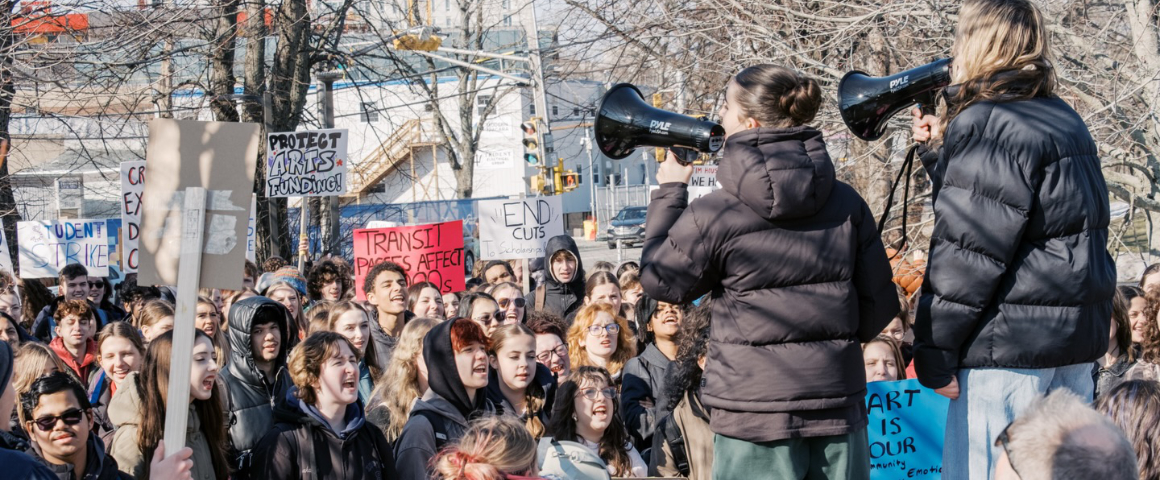
He tried to ignore two of the biggest rallies ever, each with more than 1,000 demonstrators, held two days back-to-back at Province House the week before. On March 10, he was greeted by another yet demonstration against his cuts – this one more than 800 strong.
Suddenly, he changed his mind and reversed about 40 percent of the cuts announced in his budget. Praiseworthy as that is, do all our journalists have to fall over one another to commend him for it?
What did Houston agree to? Originally, he cut financial grants to 287 NGOs, charities and government programs. Now he’s spared the execution of a few dozen on the list.
The ones – I should say the “causes” – the government will continue to fund are programs that affect “Joe and Jane Average.” For this government, Joe and Jane are rural or small town based people, who do not earn a lot and who the powerful have assessed as Tory supporters and prospective Tory voters.
For example, on Houston’s chopping block was the NS Caregivers’ Benefit Program which, as noted at the start of this article, pays a subsidy of $400 a month for in-home caregivers for elderly or disabled adults. The $12.7 million program was going to be cut by $2.5 million – 20 percent. Some Nova Scotians were concerned that dropping money from the program would mean they would have to quit their jobs to stay home and look after family members – full time. The worried caregivers couldn’t afford to leave their paid jobs – especially since the stipend for the carers has been capped at a measly $400 a month for 16 years, despite NDP efforts to get it doubled. But this week, our mea culpa premier agreed to restore the funding (at $400 a month) to the caregivers.
Houston has also cut grants to equity-advancing programs at the high school to university levels. Programs such as the Dalhousie University’s Transition Year Program (to allow better access to university for Indigenous and Black students), scholarships for Women in Engineering and other initiatives were chopped. After the protests, some cuts were reversed as of March 11. March 13, it was revealed that a new YWCA daycare centre, one of the few in the province that will serve disabled children, has been denied government funds of $1.4 million. The money is earmarked to hire speech therapists, physiotherapists and other professionals needed to help the children with special needs.
Huge hit to arts and culture
Still, NS is closing a dozen of the province’s 28 museums, cutting about 400 jobs of provincial government employees, and cancelling support of $700,000 to NS publishers.
Virtually all the province’s arts, culture and heritage programs, including music events, live theatre and festivals have had their funding cut from 30 to 55 percent. NS’s subsidy to the province’s premier performing space, Halifax’s Neptune Theatre, will be cut by $150,000. The Art Gallery of Nova Scotia will suffer a $497,000 cut. The government is cutting $55,0000 from the Joggins Fossil Institute that looks after the Joggins Fossil Cliffs in Cumberland County, a designated UNESCO World Heritage Site. In 2026, it will get less funding than it did when it first received the UNESCO designation 18 years ago!
What will become of the dozens of music festivals and theatre productions across the province every summer, and Celtic Colours in the fall? Will the government still purchase Nova Scotia art to protect in the province’s Art Bank? What will happen to the Artists in the Schools program?
We have to bear in mind that the budget for arts and culture represents only 1 percent of Nova Scotia’s $18.9 billion budget. Yet it’s been cut to smithereens.
Slippery politicians such as Houston want to believe that showing a bit of grace to elderly, disabled, Indigenous and Black Nova Scotians and putting back their underfunded and minimal programs will quell his critics. He doesn’t believe that taking away funding for the arts will count against him – after all, the comparatively well-off in Halifax tend to vote NDP and returned eight (out of nine) NDP MLAs from Halifax and Dartmouth ridings in the 2024 provincial election.
Lifting the ban on fracking and uranium mining
The other day I was listening to a Tory apologist on CBC Radio One. When presented with the idea that the government could avoid the cuts entirely by simply reinstating the 1 percent to the HST cut last year, he said “not so fast.” He explained that people in rural NS get few perks from the government support for the arts because they don’t attend shows, or theatre, or art galleries. But the1 percent HST cut means they “got” something from their government – just like when driving to Halifax, the recent removal of the bridge tolls saves them $1 or two or free parking at hospitals. These are tangible benefits from a notoriously parsimonious, nasty and secretive government.
As most savvy politicians will admit, you can’t just take money away from programs, jobs and services without offering at least a little something in return. Houston is preparing to follow PM Mark Carney’s lead on the federal stage to make Nova Scotia an “energy superpower.”
As Houston said in December 2025: “We have probably 32 trillion cubic feet of natural gas underfoot. Why don’t we develop our own? We haven’t done anything for 10 to 15 years…So we lifted the bans (on fracking to develop onshore gas and on exploring for uranium).”
He’s had to stand corrected by scientists who insist we have only 7 trillion cubic feet of gas – an 80-year supply offshore.
In 2024, the Houston Conservatives campaigned on a platform called “Make it Happen” promising more doctors, lower taxes, raising wages, improving healthcare and affordability. It’s a “bait and switch” ploy according to an article in the Cape Breton Post:
“The industry-friendly and environmentally harmful posture of this government has invited corporations seeking access to Nova Scotia’s lands and resources to invest in the province as Premier Houston makes commitments to turn Nova Scotia into an energy superpower.”
Some say if he had run on the “superpower” program, openly pushing fracking and uranium mining, the election results might have been different. After all, fracking and mining are associated with respiratory disease, cardiovascular illness and various cancers that especially affect children.
According to the Post, “The harms of this vision are wide-ranging and tragic in that they will result in the clear-cutting of forests, noise and air pollution and the long-term poisoning of soil and water – including drinking water – with heavy metals and radioactive materials.”
Rural-urban split
In NS, as in most smaller provinces, the rural-urban divide is huge. The rural areas and smaller towns tend to vote Tory, and the cities tend to vote NDP – and the Liberals pick up what they can. We see this in Alberta and Saskatchewan, too. The right relies on the countryside for its support.
Last month, Houston and his government’s popularity, temporarily shaken, was at 48 percent, only 4 points behind where it was in the fall of 2025. If an election were held today, Houston is still in majority government terrain. But the spirit and resolve of what Houston insultingly calls “special interest groups” such as people in the arts and culture, in environmental movement, African Nova Scotians, Indigenous folk, public service workers and carers, and disability rights activists are getting organized, and growing.
For the first time, two weeks ago a NS premier was booed off the stage. For the first time, those who oppose the government protested in impressive numbers three times in 8 days.
Something is going on in NS – and for Houston, it won’t be good.
Judy Haiven (jhaiven@gmail.com) is a principal of Equity Watch, a Nova Scotia based non-profit that fights against discrimination, sexism and bullying at work
[Photo of student walkout: Halifaxnoise Facebook]
Support working-class media!
If you found this article useful, please consider donating to People’s Voice or purchasing a subscription so that you get every issue of Canada’s leading socialist publication delivered to your door or inbox!
For over 100 years, we have been 100% reader-supported, with no corporate or government funding.