All out to defend education on March 24!
By Lenny Devereux
“Students choose nursing because we care about healthcare and the dignity of our patients,” Sierra Punchard of the Canadian Nursing Students’ Association told the crowd outside the Ontario legislature on March 4. “But our passion doesn’t pay our debt.”
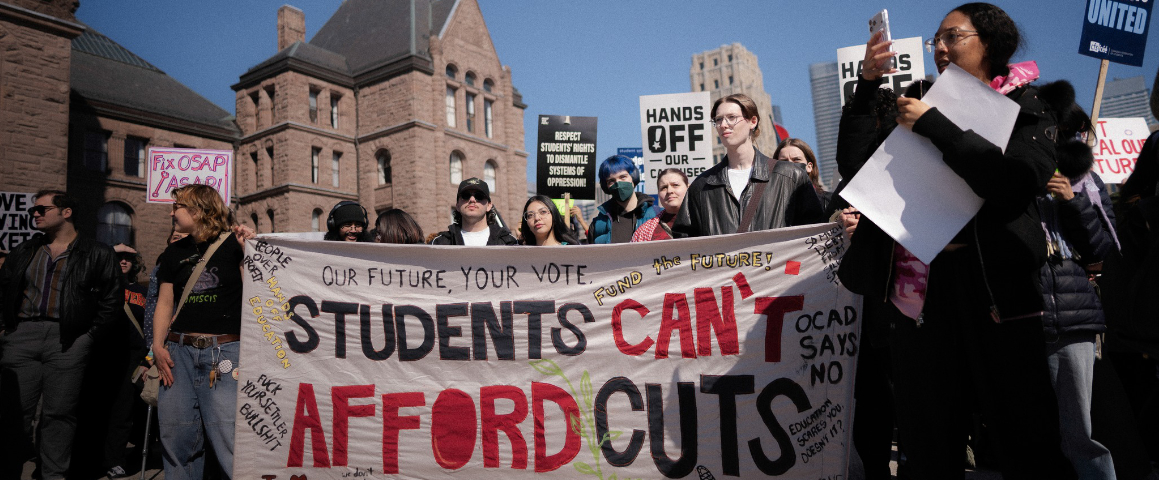
Four thousand protesters crammed into Queen’s Park’s snow-narrowed walkways to fight back against Doug Ford’s latest assault on education – lifting the 2019 tuition freeze for 2-percent annual increases and capping student assistance (OSAP) grants at just 25 percent, forcing students to cover the rest through loans.
The Conservative government claims this will “preserve student access to education for decades to come.” But as Ontario Public Service Employees Union (OPSEU) president JP Hornick told the rally, the only “access” being preserved is that of militarism to Ontario’s public budget. “They always find money for resource extraction, kicking Indigenous people off their land, and militarism. When it comes to education, students are asked to foot the bill.” Condemnation echoed through the park: “Shame!” – shame on the Ontario government, shame on Doug Ford.
Ford’s claim that students are using OSAP to get “basket-weaving” degrees is inaccurate and tone-deaf; it’s also blatantly racist. High schoolers from Etobicoke School of the Arts point out, “basket weaving is an Indigenous practice.” Weavers select materials with care, sustainably harvesting local plants with thanks or prayers to the Earth. The design carries culturally important meaning, represented through the weavers’ careful work.
Students expressed real fears that they will be unable to afford post-secondary education, and they underlined a class distinction between OSAP recipients and the politicians cutting it. “I think it contributes to the fact that Ford was able to cut OSAP without thinking about it, because he’s been in such a privileged position his whole life,” one student explained. “He doesn’t understand that cutting OSAP will cut the number of people who go into healthcare, pharmaceuticals, education – all the other things we need to keep society running. I also don’t think he understands how impactful student loans are, considering the fact that his father funded whatever he wanted to do.”
One student described her family’s class journey across generations. “My grandparents weren’t able to access education. My parents were because they had the privilege of free education [in Brazil]. They were able to give me a life where I don’t have to worry about having food on the table.”
Ben McCarthy, an OPSEU member who grew up in a quarry town, sees Ford’s cuts through the lens of communities left behind. Ford talks about the “brain drain,” but Ben explains this government is driving it.
“The money being taken out of those communities is from people not able to do the skilled work required to make those economies grow. It’s a confusing thing because if you look at per-student funding across the country, Ontario is the most poorly funded.” This remains true despite the Ford government’s promised $6.4 billion to education funding over the next four years. “We’re one of the wealthiest provinces in the nation, and we’re being told that we can’t afford to fund education. I think there’s a false sense of scarcity that this government wants to put around.”
That “false scarcity” hides real abundance – just not for working people. “In 2023-2024, the college system was $2 billion in the black,” Ben said. “From one year to the next, they’re doing record-breaking layoffs – 12,000, maybe the highest in Ontario history.”
This is capitalism in action: COVID was used to justify cuts, then colleges made record profits.
Limiting higher education accessibility, and therefore subsequent job prospects, in rural communities draws a straight line between community poverty and lack of government investment. Governments provide poorer regions with lower quality infrastructure, housing and food options (rural communities are often “food deserts”), and public services like schools, hospitals and transit. As a result, higher education is a privilege for a lucky few, who then leave in droves for the big city and wealthier neighbourhoods.
Uri, a member of the Young Communist League (YCL), sees Ford’s cuts as part of a longer war. “This is a continuation of what Ontario governments have been continuously doing on both sides of the political spectrum since the 90s,” he explained.
Harris’s “Common Sense Revolution” gutted education funding, centralized control over schools, and, as his own education minister was caught on tape admitting, deliberately manufactured a crisis to justify cuts. Ford is simply the next torchbearer of this legacy.
Students also demand an end to the Student Choice Initiative, buried in Ford’s omnibus Bill 33. Uri explained the policy “gives students the ability to opt out of any non-compulsory fees involving clubs or unions, which effectively stripped the operating budget out of anything to do with student life on campus.” If students can’t fund their clubs, their unions or their organising spaces, they can’t fight back.
The March 4 rally was loud, angry and entirely peaceful – until the moment it ended.
As the crowd dispersed, a protester climbed the statue of George Brown and spray-painted “Fuck Ford” on it. Within seconds, police moved in, dragging a young man off the statue and shoving him to the ground. One knelt on his neck and another pressed both knees into his back. They yelled at him to stop resisting as he lay pinned beneath them. Another slapped three separate people – not to restrain them, not to protect anyone, but out of what witnesses later described as “vitriol and anger.”
The Canadian Federation of Students condemned the response as “heavy-handed and disproportionate,” calling it “a clear and calculated attempt at repression, intimidation and fearmongering.” The government always finds money for militarism. Not just abroad but here in Canada as well, against students demanding an education.
Now, with OSAP gutted and tuition rising, students are being asked to pay for a crisis they didn’t create. Ben described it as a case of “false scarcity.” There’s plenty of money, but not for working-class students. It’s for bombs, for billionaires, for the same system that kneels on protesters’ necks when they dare to demand better.
The March 4 rally brought thousands into the streets but a single rally, no matter how loud, won’t win this fight.
“Solidarity feels like a real mechanism,” Ben said. “It begins with one-on-one conversations. Talk about your experiences.” And join your union local, pushing for solidarity with the student movement.
Uri sees this rally as a seed, not a peak. The YCL has made it a priority to help rebuild that movement, getting members involved in their student unions.
The next opportunity is March 24, when another “Hands Off Our Education” rally will gather at Queen’s Park. The task now is to turn that solidarity into something that lasts – an organized, fighting movement that can win.
Support working-class media!
If you found this article useful, please consider donating to People’s Voice or purchasing a subscription so that you get every issue of Canada’s leading socialist publication delivered to your door or inbox!