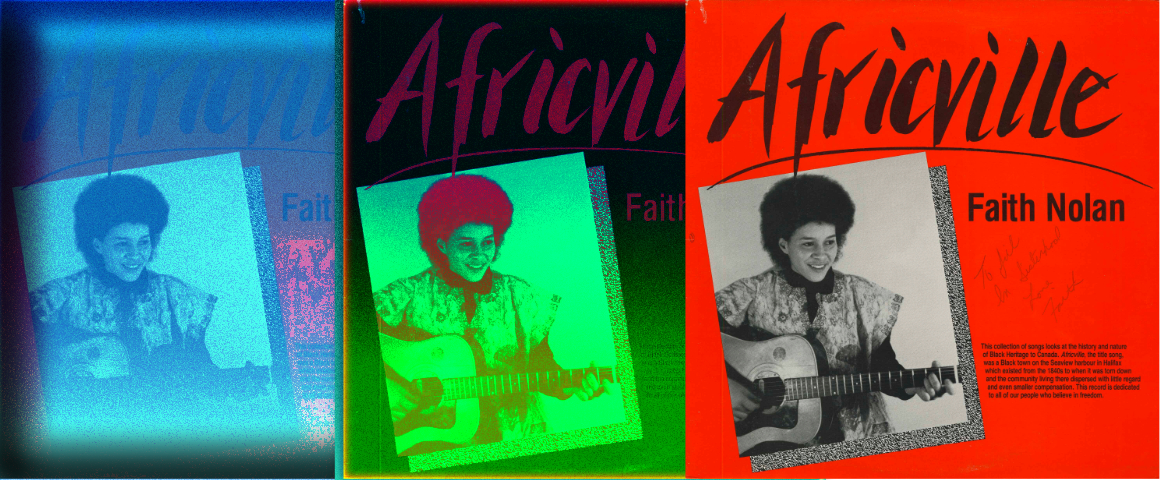
Africville
Faith Nolan
1986
Review by Dave McKee
Forty years ago, Faith Nolan released her debut album, Africville. Recently, she made her catalog available through online streaming services, and that’s a good thing because it makes this album available to a wider and newer audience.
Musically and politically, Africville has earned landmark status with its blend of blues, folk and jazz sounds, powered by Nolan’s powerful vocals and uncompromising lyrical chronicle of the struggles of Black people, and Black women in particular.
The album opens with the title track, which recalls the historic Black community in Halifax that faced profound and intentional neglect from the city for 150 years until it was demolished in 1969, and its residents removed in garbage trucks. It was an act that continues to symbolize systemic anti-Black racism in Canada. Against the superb piano playing of Kingsley Etienne, Nolan, who lived in Africville for a time, sings of former residents whom she encounters and finds struggling with their displacement, isolation and loss of community.
The song’s chorus poses the question, “What happened to Africville?” and sets the perfect stage for rest of the album, which investigates that question from a historical and systemic point of view.
In answering her own question, Nolan sings of Josiah Henson, who was born into slavery in Maryland and escaped to Upper Canada in 1830. He became a leader of the Black community in what is now Ontario, and founded a settlement and trade school at Dawn (near Dresden, another historic Black community) for other people who had escaped slavery. “I got something brand new on my mind,” sings Nolan. “I got freedom to help my people to survive.”
In “Child of Mine,” which also features her engaging and energetic rhythm guitar, she reminds us how deep Black history is in Canada: “When did we come here? Child of mine, child of mine. Three hundred years ago is a long time. Child of mine, child of mine. This is our country – this is our home.” In doing so, she also exposes the terrible conditions – including slavery – under which the Black people who first arrived in this land lived and struggled against.
This writer’s favourite song is the a cappella “Marie Joseph Angelique,” about the Madieran woman who was enslaved in New France in the 1700s and brutally executed after escaping her enslaver, under a charge of arson. The haunting piece showcases Nolan’s amazing vocal powers, which deliver to the listener all the rage and sorrow, despair and hope that Angelique’s life represents.
Bridging the gap between generations, Faith is joined by a children’s choir on “Mary Anne Shadd,” which celebrates the 19th century anti-slavery activist, teacher and lawyer. Shadd was also the first Black woman publisher in North America and the first woman publisher in Canada, establishing the weekly Provincial Freeman newspaper in Windsor in 1853.
Nolan’s harmonica and slide guitar come to life beautifully in “Nobody Knows My People,” which roots the singer’s experience and identity within that of Black people collectively, and challenges us to do the same. “Nobody knows my people, they don’t know about me,” she declares, leaving the listener to consider more fully the relationship between individual and community within our society.
Accompanied by congas and backup singers, Faith invites us all in the upbeat “Emancipation Day” to celebrate the abolition of slavery throughout the British Empire in 1834. “All over Canada, Black people shout: ‘Hallelujah, hallelujah, I’m free now, no doubt.’” This is followed up by the jazzy “Edith Clayton,” which hails the celebrated Nova Scotia basket maker whose technique incorporated those of African and Mi’kmaq women and represents the power of unity. “Weave on, Sister Clayton,” sings Faith. “Stop the war and stop the hatin!”
In a very personal song which makes the connections between gender, racialization and class, and which also bridges the generations of Black experience portrayed on the album, Nolan relates her experience as an industrial worker in “Box Factory.” It’s a heartbreaking song in which she sings of being exhausted after long shifts, of difficult relationships with co-workers, and of the threatening presence of the overbearing boss.
Just as it started, the album ends with a question in the form of the superb “Regina.” It’s about a single mother on welfare who struggles to make ends meet and kills a white man who assaults her. The song asks, “Regina, why did you kill that man?” before diving into realities of poverty, patriarchy, racism and intergenerational trauma from 400 years of slavery. Nolan’s guitar chops really shine in this up-tempo jazzy number, whose militancy perfectly bookends the opening track’s question, “What happened to Africville?” and drives us to understand that the “answer” to Africville lies in struggle.
So much more could be said about Africville. It is a moving album. It recalls an ongoing history of pain and oppression, but also of solidarity and struggle. It’s a powerful listen in the period heading out of Black History Month and into International Women’s Day, but it’s an essential listen any day of the year.
Support working-class media!
If you found this article useful, please consider donating to People’s Voice or purchasing a subscription so that you get every issue of Canada’s leading socialist publication delivered to your door or inbox!
For over 100 years, we have been 100% reader-supported, with no corporate or government funding.