By Cam Scott
On February 5, Prime Minister Mark Carney launched a new automotive initiative before an audience of press and workers at the Martinrea facility in Vaughan, Ontario. In the day’s statement, Carney played a pleasing tune – promising sustainability and independence, and to bring manufacturing back home.
This should interest workers at Martinrea, which maintains at least a dozen operations in the US Midwest. For a single morning then, Carney sounded faintly progressive – fulfilling long-standing and respectable demands for the production of a Canadian electric vehicle, and to distance the industry from a moribund United States. But this investment and its benefits are a small footnote to Carney’s full industrial plan, which is almost wholly purposed at militarization and defence.
Carney’s remarks in Vaughan even anticipate the ability of Canada’s industrial capacity to transform itself during an arms race. “During the Second World War,” Carney said, returning to a favourite theme, “the industry would quickly shift almost entirely to military production, producing more than 800,000 military transport vehicles and 50,000 tanks … These feats were the result of Canadian determination and ingenuity – of an industry that adapted, pivoted and, when necessary, transformed.”
Up in arms
Surely enough, less than two weeks after his modest overtures toward the automotive industry, Carney launched his new Defence Industrial Strategy at a Canadian Aviation Electronics (CAE) facility in Montreal. (CAE is best known as a major supplier of arms to the IDF, even after Ottawa claimed to have ceased shipments to Israel.) This strategy “positions Canadian industry to take advantage of $180 billion in defence procurement opportunities and $290 billion in defence-related capital investment opportunities in Canada over the next 10 years,” pledging to increase defence exports by half and to more than double arms revenues.
Carney had soft-launched this strategy months ago, practicing its rationale aloud in his highly publicized speech at the World Economic Forum in Davos. Once again one reads of how “the international rules-based order is fading,” such that Canada must streamline procurement and invest in aerospace, cybersecurity, rearmament and other apocalyptic trends in order to defend our sovereignty and that of “trusted allies” – the latter of which is notably unnamed amid shifting allegiances. This epithet recurs meaninglessly throughout Carney’s speeches, as if to placate all sides of a budding rivalry.
Here too Carney speaks of Canada’s changing role in a “fractured and darker world,” appealing to a general anxiety in order to push an arms race between declarations of war. This appeal seems to have worked, and for all the obvious insufficiency of this plan before cascading crises of housing and healthcare, the press has largely greeted his announcement as a job-creating strategy rather than a harbinger of deep austerity. In an interview with CTV, for example, Minister of Industry Mélanie Joly boasted that the annual investment in defence was “pretty much three times the national daycare program.”
Beyond this falsely optimistic portrayal, Carney’s moves were celebrated by industrial mavens, no doubt expecting large wealth transfers to their respective firms or sectors. The Canadian Association of Defence and Security Industries praised Carney’s “clear, accountable vision,” while CAE executive Matt Bromberg crowed over the rapid acceleration of high-tech production. And while first statements largely focused on finished goods and personnel, the Canadian Chamber of Commerce wrote to commend the government on its determination to supply allies with “defence-critical” minerals, clearly anticipating a deregulatory boon to mining companies.
According to Heather Exner-Pirot, Director of Energy, Natural Resources and Environment at the Macdonald-Laurier Institute, Canada’s abundance of critical minerals makes for a distinct advantage within NATO supply chains. In her words, “Canada is well placed to be an arsenal of democracy on the raw materials front” – particularly in the case of a deepening trade war with China, which overwhelmingly commands the market in rare earth commodities. And although Carney’s nearly apolitical pragmatism seems to have turned a page in Canada-China relations, even anticipating joint investments in electric vehicles, this remark from the MLI is an important reminder that, particularly in the world portrayed by Carney after Davos, there are no allies after all – only passing interests.
Middling power
In the same breath as he launched the Defence Industrial Strategy, Carney spoke of his intent to “broker a bridge” between the European Union and the Comprehensive and Progressive Agreement for Trans-Pacific Partnership (CPTPP). This ambition was widely interpreted as an oblique provocation of the US, whose withdrawal from the earlier Trans-Pacific Partnership Agreement precipitated the formation of the CPTPP in the first place. Given China’s past interest in the CPTPP, as well as European trade deficits with China, Carney’s moves have the potential to substantially exclude the US from all manner of future trade deals.
This would be quite the flex on behalf of a “middle power” bloc were it so simple. But many defence industry commentators have puzzled over the fine print of Carney’s imperative to “Buy Canadian,” noticing the extent of North-South corporate integration and the uncertain criteria by which the “Build–Partner–Buy” framework determines when to work with unspecified allies to fill contracts. As USMCA negotiations proceed apace and the US Supreme Court rules against Trump’s tariffs, it’s likely better to think of Carney’s market diplomacy as an expensive bluff, anticipating continental reintegration and on preferential terms.
For all of Carney’s emphasis on building a sovereign industrial military, he hasn’t yet advanced a foreign policy separate from US priorities. Since the start of 2026 alone, Canada has been a perfect accomplice to US aggression throughout Latin America and the Caribbean. The only reason why Canada isn’t on Trump’s nakedly imperialist “Board of Peace” is because of Carney’s “you-can’t-fire-me-I-quit” fit of eloquence in Davos last month. Plainly, there’s no indication at the level of policy that Carney intends to embark upon a sovereign, let alone dissenting, path among familiar powers.
In fact, Canada’s defence-based accumulation strategy is not so defiant or singular. On February 6, Trump announced his own “America First Arms Transfer Strategy,” intending to support domestic reindustrialization through US-based supply chains. And as both Canada and the US only pretend to divest from one another, the European Parliament is days away from publishing its own Industrial Accelerator Act (IAA), obliging made-in-Europe procurement in key sectors that compete with China. The IAA has little to do with defence by comparison, but here too we can see how industrial protectionism works to ratchet up capitalist rivalry on a global scale.
In Carney’s own language, “strategic autonomy” means precisely this: having the strength to be a “partner of choice” among imperial powers. At Davos, Carney asked the world to judge Canada not by “the strength of our values, but the value of our strength” – acting both diplomat and dealer as he boasted of rapidly deregulating and diversified opportunities in energy and minerals, finance and logistics, arms and AI. This newly unveiled strategy confirms not just the cynicism of Mark Carney’s vision, but the sheer ambition. And at this point, the new order that he promises feels far more dangerous than what we leave behind.
The fight ahead
But Carney’s sleek politics have laid the groundwork for a massive fightback, consolidating as he speaks. So long as the extractive toll of Liberal strategy runs afoul of Indigenous rights and title, new modes of land-based resistance are assured, as are new solidarities. And as Carney’s gutting of government services provokes the public sector, labour is preparing a confrontation of its own.
In Carney’s lip service to the auto workers of Vaughan, we can hear the outline of a program for true sovereignty, only as farce. As US hegemony and its power blocs come to pieces, we should as forcefully propose a vision of Canadian independence based on public ownership and full employment, sustainable development and multilateral fair trade, and a foreign policy of peace and disarmament.
This is precisely what the Canadian Labour Congress needs to be discussing at its convention in Winnipeg in May. In preparation for that gathering, union activists involved with the Action Caucus are promoting resolutions calling on the CLC to engage affiliates, provincial federations and labour councils in a cross-country campaign to mobilize all workers – including those in non-affiliated unions and unorganized workers – in the struggle for trade policies that truly put workers first. Such a campaign would call for Canada to get out of corporate trade deals like the USMCA and to pursue mutually beneficial trade policies with the world, to create well-paid value-added jobs outside of global trends toward militarization, and to respect Indigenous rights and environmental protections at every stage of development.
It may be Carney’s specialty to see the private opportunity in rupture; but it’s ours to imagine something wholly different. The Defence Industrial Strategy is a massive misallocation of resources that will impact almost every area of life in Canada, but Carney’s hubris has prepared a popular opposition of unseen scale – and all the cheerful reporting in the world can’t stop the year of movement ahead. The CLC and its affiliates, including workers everywhere, must take the lead in this fight.
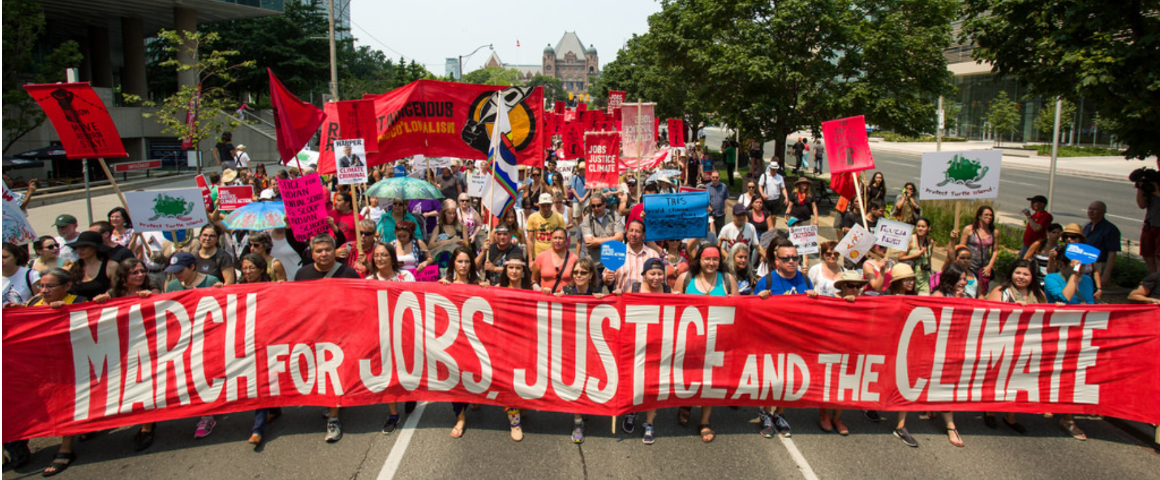
[Photo of 2015 Toronto march for jobs and climate justice: Robert van Waarden / Project Survival]
Support working-class media!
If you found this article useful, please consider donating to People’s Voice or purchasing a subscription so that you get every issue of Canada’s leading socialist publication delivered to your door or inbox!
For over 100 years, we have been 100% reader-supported, with no corporate or government funding.