By Cam Scott
Less than one year into his reign as Prime Minister, Mark Carney is poised to become Canada’s greatest-ever spender on defence – surpassing PM Pierre Trudeau’s record of 1970, which directed 13.3 percent of all federal spending to the military.
This dangerous largesse follows NATO’s Defence Investment Pledge, obliging member countries to spend 2 percent of their GDP (and 5 percent by 2035) “to meet the needs of its armed forces, those of Allies or of the Alliance.” This is an unprecedented gift of public wealth to an increasingly unstable military bloc, and however confidently Carney attempts to sell this budget line as a boon to working people, it’s apparent that the Liberal Party’s “nation-building” budget will only benefit multinational corporations.
As the world inches closer to total war, this budget poses an existential threat and has been opposed as such by all peace-loving people. But even the Conservative Party, whose foreign policy is indiscernible from that of the Liberals, has started to balk at Carney’s math. Just what accounts for this split in capitalist priorities, and who favours Carney’s complete identification of industrial policy with national “defence?”
Military Keynesianism
In its clearest version, Carney’s “Canada Strong” blueprint draws from the dubious record of military Keynesianism – the belief that increased military spending ought to stimulate the economy and stanch unemployment, adapted from the thought of economist John Maynard Keynes.
Today this term is primarily used by skeptics, where the majority of economists reject the benefits of war budgets in the longer term. Marxist critics have long understood military spending as an imperialist crisis strategy which can only enrich parasitic financial interests as it postpones an inevitable crash.
Even so, Carney’s recent moves have repopularized the premise among policy analysts, several of whom seem determined to credit the former banker with a cure-all solution to an escalating trade war and a sharpening class war at once. According to Abbas Qaidari, a security specialist writing for the Institute for Research on Public Policy, Carney has successfully reframed “military expenditure not as an exception to welfare economics but as an extension of it. In this narrative the state’s coercive arm is reconciled with its redistributive one – a subtle but profound shift in Canada’s economic self-conception.”
This claim is impossible to reconcile with the austerity ahead. Carney’s “Canada Strong” budget promises $60 billion in cuts to federal spending in the next five years, axing nearly 40,000 public service jobs and inflicting deep annual cuts to Health Canada, the Canadian Food Inspection Agency, the Public Health Agency of Canada and more, with foreseeably life-threatening effects. Carney soft-launched his defence strategy amid talk of necessary “sacrifice,” and even as his office boasts of wages outpacing inflation and falling rates of unemployment, there is nothing in his martial plan to secure these outcomes.
Military spending can stave off recession in the short term, but defence is not the magic bullet some perceive. Leaving aside its wartime variant, there are deeper problems with the Keynesian approach, which fails to distinguish between productive and unproductive investment and simply supposes spending itself to grow the economy. There’s a level of analysis on which this can be observed, but from a Marxist standpoint, capital projects cannot produce value per se. Rather, this investment must be afforded from surplus elsewhere created – namely by labour – and subsequently appropriated by the state as tax, or borrowed.
Public spending simply administers the value in production, such that state projects are always paid for by workers, and at expense of capitalist profits, rent and interest. This necessary relationship is obscured in many ways including the borrowing and recycling of funds, and by the wage relation itself – such that liberal policy makers perceive the state to advance opportunity and resources to labour from on high. Likewise, and in spite of appearances, state “welfare” initiatives can only ever return to workers a portion of the wealth that they generate as a security, never as a handout.
Now, just as public works and military expansion alike must be afforded from the proceeds of labour rather than paid for from thin air, the counter-recessionary benefit of “Keynesian” stimulus only advances the value of labour as yet unperformed. As a rule, government spending only anticipates production by financial means, racing ahead of what can be raised from taxation by borrowing and reinvestment.
At the end of the day, government debts are either borne by the capitalist class which pays taxes out of profit, or by working people from their wages (which, being administered by the capitalist class, amounts to the same thing). Social democracy and neoliberalism share a monetary perspective that reduces the class struggle to a contest over the terms by which this public debt is gradually serviced.
Working people should be concerned with the absence of democratic control over this would-be public wealth. But in this struggle, we can also diagnose political rivalries within the ruling class – where Carney’s financial pedigree aligns him with those institutions and investors apt to profit from government debt, while the risk-averse and deficit-wary right are more typically concerned with industrial margins and nearer profits.
Ruling class rivalries
This tension has re-shaped the Conservative Party from within in recent years. Stephen Harper’s own enormous stimulus packages were characterized by critics to his economic right as a “total embrace of Keynesianism,” whether or not they were obliged by the global financial crisis. While Harper defended his stimulus plan, which involved bailouts and tax breaks alongside infrastructural investment, he lost significant support among deficit-watchers and smaller companies.
The current Conservative Party is in many respects a revolt against Stephen Harper’s assent to financial logic in the early 2000s, having been recomposed from neoliberalism’s many discontents. This new Conservative movement has found its “grassroots” aspect in a coalition of small to medium business, though it retains its base in Alberta’s resource sector. This helps explain Pierre Poilievre’s phony workerism: it isn’t that the Tories mean to defend workers as such; rather, they represent those industries that require traditional labour roles for surplus value extraction.
Today, it seems that Mark Carney has inherited the mandate of the Harper era – namely, to transform a potential economic crisis into an opportunity for sweeping privatization by way of public spending. And like Harper before him, Carney’s enormous contributions to the energy sector can’t seem to quell criticism of excessive spending from those still further to his right.
In this moment of apparent consensus on national development among the major parties, it’s important to mark differences between the short term and sectoral goals of different sections of the ruling class and their political representatives. This undertaking could start with a question: has the Liberal arms budget actually “neutralized opposition from both deficit hawks and social democrats,” as Qaidari claims?
We can dispense with the latter claim quickly, as there’s hardly a social democrat left standing in this parliament. NDP leader Don Davies noted the budget’s reversal on climate change, its shorting of healthcare, and its slight to Indigenous rights; but he also abstained from voting on its passage to avoid another election.
More representatively, almost the entirety of Canada’s union leadership opposes the war budget, and rank-and-file resolutions overwhelmingly condemn the foreign policy that it pursues. “This is not the same as meaningful, ongoing investment in universal, high-quality public services,” says Shawn Campbell, President of the Confederation of Canadian Unions; while CUPE’s breakdown of the budget concludes that “the Liberals expect our members, friends and neighbours to swallow austerity while they give handouts to the rich and big corporations.” Labour is far from placated, and the political fortunes of the NDP depend entirely on whether or not their bureaucrats are willing to fight for this presumed base.
What of Carney’s official opposition? Even as the Liberals giftwrap many longstanding Conservative demands, Tories continue to sound the alarm at Carney’s projected $78.3 billion deficit. Poilievre initially resisted the NATO spending target, framing it as “an inflationary burden” to taxpayers, and continues to balk at Carney’s promise to spend 5 percent of GDP on core military capabilities by 2035. James Bezan, Conservative Shadow Minister for National Defence, is hardly more enthusiastic, voicing his proud opposition to the budget amid concerns over a soaring cost of living and unclear capital investments.
Here too Bezan sounds to the left of Carney: “We also have to remember that the big deficits and the great big debt we have, which is now $1.35 trillion, are money borrowed from bankers and bondholders. It is money that should be in the hands of Canadians. It is not going towards investing in more doctors and nurses in our health care system,” he told the House last November.
This is hardly a serious defence of public healthcare, which would also oblige deficits. Bezan is a cattle farmer with ample land, and his Manitoba riding coincides with a prairie steel manufacturing hub. Once again, these demographics are more broadly descriptive of the base of the Conservative Party, which tends to represent domestic capital and regional monopolies more so than financial interests, particularly since the reconsolidation of the party around Alberta’s single-industry oil economy.
This sector-based bias recommends a different style of crisis management than that of the Liberal Party, where those sections of the ruling class directly concerned with commodity production will prefer quicker returns and eschew public spending, while those sections closer to bank capital will tend to financial engineering and have a higher tolerance for longer term and speculative risk.
This, of course, is a simplification – the fact remains that all of Canada’s major banks are enmeshed with Western energy, and the identity of finance and industrial capital is structurally assured. But narrow advocacy for one or another sector of wealth is in the rivalrous nature of capitalism, and only reflected by its party affiliations.
Our own best customer
As class-blind Keynesian wisdom would have it, any deficit is owed by the country to itself – hence the certainty of Carney’s boast to Canada that “we will be our own best customer.” This, in a nutshell, is the plan of (military) Keynesianism: to stimulate aggregate demand across the economy, in the certainty that defence spending will correspond to industrial contracts and research grants, which will correspond to jobs, which will correspond to greater effective demand and expanded consumer markets.
As discussed, this is a capitalist subsidy that moves through the related fortunes of working people. But how accurately, by the Liberal account, will Canada’s investment in a global arms race oblige these domestic industrial outcomes? And should this massive arms budget stay in Canada, what jobs and incomes are expected to flow from this expenditure?
Stephen Fuhr, Canada’s first-ever Secretary of State for Defence Procurement, boasted that “we’re not going to be spending 75 cents of our dollar south; we’ll be amortizing that money out in Canada where we can, and then spending it in other places where we have to,” presumably looking across the Atlantic.
Even so, many of the largest defence contractors operating in Canada are still subsidiaries of US and some European corporations. This is not to underrate the global impact of homegrown monopolies such as Canadian Aviation Electronics, who continue to partner with major Israeli weapons companies. In any case, the integration of Canada’s defence industries into global supply chains ensures that procurement funds will chiefly flow abroad.
Moreover, Procurement Minister Joël Lightbound has clarified that foreign firms will qualify as domestic suppliers under the new Buy Canadian policy, provided that they have a physical location in Canada and are registered with the Canada Revenue Agency. How does this clear reintegration with US capitals interact with Carney’s bluster?
Canada’s Industrial and Technological Benefits Policy (ITB) obliges recipients of defence contracts to contribute an equivalent value back to the national economy, which industry cheerleaders frame as a straightforward investment in Canadian jobs. In practice, however, this requirement is nothing of the sort. Government tables show just how far each multinational contractor remains from their mandated goal, depicting a range of discretionary contributions to boutique tech sectors instead of returning employment.
At the invitation of the ITB, companies such as General Dynamics, Raytheon and Lockheed Martin launder their respective images by funding research in AI or distributing contracts for piecework across smaller fabrication plants, to little impact. Never mind the classic “guns versus butter” dilemma – what kind of an industrial strategy permits foreign capitals to litter funds as they are wont to do, and submit receipts later?
Under the newly created Regional Defence Investment Initiative (RDII), small-to-medium enterprises (SMEs) are encouraged to apply to local development agencies for funding to adapt existing technologies for military use, or to connect with major defence contractors and vendors. This purports to plug gaps in an investor framework that privileges monopolies, where 90 percent of firms supplying Canada’s defence industry are SMEs.
The RDII may sound like an employment strategy of sorts, but the reskilling it envisions threatens the very opposite. It’s well-established by now that the swelling budgets of the military-industrial complex are absorbed by high-paying tech sector contracts rather than in production, and the diversion of research to weaponry stalls job creation in more sustainable industries.
Essentially, this $357.7 million professional development program envisions a country of subsidiarized “mom-and-pop” arms manufacturers, yoking regional fortunes to fatal global trends toward surveillance and war. Today, business consultants urge “defence-curious” companies to seek contracts under the Buy Canadian Policy, while government bodies from Pacific Economic Development Canada to the Atlantic Canada Opportunities Agency boast of their region’s unique advantages before investors.
This rush to market coincides with a moment of kaleidoscopic uncertainty for NATO members, in which Carney is playing all sides. And even as his new investments hasten greater integration with the NATO bloc, they as clearly mean to prop up a Canadian bourgeoisie over-against its unstable US counterpart, and to leverage Canada’s national resources amid new global rivalries.
But as Carney’s plan relies upon intensified domestic competition to secure Canada’s advantage over US firms, there’s no way that his military stimulus will reach workers in any meaningful sense – nor should we accept an employment strategy based on deepening Canadian imperialism were that the case. As the record of Keynesian stimulus and its wartime counterpart shows, this is a transfer of wealth from rather than to the working class, and it must be narrated as such. From the proper vantage, Carney’s vaunted attempts at class compromise look far more like a renewal of class war.
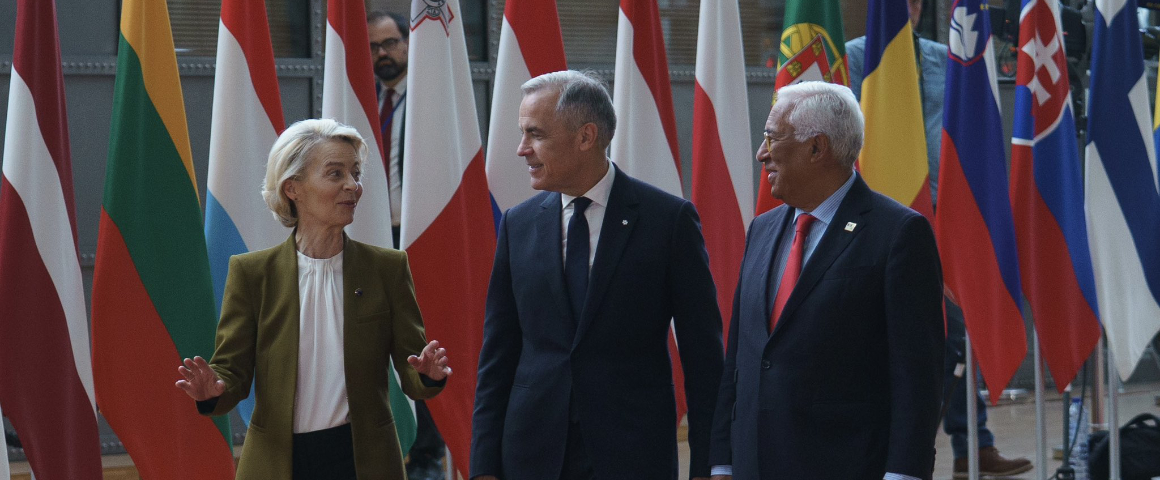
[Photo: Mark Carney talks military economy with EU leaders]
Support working-class media!
If you found this article useful, please consider donating to People’s Voice or purchasing a subscription so that you get every issue of Canada’s leading socialist publication delivered to your door or inbox!
For over 100 years, we have been 100% reader-supported, with no corporate or government funding.