By Owen Schalk
From November 12 to 19, I travelled to China with a delegation of Canadian journalists organized by the Chinese embassy in Ottawa. Our delegation visited Beijing and Xinjiang Uyghur Autonomous Region, where we met with representatives from government institutions including the Ministry of Commerce (MOFCOM) and people’s organizations like the Chinese People’s Institute for Foreign Affairs (CPIFA).
The purpose of the delegation was to encourage people-to-people diplomacy and to showcase China’s developmental successes to a Canadian audience. Our delegation spoke with Chinese trade and policy experts about the future of Canada-China relations, and with figures in local media about the mainstream narratives around China that prevail in Canada. We witnessed cutting-edge technological developments in the field of robotics and artificial intelligence. Perhaps most impressive, however, was our first-hand glimpse into China’s centralized, long-term approach to carbon emissions reduction.
The climate crisis represents the gravest challenge to life as we know it. The International Court of Justice has labelled climate change “an existential problem of planetary proportions that imperils all forms of life and the very health of our planet.” According to the court, failure to protect the climate system constitutes “an internationally wrongful act.” Climate-related hazards endanger millions each year, primarily in the Global South, but the Western world is not safe either, as last year’s catastrophic wildfires in western Canada revealed. Of course, the potentially calamitous climate situation is primarily the result of Western capitalist industrialization – from 1850 to 2015, the countries of North America and Europe (plus Australia, New Zealand, Japan and Israel) were responsible for 92 percent of the world’s excess carbon emissions.
Although China is now the world’s largest emitter, it is not even close to being the largest historical emitter. And in terms of per capita emissions, China falls far behind the US and Canada.
China’s recent gains in emissions reduction contrast sharply with the US and Canada. Over the last 18 months, China’s emissions have been flat or falling, indicating a historic emissions slowdown; by contrast, Canada’s recent emissions reduction gains have stalled, while US emissions are increasing. The Trump administration has even made moves to stop collecting emissions data from the country’s largest polluters.
China’s emissions reductions gains are the result of a centralized planning process guided by the Communist Party. Five-year plans are the backbone of China’s development; they are proposed by the Central Committee, drafted by the State Council, and approved by the National People’s Congress (NPC). Each five-year plan covers “a broad range of fields including the economy, society, technology, ecology and culture,” and their stated goal is transforming China into “a modern socialist nation.” To this end, the five-year plans set precise development goals that the entire system aggressively mobilizes to achieve.
China’s 15th Five-Year Plan (2026-2030) sets out the government’s “dual carbon” goals: peaking carbon dioxide emissions before 2030, and reaching carbon neutrality before 2060. While national in scope, the five-year plans also provide the framework in which provincial- and city-level regions craft their own development plans, which aim to address local issues while serving the country-wide development plan agreed by the NPC, including decarbonization.
In Beijing, our delegation visited a Xiaomi electric vehicle factory, which produced 400,000 EVs between March 2024 and September 2025. Xiaomi is one of several huge Chinese companies involved in the production of such vehicles; others include BYD, Wuling, Geely and Li Auto. Undoubtedly, private capital has played a large role in China’s energy transition, an approach that comes with serious risks for any socialist country. At the same time, it is clear that private capital in China is not holding back China’s energy transition as in the West, but is compelled to shape its goals to fit with the five-year plans developed by the Communist Party.
While exploring Beijing, I was instantly struck by the high number of EVs on the road. The green license plates of EVs equaled or even outnumbered the blue license plates of gas-powered cars. Indeed, China’s EV industry is another important component of its emissions reduction strategy; transport fuel emissions dropped 5 percent in the third quarter of 2025, owing to the rapid production and adoption of EVs. Public transportation in Beijing and many other cities is overwhelmingly electric.
Today China accounts for almost 60 percent of the world’s renewable energy capacity. A sizeable and growing portion of China’s domestic electricity production comes from renewables: from 27 percent in 2020 to 35 percent today. China contributes 50 percent of global solar capacity, while manufacturing 80 percent of the world’s solar panels. In 2025, China “added about 240 gigawatts (GW) of solar and 61 GW of wind capacity in the first nine months alone, setting a new global record.”
Taken together, these developmental strides have allowed China to meet rising energy demands without increasing fossil fuel use. They have also made China a global renewables leader. China now exports enormous amounts of green tech and clean energy around the world, particularly to countries in the Global South.
Additionally, China is the world’s largest producer of wind energy. In 2023, China accounted for two-thirds of all newly installed wind energy projects in the world. Xinjiang, another destination on our trip, is a central hub of China’s renewable energy industry. The Uyghur Autonomous Region is developing rapidly; in 2024 alone, Xinjiang’s energy production increased by over 30 percent, with wind power generation growing by 17 percent and solar generation by 66 percent. Today, Xinjiang accounts for over 20 percent of the country’s wind energy reserves.
In Burqin County, Xinjiang, our delegation visited two monumental energy projects: a wind farm that produces enough electricity to power hundreds of thousands of homes, and the Burqin Hydropower Station, owned by China’s Nuclear Group, which will in fact combine water, wind and solar into a major energy storage facility which will become operational in 2030. The state-owned company overseeing the Burqin Hydropower Station’s construction emphasizes that the station is a key project set up under the 14th Five-Year Plan, as part of the National Medium- and Long-Term Development Plan for Pumped Storage (2021-2035).
In Canada, the anarchy of capitalist production, and the prioritization of profit over human and ecological needs, has prevented the creation of any rational, planned framework for energy transition. Indeed, the Mark Carney government is doubling down on fossil fuels, as shown by Ottawa’s recent energy deal with Alberta, at a time when the state should be mobilized to develop renewable energy alternatives.
At the same time, Ottawa has answered Washington’s call for increased military spending, devoting $150 billion annually to militarization, which will inevitably generate an enormous amount of planet-heating pollution. As Scientists for Global Responsibility noted in a report from September, “It is extremely difficult to see how the current and planned military spending increases can be reconciled with the transformative action necessary to prevent dangerous climate change.”
Compared to China’s centralized, state-led, long-term approach to decarbonization, the Canadian government is lacking, to say the least. While China’s planned system has made the country a global leader in renewable energy production, the Canadian capitalist model, defined by shortsighted profiteering and increased militarization, has committed Canada to emissions reduction failure.
Only under socialism – with its long-term, scientific organization of production and development, freed from narrow-minded profiteering, serving the interests of the majority – can Canada abandon this regressive course and fully commit itself to the fight for an ecologically just and sustainable future.
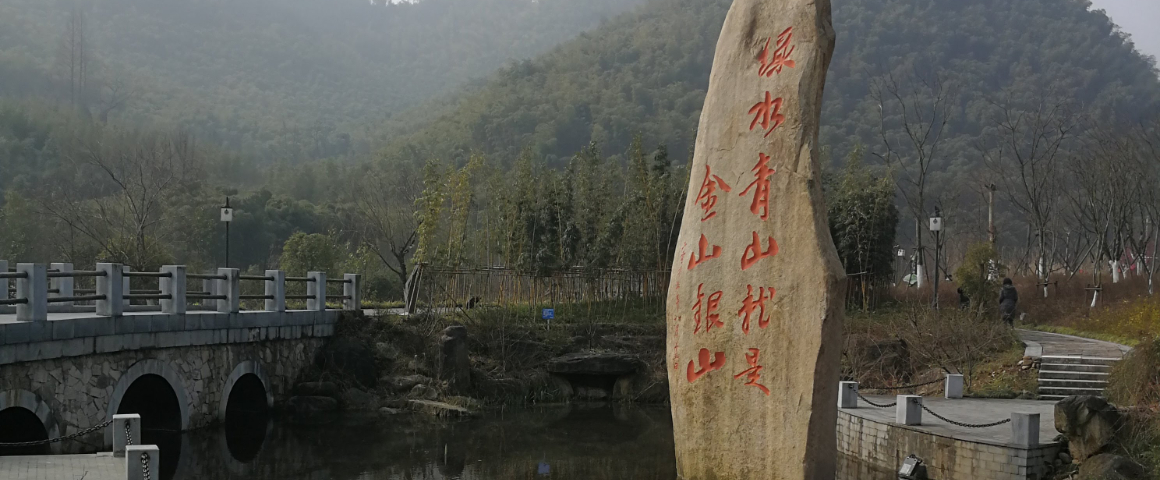
[Text in photo is Xi Jinping’s environmental slogan: “clear waters and green mountains are as valuable as gold and silver mountains”]
Support working-class media!
If you found this article useful, please consider donating to People’s Voice or purchasing a subscription so that you get every issue of Canada’s leading socialist publication delivered to your door or inbox!
For over 100 years, we have been 100% reader-supported, with no corporate or government funding.