

By Stéphane Doucet
From restaurant meals and weekly groceries to the latest online purchase, the parcel at our doorstep has become a central feature of modern life in Canada. This dramatic shift towards home delivery – supercharged in the last decade – is often celebrated as a triumph of convenience and market choice.
But beneath the surface of this booming industry lies a stark and troubling contradiction: as our reliance on delivery services skyrockets, the country’s public postal service is being pushed into a manufactured financial crisis.
The decline of Canada Post is not a natural market outcome, but the direct result of allowing private corporations to cannibalize its most profitable services. This model of fragmented, for-profit competition is not only wasteful but actively undermines a vital public institution. The solution lies in reclaiming home delivery as a public monopoly for the benefit of all.
People across Canada rely on home delivery for a wide variety of things, and in increasing numbers. In 2022, 27 million people in Canada (69 percent of the population) used online shopping to fulfill some of their needs; Statistics Canada has reported an increase of 19 percent in the numbers of people employed in delivery services between 2022 and 2023, reaching almost 300 000 workers in the sector across the country.
Canada Post is a public service connecting very distant and sometimes isolated communities across the country, and as such, shouldn’t be subject to market-based metrics of profitability. In fact, it’s quite the opposite: we expect hospitals and schools to cost money, and that this cost be borne primarily through the taxation of corporate profits and people with higher incomes.
The manufactured financial crisis is in large part due to the encroachment of large corporations into the sector where Canada Post should have a true public monopoly. This encroachment costs the public postal service much of its most lucrative business. Rather than “increasing efficiency,” this form of competition is a great example of how capitalist markets are wasteful and inefficient. A rational and planned approach to the economy, one rooted in people’s needs and environmental sustainability, could save resources and deliver better services at a lower cost.
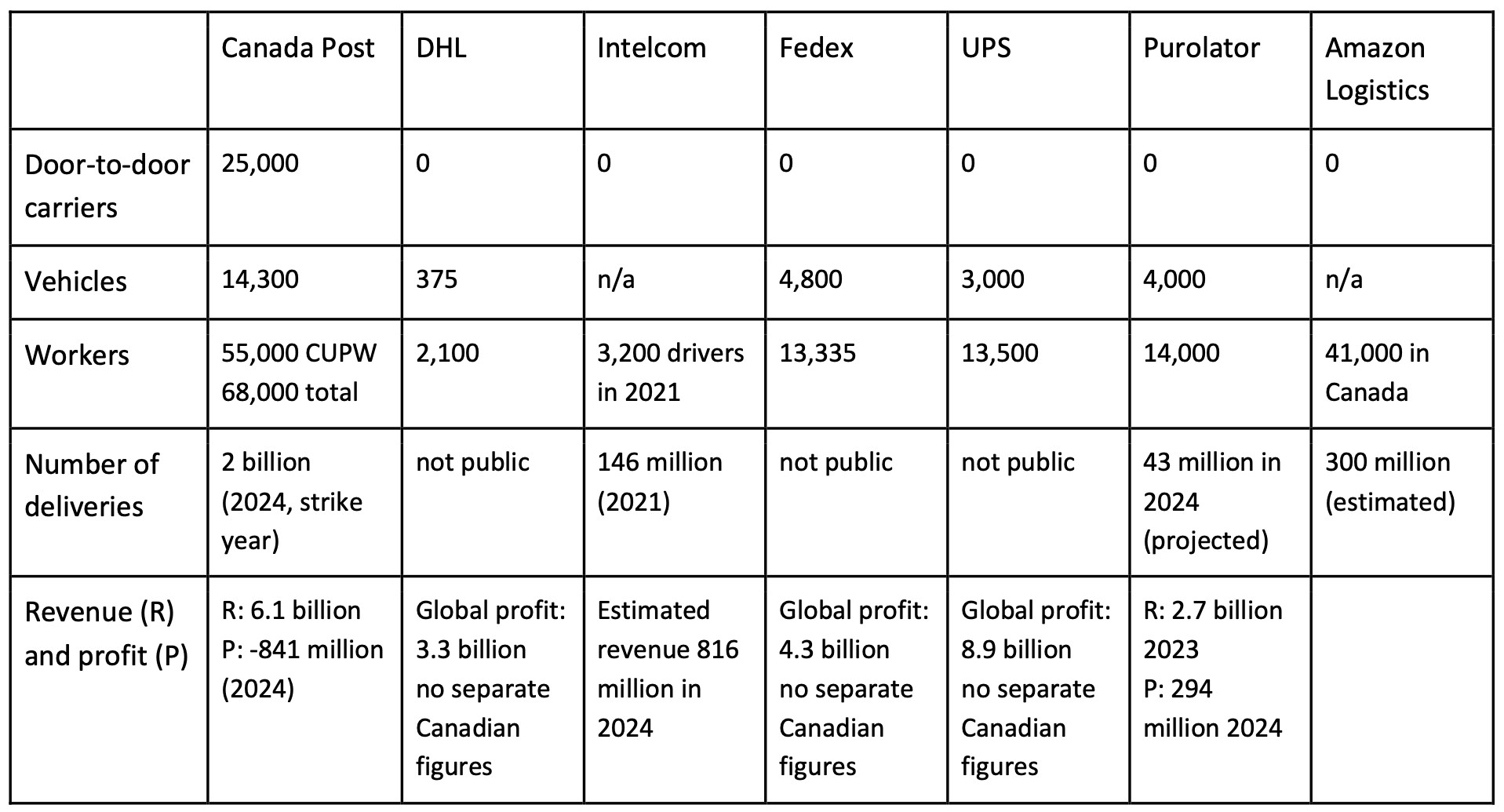
The table below compares a handful of the biggest players in mail and parcel delivery in Canada. We can see right away that Canada Post is the only company providing door-to-door delivery, employing some 25,000 mail carriers. The rest of the companies don’t provide this service as it isn’t profitable. Canada Post owns just under half of the combined delivery fleets of the listed companies, keeping in mind that Intelcom doesn’t disclose the size of its fleet, and employed upwards of 3,200 drivers almost 5 years ago (the last available numbers).
For the most part, all of the private companies listed confine their operations to a limited area, primarily in big and medium-sized cities and towns. On the other hand, Canada Post has a mandate to provide country-wide service.
In terms of workforce, Canada Post employs just over half of the combined number employed across the six companies. Looking at the publicly available figures for revenue and profits, it is clear that private corporations are making plenty of money. In an effort to support its argument for cutting services, Canada Post management notes that the public service delivered 62 percent of parcels shipped in Canada in 2019, versus only 24 percent in 2024. Without a doubt, the private sector has gobbled up a massive amount of Canada Post’s market share, and revenue, in that regard.
For the discussion about further privatization and cutting of services at Canada Post, the bottom row in the table – revenue and profit – is the most important. While public services aren’t meant to generate money – as part of the social wage, they are a way to develop the country’s human, economic and social potential – private transport and logistics monopolies view Canada Post as a competitor which is able to offer lower prices and takes part of their market share. They want to increase the billions they already rack up – this includes Purolator, which is 91-percent owned by Canada Post. Another aspect of this is the capitalist drive to lower the social wage and the cost of public services.
These billions for the private sector are the result of exploitation of very low-waged and often non-union delivery workers in the private sector, as well as exorbitant prices charged to the consumer, and come at the expense of the public postal service’s financial stability. Companies like Intelcom deliver packages from Amazon which should be delivered by Canada Post – if they were, it would generate hundreds of millions of dollars for the public service and sustain thousands of good-paying union jobs.
Scores of competing delivery services in the same territory makes for a tremendously wasteful and inefficient system for providing the service of home delivery. Having a dozen trucks deliver along very similar routes leads to higher prices, congestion and increased pollution. A public monopoly would cut down on all these very real social ills.
The rise in home delivery and the resulting economic expansion of the sector indicates clearly that capitalism no longer has the capacity to improve people’s lives. The drive for profit runs counter to the needs of people and the planet. The struggle to maintain and expand Canada Post isn’t a revolutionary struggle, but it can help people understand general, historical dynamics at play in the economy. Having a clearer sense of these dynamics can only help working people confront the larger political problems they face today, which will only get more serious in the years ahead.
Support working-class media!
If you found this article useful, please consider donating to People’s Voice or purchasing a subscription so that you get every issue of Canada’s leading socialist publication delivered to your door or inbox!
For over 100 years, we have been 100% reader-supported, with no corporate or government funding.