PV Labour Bureau
If asked to sum up the recent Ontario Federation of Labour convention in one word, a lot of delegates would probably say “divided.” From procedural floor fights over the OFL officer elections, to accusations of racism and bullying in equity caucus meetings, to personal attacks and tears during internal union discussions, to barbs traded right on the convention floor, the evidence of division was widespread. Even before the convention was called to order, in-fighting was spilling out into the open within union meetings and on social media.
But another word that many delegates might use to describe the convention is “hungry,” meaning hungry for labour unity in action to defend working people’s rights and gains. This mood was clearly apparent in delegates’ strong support for amendments calling for a unified strike support strategy, a Worker’s Bill of Rights, nationalization of the steel and auto industries, and for the OFL to mobilize an Ontario Common Front to unite unions and social movements around a progressive People’s Platform.
The developing contours of such an approach were already visible before the convention started, when multiple affiliates in both the private and public sectors submitted resolutions focused on political unity, action and the development of a political program which would deliver for working people.
Roots of division: crisis in social democracy
The divisions which were so apparent at this convention are a reflection of broader fissures in a labour movement struggling to find its way. Against a backdrop of sustained and escalating attacks against working people’s living standards, as well as labour and democratic rights, the labour leadership in Ontario has largely been unable to articulate a path forward. Overwhelmingly, this is a result of the leadership’s reliance on social democratic ideology, which tends to eschew mass mobilization in favour of electoral campaigns, and supplants radical demands with timid and incremental reforms that maintain “labour peace.”
This crisis in social democracy has been apparent for many years, finding reflection in both the decimation of the NDP at the federal level and the meekness and opportunism of their provincial counterparts.
In this context, it is easier to understand why the question of political vision was notably absent from the debates around OFL leadership. While the two main camps made vague gestures to political strikes against Doug Ford’s Conservative government, neither presented a proposal for how their leadership might orient the OFL or the broader movement toward such a struggle. Both offered the status quo governance they had just carried out during their last term. Instead of a political battle, the election fight was dominated by petty, personal attacks and procedural chicanery.
The political vacuum created by the crisis in social democracy opens the labour movement to penetration by right-wing opportunism – evidenced by increased inroads by the Liberal and even Conservative parties – and sectarianism represented by those who solely promote the most radical sounding slogans and tactics while isolating the genuine left wing of the labour movement.
In the OFL convention, the officer election provided space for maneuvering by the right wing, particularly a faction within OPSEU, currently battling within their own executive board, who ran a surprise floor challenge in the elections for president and executive vice-president. Out of this, first time OFL delegate Michael Hamilton – whose thoroughly de-politicized election message was simply that he was the candidate for delegates who reject the election fighting on the floor – won the executive vice-president position.
Glimmers of a fighting labour movement
At the same time that the crisis in social democracy allows room for opportunistic and sectarian views, it also opens more space for genuinely left-wing politics in the labour movement, something which is badly needed. A fighting labour movement focused on independent political action is necessary, but it can only be built through concrete class struggle.
Glimmers of such a movement have been visible in the past several years, as militant strike activity has been seen in every sector of Ontario – indeed, in every province in the country – and the labour movement makes gains in the workplace and in the public sphere for the first time in decades. This same developing tendency was visible on the convention floor, with the discourse around a divided leadership being repeatedly undercut by growing forces within the labour movement who want a political program focused on class struggle — and are willing to fight to get it.
Particular highlights included the resolutions for a unified strike support strategy and the development of a Worker’s Bill of Rights, as well as discussion on the dire threat posed to the labour movement by state interference in bargaining. This included denunciations of Section 107, anti-labour use of the notwithstanding clause, and other forms of anti-democratic attacks. USW delegate Jack Copple underscored that the timing of these attacks was not a coincidence when he said, “We just had the highest level of strike activity in over 40 years in Canada – they’re taking notice that we’re standing up, and they’re not happy about it!”
While the federation leadership attempted to bend these discussions towards lobbying and support for the NDP, delegates were clear: these resolutions were about action first.
Further appeals for unity in action were made during discussion of the resolution to nationalize the steel and auto industries. OSSTF delegate Domenic Bellissimo made the case for public ownership plainly, highlighting the billions of public dollars already being poured into the construction of the plants with no guarantee of jobs in the long run: “Public ownership makes a lot of sense. At one time, we owned Air Canada, CN Rail, Petro Canada and a pharmaceutical company – Connaught.”
Speaking to the same resolution, Durham Region Labour Council vice-president Krista Laing discussed the devastation being handed out to autoworkers in Oshawa and called for immediate steps towards public ownership. “If we build the factories, if we pay for them, if we work in them, then we should own the goddamn things too!” Delegates agreed, as thunderous applause and table thumping shook the halls. The resolution received near unanimous support.
Similarly, delegates supported a resolution from CUPE Ontario calling on the OFL to “organize a common front of labour affiliates and community organizations to develop and advance a shared agenda on jobs, public services, climate, housing and human rights.” Notably, the convention also adopted a resolution calling on labour to rebuild solidarity between public and private sector unions, particularly the construction trades. This includes a commitment by public sector unions to work for contract language which ensure that construction and maintenance work in their facilities is performed by affiliated members of the OFL.
Stronger internationalism
Importantly, there were also resolutions on international peace and solidarity, including ones in support of the Hot Cargo campaign against trade with Israel and to condemn US aggression against Venezuela and in the Caribbean, which both received overwhelming support.
There were attempts from right-wing delegates to obstruct these resolutions. After trying and failing to put forward several procedural obstacles to prevent the vote altogether, an argument was brought forward on political grounds: “Why should we take a position on this at all? Our mandate should start and end in the workplace – not focus on conflicts happening halfway across the world.”
This longstanding argument was soundly defeated by CUPE Ontario delegate Katherine Grzejszczak, who argued this was a workplace issue. “People are losing their jobs just for speaking out against a genocide!” Grzejszczak pointed out, herself having been terminated over the summer for condemning Israeli attacks on Palestinians and Iran. Other delegates spoke in favour of international solidarity with workers from all corners of the world, highlighting that “an injury to one, is an injury to all” does not end at Canada’s territorial boundaries.
A movement at a crossroads, and a key role for the left
While division may have consumed much of the OFL convention, and the labour movement in Ontario generally, it is clear that there is a growing desire to build a fighting movement centred on class struggle politics. This OFL convention shines a spotlight on a labour movement which is standing at a crossroads. The key question is how to move the federation to form an important component of working people’s struggles, based on a real commitment to the program put forward by many convention resolutions.
For the last several years, many labour leaders in Canada have been tailing their own membership. This has been illustrated by the spate of rejected tentative agreements and return to militancy on picket lines.
To advance the struggle beyond the spontaneous uprisings we have seen and advance the policies won on the OFL convention floor, left caucuses must be developed and strengthened within local unions and at labour councils. These caucuses should focus their energy on winning the labour grassroots and local leadership to action campaigns rooted in class struggle politics and mass independent labour political action. By winning the centre of the movement over to the left, this kind of activity can isolate and defeat the right wing. From there, unity in action can be won across the labour movement to advance the interests of working people as a whole.
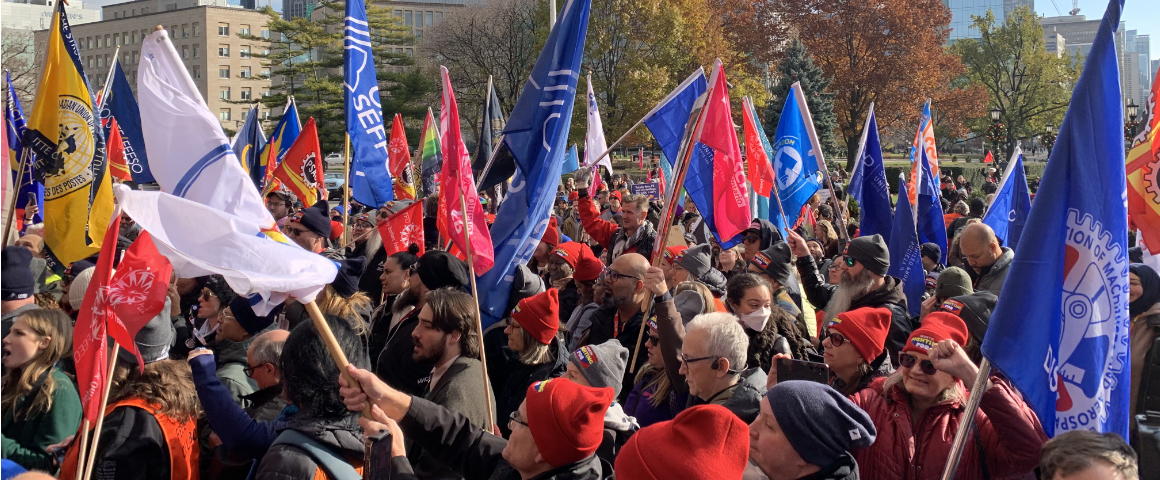
[Photo of union rally at Queen’s Park during OFL convention: Andrew Kesik]
Support working-class media!
If you found this article useful, please consider donating to People’s Voice or purchasing a subscription so that you get every issue of Canada’s leading socialist publication delivered to your door or inbox!
For over 100 years, we have been 100% reader-supported, with no corporate or government funding.