By Cam Scott
On October 8, Liberal Minister of Public Safety Gary Anandasangaree introduced Bill C-12, The Strengthening Canada’s Immigration System and Borders Act.
This new legislation closely resembles the controversial Bill C-2, tabled this summer, which the Migrant Rights Network described as greasing the gears of a massive “deportation machine.” According to Anandasangaree, the new bill “carves out the more contentious elements of Bill C-2” in order to rush through the larger part of its sweeping immigration reforms.
Like its predecessor, Bill C-12 grants unprecedented powers to individual ministers as well as law enforcement. According to the Canadian Immigration Lawyers Association, “Bill C-12 shifts core immigration functions into a national security framework, bypassing the established legislative structure.” This anticipates the termination of thousands of applications, from those solicited by business incubators and visa brokers to compelling refugee claims by asylum seekers.
Despite Liberal authorship, this aggressive immigration regime seems to fulfill a longstanding goal of the Conservative and People’s Parties, whose explicitly xenophobic policy proposals use immigration as a scapegoat for everything from housing shortages to emergency room wait times.
This may seem like an about-face by the Liberals, but right-wing attempts upon Trudeau’s “cult of diversity,” to quote the bigot Maxime Bernier, miss the fundamental continuity of Canada’s immigration strategy, where apparent policy reversals are only seasonal expressions of capitalist imperatives. In fact, Canada’s solicitation of short-term labour contracts from abroad and its harshly prejudicial vetting of migration along class lines and by region are two sides of the same coin.
Naturally, immigration controls expand and contract capital’s access to labour, and quotas are set by sector with intent to profit by the many geographical displacements that capitalism commands. Accordingly, most political contests over immigration in imperialist countries are between competing blocs of capital and their official representation. As such, they must be understood with reference to tensions between regional and transnational monopolies, or as ideological effects of the formal distinction between financial and productive enterprise.
While the right often opposes immigration in a narrow appeal to a geographically sedentary “old stock” identity formation, representing smaller concentrations of inherited or self-earned wealth, liberals in power tend to use the racializing turns of migrancy to discipline labour as a whole, drawing from a legally precarious reserve army to grow the productive forces in spurts. (As Marx wrote in his notes on national competition between workers, “the wages of 1000 workers of the same skill are determined not by the 950 in employment but by the 50 unemployed.”)
A clear example of this dynamic is Canada’s Temporary Foreign Workers Program, introduced in the 1970s and expanded to resemble a system of indenture under both Harper and Trudeau. As a CUPE brief on migrant workers in the public sector explains, the TFWP is “systematized, racist and exploitative” by design: “Wealthier nations, like Canada, have set up temporary foreign worker programs for the benefit of employers, who are able to maintain low wages for workers whose rights cannot easily be protected.”
The Conservatives have campaigned extensively against the TFWP in recent years, but for all the wrong reasons and without mention of the hideous working conditions faced by permit holders. Rather, Poilievre and his peers blame a wide variety of phenomena on “cheap foreign labour,” demanding “Canadian jobs for Canadian workers” instead. This racially coded advocacy eagerly duplicates the phony workerism of MAGA in the US, but has become a talking point of both Conservative and Liberal parties north of the border.
Migration and wages
Does migrant labour suppress wages, as the right wing likes to claim? The simplest and correct response is no, not as such – but weakened legal protections for any segment of the workforce will surely have this effect, and migrant labour is uniquely vulnerable.
Where actual jobs for migrants are concerned, the Liberals and Conservatives have mastered a good cop-bad cop routine corresponding to the fluctuations of the labour market. In a typical year, Liberals solicit migrant labour on behalf of hyper-exploitative Canadian firms, and from the further effects of this abusive funnel, the Conservatives weave a narrative that blames immigration – that is, immigrants themselves – for the labour conditions they endure.
While right-wing populists scapegoat immigrants for a general lack of work or stagnant wages, economists broadly agree that immigration enriches the host country. (That so few workers benefit from this wealth is another, more important fact.) Studies from the National Bureau of Economic Research in the US and the Bank of Canada rosily describe how rapid growth of the productive forces by way of immigration effectively controls inflation and enables growth amid recessionary conditions.
Even so, TD Bank’s chief economist has praised Liberal crackdowns on immigration, claiming that the cancellation of work permits has helped control Canada’s already alarming unemployment rate – more than 7 percent this October. But this argument is entirely circular where those workers turned away would otherwise have plugged gaps in a collapsing class arrangement, or faced even greater difficulty finding work.
Deleting the legal status of a section of the unemployed doesn’t prevent job loss in the slightest, particularly where most recent immigrants to advanced capitalist countries find themselves performing informal tasks for which there is very little domestic competition. This “complementary productivity” has a stabilizing effect on wages elsewhere administered, where competition mostly transpires between immigrants of similar experience.
As regards wage pressures, the Bank of Canada notes that the lower compensation of non-permanent residents can be seen to “soften” growth, but irrelevantly in light of spillover effects between industries, where employment in a comparatively low-waged agricultural sector, for example, necessarily corresponds to increased activity in trucking and retail. All told, the lateral competition that employers use to drive down wages is an intra-class phenomenon that would only affect those workers born in Canada whose English conversancy or certification is comparable to that of recent immigrants.
Artificial antagonisms
Clearly immigration grows the economy, and the real problem is the uncertain benefit of capitalist growth to most workers – including a reactionary section who perceive the proceeds of their labour to be horizontally dispersed rather than vertically appropriated by the ruling class. This false perception only benefits employers, and Marx wrote powerfully of how antagonism between workers becomes a weapon in capitalist hands.
But if immigration enriches the economy, why is the right wing of the ruling class, including the Carney Liberals, so against it? Sheer racism cannot be underrated as a cause, where lineal concentrations of wealth project ideologies of white supremacism and national chauvinism. But don’t closed borders contradict the globalizing rule of capital? Why in a crisis does this class rally a racial or national base to its defence?
Plainly, the right doesn’t intend to stop the abuse of immigrant labour, but to deepen a class cleave between legal statuses, relegating more and more people to temporary or transient residency as they move towards an investor-based immigration system, recruiting capital rather than workers. This is a sure way to circumvent the labour standards and social wage of core economies, which are the hard-won legal victories of working-class movements.
Capitalism cannot do without migrant labour as such, and the racial ideologies that call for movement restrictions are themselves an output of the imperialist system that ensures the necessity of migration for millions of workers. Clearly, xenophobic policies including Bill C-12 do not intend to repopulate informal economies with domestic labour, but to control and repress a flexible global reserve.
Take the example of an unsuccessful application for permanent residency. For months of suspense, the applicant generates surplus for Canadian firms, only to have their case declined before such time as they might benefit from healthcare or any service provision. The temporary appearance of the undocumented worker in the imperial core is then a spatial hiccup in a textbook extractive relation, where Canadian firms profit by the underdevelopment of a global periphery in domestic worksites as well.
If anything, Bill C-12 proposes to intensify this turnover, rendering broad swathes of the global working class susceptible to police tactics and legal terror. This includes the ICE attacks taking place in the US, and as Migrante Canada reports on workplace raids by the Canada Border Services Agency, it’s chillingly clear that Bill C-12 is part of a continental plan – even originating from Trump’s demands for stricter immigration controls on both sides of the border.
A global “War on Drugs”
Of course, the ruling class and its ambassadors can’t come out and say this. So how does Bill C-12 propose to justify these exceptional powers? The legislation itself doesn’t speak of labour or demography, though it will certainly be enforced in strict accordance with economic imperatives and along racial lines. Rather, it justifies the cancellation of thousands of permits by a summary criminalization of migrancy, drawing on the language of a global War on Drugs.
In its own words, Bill C-12 intends to “combat transnational organized crime, stop the flow of illegal fentanyl, crack down on money laundering, dismantle criminal networks, and improve the integrity of our immigration system.” As Trump and Rubio carry out extrajudicial strikes on alleged smuggling vessels in the Caribbean, boasting of their intent to attack “drug routes” in Venezuela, this language seems to flatter a US plan to transform the domestic “War on Drugs” into a blueprint for military intervention and regime change.
Of course, the US War on Drugs has always been international in scope, where illicit trade shadows the imperialist world-system. Illegal drugs have been used at arm’s length to destabilize countless countries and economies, and the narcotic infiltration of both urban and rural communities across the US and Canada follows a similar pattern.
Here too the state uses prohibition to shrink and expand the labour force, where criminal organizations and law enforcement alike target marginalized communities as markets for drug commodities. And as Trump repurposes the infamous detention centre at Guantánamo Bay in order to house deportees, the continuity of both the War on Terror and the War on Drugs with anti-immigrant policies is more apparent than ever.
Solidarity in kind
Attempts to portray immigration as a vector of terror or crime are as old as capitalist social formation, and legislation such as Bill C-12 exploits the worst associations in its attempt to construct a subject worthy of crackdown. That said, the bill hardly concerns drugs, even to the extent that the enforcement strategies it recommends are bound to fail amid a serious crisis of lethal supply. While C-12 modifies the Controlled Drugs and Substances Act and other pieces of legislation pertaining to illicit economies, the larger part of its permissions pertains to the mass cancellation of immigration statuses, from foreign study permits to asylum claims, without specifying any cause at all.
Immigration Minister Lena Diab has already spoken of the bill’s intent to “address the unsustainable growth” of Canada’s population, and with specific reference to imperialist wars and encroaching climate crisis. By this government’s own account, the “War on Drugs” from which this legislation follows is entirely beside the point of a demographic strategy by which to restrain the working class in a deepening crisis.
Plainly, Bill C-12 is not concerned with either “national security” or the fortunes of legally enfranchised workers. Rather, this act fulfills longstanding plans to further weaken labour and to divide the class by fear and isolation; to erode due process and expand surveillance over all working people, starting with the most vulnerable.
Refusing the racist distinctions enshrined in capitalist law requires careful attention to the differences that make up our struggle, and the common cause for which we fight. Migrancy is an essential condition of proletarianization, where one is forced to sell one’s labour-power as one can. The difficulties faced by refugee and migrant workers may be greater than those faced by their domestic counterparts, as are the distances traversed – but this is a difference of degree and not kind.
The class strategy that produces legislation such as Bill C-12 must be opposed as such – which starts with a refusal of antagonisms within the global working class. As civil liberties associations and human rights advocates continue to oppose this cruelty, organized labour must take up its share of the struggle. And as Canada’s ruling class bets on the parochial self-interest of workers, we must draft deeper solidarities in order to protect our neighbours and to confront the forces of imperialism as they appear at home.
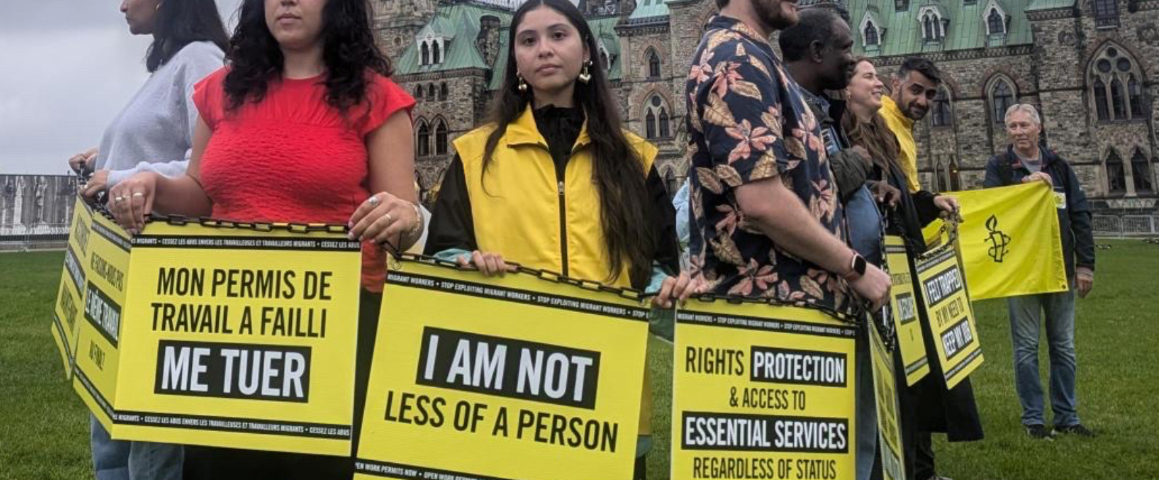
[Photo: Amnesty International]
Support working-class media!
If you found this article useful, please consider donating to People’s Voice or purchasing a subscription so that you get every issue of Canada’s leading socialist publication delivered to your door or inbox!
For over 100 years, we have been 100% reader-supported, with no corporate or government funding.