By Jay Brudny
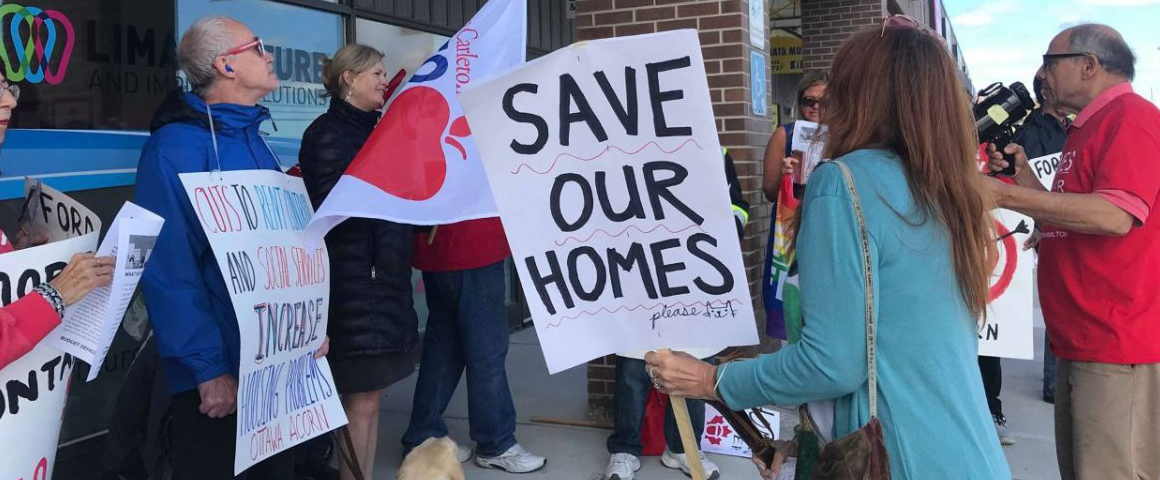
As the housing crisis continues to intensify, gentrification has become a simple fact of life in Canada, with working-class neighbourhoods being selected one after the other for “community reinvestment” or “urban renewal” or some other version of the same formula.
In response, the media, intellectuals and various NGOs have produced a cottage industry of theories to explain gentrification without fundamentally challenging the capitalist system which produces it.
This process has become so common that many people treat it as a natural force. But what is gentrification, really? And more importantly, who profits from it, and who has the power to stop it?
What is gentrification?
Most mainstream explanations of gentrification rely on a simple set of characteristics. “Middle-class” professionals move into a working-class district, rents go up, poor and working-class people get kicked out, and soon the area is full of luxury condos and overpriced coffee. In this explanation, gentrification becomes a lifestyle choice, a cultural shift that some can adapt to while others can’t.
That story isn’t totally wrong, as those characteristics certainly fit with what we see happening in towns and cities across the country. But it misses the root of the problem. It focuses on “who gentrifies” instead of focusing on the driving forces of gentrification itself.
Rather than a simple movement of “middle-class professionals,” the process of gentrification occurs where there are large and easily exploited rent gaps created by capital with help from the state.
A rent gap is the difference between what landlords receive from tenants (called “capitalized ground rent”) and what they could receive if that property and the area surrounding it were “improved” (called “potential ground rent”).
Take for example an old apartment building in a neighbourhood starved of public resources for years. Because the area has high unemployment, crumbling infrastructure and few public services, landlords can’t charge very high rents.
But on paper that same building could generate two, three or even four times the profit, especially if the neighbourhood was “desirable” for higher income tenants. That difference is the rent gap. And closing that gap is exactly what capitalism tries to do, by any means necessary.
We see then that gentrification starts long before the first condo goes up or the first cafe opens. It starts when austerity and divestment create the conditions for profit-making, at the expense of the current population.
Along with austerity and systemic divestment comes discrimination, or the stigmatization of certain neighbourhoods. We can see this discrimination occur along lines of racialization as well as class, with neighbourhoods undergoing disinvestment being portrayed as hotbeds of crime or desolate wastelands due to the surge of poverty. This discrimination leads to over policing and increased violence towards predominately racialized communities.
Once a neighbourhood has undergone this kind of attack, it then becomes ripe for “government assistance,” “reinvestment” and “community renewal programs.” Rather than seeking to uplift the community and its members, as they claim to be doing, these programs are strategically led by landlord and developer monopolies and enforced by the state apparatus to ensure large returns on investments, at the expense of the current population.
Now we can see the cycle: austerity–divestment–discrimination–“reinvestment”–displacement. But more importantly, we see who stands to gain: landlord and developer monopolies, investors, and their functionaries in government and the state. With every repeat of this cycle, the control of monopoly landlords only increases allowing monopolies to exploit the rest of the population at ever increasing rates with impunity.
Monopoly-led gentrification in action
A recent study of rental housing in Toronto found that the largest financialized landlords charge “rent premiums” of 44 percent across the city. These premiums – amounts in excess of market rent – represent an average extra $670 per month.
Where are the highest premiums charged? Not in wealthy areas, but in what the municipal government calls Neighbourhood Improvement Areas (NIAs). NIAs are areas identified as having the most “inequitable outcomes” measured by the presence of low-incomes, high unemployment, high school graduation rate, community meeting places and more.
Why target these neighbourhoods? Because they have the widest rent gaps. And once landlords drive out existing tenants, they can use vacancy decontrols to jack rents, not just in one building, but across the whole neighbourhood.
An example of this process is seen in Toronto’s Parkdale neighbourhood, a historically working-class neighbourhood with a high concentration of immigrants.
From the 1960s onward, the municipal, provincial and federal governments have inflicted devastating austerity in Parkdale and the surrounding area. This has included “slum clearings” carried out to build the Gardiner expressway, deep cuts to the CAMH medical centre, and the freezing of federal funding for social housing. The media response is to describe Parkdale as a “service dependent ghetto.” In reality, government policy created these atrocious conditions in the first place.
Coincidentally, this is all great news for capitalists in the housing sector, as it created some of the most exploitable rent gaps in the city.
Huge corporate monopoly landlords like Akelius Canada LTD, CapREIT, Starlight Investments and others have seen this opportunity and made it their business to squeeze every dollar out of it. Their playbook is familiar by now. Above Guideline Rent Increases – a mechanism which allows landlords to raise rents over the provincially mandated rate of roughly 2-2.5 percent per year – are used to price existing tenants out. Targeted campaigns of tenant harassment make people feel unwelcome in their own homes. Maintenance and property standards are neglected. And tenants who resist face the threat of mass eviction.
Once the former tenants are gone, the numbers speak for themselves. For example, Akelius sees average rent hikes of 39 percent per unit across the city after former tenants are forced out. The rent gap is closed, and working-class tenants are displaced.
Where do they go? Either to another neighbourhood bled dry by austerity waiting for capitalist “renewal” or, increasingly, into homelessness. Thus, Friedrich Engels remains correct in his conclusion that the ruling class in capitalist society can never solve the housing question, but can only move it around.
Illustrative of Engels’ conclusion, Doug Ford’s Ontario government has passed Bill 6, giving municipalities and police sweeping powers to clear encampments and criminalize the homeless. As the Communist Party of Canada (Ontario) pointed out, this law doesn’t create housing, improve shelters or expand mental health care. Ford’s mandate is clear: punish the victims, protect the capitalists.
Gentrification as class war
Monopoly capital is on an all-out offensive against the working class in every aspect of our social, economic, political and cultural lives. Gentrification is how this appears at the neighbourhood level. Austerity, privatization, union-busting, the drive to war, environmental destruction, the housing crisis – these are all intimately connected by the corporate monopolies who are leading the charge.
That means the fight against gentrification can’t be isolated. It has to connect with the labour movement, the peace movement, the fight for climate justice, and every other struggle which has interests against capitalism.
As monopoly power grows, an ever-increasing number of people are compelled by their own economic and political interests to mount a fightback against corporate monopolies and the capitalist state. And if the problem is capitalism, then the solution can’t just be about one landlord or one building. Rent strikes, eviction defence and local fights, if kept isolated, are not enough.
On this basis, the Communist Party of Canada and the Young Communist League call for an anti-monopoly alliance that brings together tenants, workers, unions, students and community organizations to take on the system as a whole. A broad anti-monopoly alliance led by the working class would be better situated to fight for demands such as:
- A comprehensive government social housing program that treats housing as a public utility and delivers it according to need.
- An emergency plan to build two million new, publicly owned, social housing units, and upgrading/retrofitting existing units, to address the massive core housing need in all areas of Canada.
- Legislated rent rollbacks and controls for all renters, to ensure no one has to pay more than 20 percent of income on housing.
Ultimately, beyond these tactical reforms, such an alliance would be better positioned to fight for shifting decision-making power out of the hands of landlord and developer monopolies and into the hands of the working class.
This unity won’t happen spontaneously. It requires conscious organization and leadership. But as we’ve seen before, when the working class unites around a clear vision, corporate power can be defeated. And the fight for housing is one of the sharpest battlefields we have today.
Will we allow corporate monopolies to continue decimating our neighbourhoods? Or will we organize to take them back?
Support working-class media!
If you found this article useful, please consider donating to People’s Voice or purchasing a subscription so that you get every issue of Canada’s leading socialist publication delivered to your door or inbox!
For over 100 years, we have been 100% reader-supported, with no corporate or government funding.