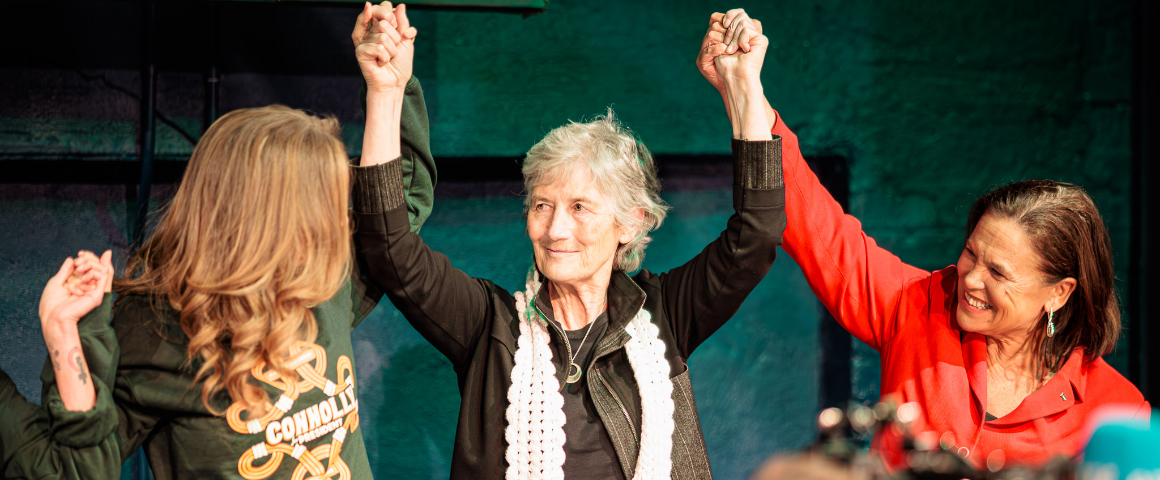
Ireland is in the final days of a presidential election campaign which has raised real prospect of victory for left-wing candidate, Catherine Connolly. To discuss the significance and development of this campaign, People’s Voice editor Dave McKee spoke with Harun Šiljak, Dublin Secretary for the Communist Party of Ireland.
People’s Voice: The president in Ireland is largely a ceremonial position, but the current election is a very important one. Could you describe why this campaign in particular is different?
Harun Šiljak: Our most recent statements on the presidential election call for turning the presidential election into a referendum on neutrality and peace. And that’s very much where the discourse is right now, because for over a year, we have been seeing attacks on Irish neutrality by the Irish government itself and putting in the program for government a plan to dismantle one of the mechanisms that lies in the core of the Irish neutrality, the “Triple Lock.” This mechanism corresponds to Irish troops being impossible to deploy without agreement from the government and Parliament, and with a United Nations mandate for deployment.
Catherine Connolly, one of the two remaining candidates in the presidential election, has been repeatedly emphasizing the importance of keeping this Lock. She has spoken of the hypocrisy of the Irish government, which only a few years back would have spoken off the Triple Lock as the core of our neutrality and is now speaking of the need to dismantle it.
What are the forces driving this changed approach to the question of neutrality?
We don’t have neutrality enshrined in the Constitution, and that’s another rallying call that has existed in the left opposition in Ireland in the recent years, to enshrine neutrality in the Constitution.
Fundamentally, Irish neutrality draws its basis from the history of colonialism and the post-World War II efforts at international peace building. For example, through the Non-Proliferation Treaty and the work of Frank Aiken, but also through the peacekeeping forces that Ireland has repeatedly joined under the flag of the United Nations, in the likes of Congo, Cyprus, Lebanon, etc.
The current attacks on the Triple Lock mechanism are very much an attempt to circumvent the UN mandates and allow Ireland to join EU battle groups deployed elsewhere, like in Africa’s Sahel, and also to join the “coalition of the willing” in conflicts like Ukraine.
Connolly’s campaign has been endorsed by a broad group of left forces, left parties and movements. To what extent does that fact, reflect a step towards left unity in a more injuring way? And are there specific ways in which that unity has been built?
Ireland is an interesting place electorally, because it has single transferable vote proportional representation. You don’t usually have pre-election coalitions, meaning left parties wouldn’t necessarily have major coalition talks before a general election. Rather, you would see efforts to establish a broad “vote left, transfer left” framework, where voters would be encouraged to vote for their preferred left candidates first and then keep transferring down the list going through other candidates of the left. This maintains their votes in the game for as long as possible and helps other left groups get elected.
But in 100 years of the Irish state, we are yet to have a left-led government. So, this particular electoral situation is interesting from the perspective of a pre-election coalition of sorts, where both resources and political capital of the left parties have been dedicated to putting Connolly into the residence of the Irish President.
It’s an important single moment because people have doubted the capacity of the Irish left to come together, and they have questioned whether the left and centre-left parties could or would work with Sinn Féin.
The left forces involved include the parliamentary parties of the left who are represented in the Irish Parliament, the Dáil. So, this is the likes of the Social Democrats, Labour Party, Sinn Féin, People Before Profit–Solidarity. And that has been influential in terms of the resources those parties have, and where their votes are based.
There’s also support from parties without parliamentary representation, like the Workers’ Party and the Communist Party, which really shows that this election is recognized as a referendum on neutrality, on peace. But it’s also an indication that the election is a referendum on this government’s track record on homelessness, health and other pressing issues that have been draining the Irish working class over the past decades.
Adding to the party organizations that have been supporting Connolly are trade unions like MANDATE and Praxis, and trade councils [similar to labour councils in Canada] like Dublin Trade Council, Waterford Trade Council, Galway Trades Council. You also have groups like Tenants for Connolly, Artists for Connolly, and Disabled People and Carers for Connolly.
Those groups have covered an immense amount of ground in campaigning and in presenting where Catherine Connolly stands in this election. And that has really helped – the mainstream media now has to identify who Connolly is and what she stands for.
It sounds like the campaign is largely driven by movements as opposed to political parties. What’s the importance of that?
Connolly is a great example of an independent candidate in Ireland, which is relatively common in Irish parliamentary politics. You have a lot of a lot of independent candidates who have built their experience, especially on the left, with a strong political line and strong independent work. And that also allows them to work with a wide range of organizations and movements.
That’s how Connolly became deputy speaker of the Irish Parliament, and with that experience she’s able to garner attention from different corners.
But as you notice there, this has been very much a grassroots-driven campaign which is building upon experiences and victories that were achieved in different struggles like against water charges and to repeal the abortion ban. Arguably, the 2017-18 campaign to repeal the Eighth Amendment to the Irish Constitution and legalize abortion is very much an inspiration behind a lot of people campaigning for Connolly.
So, this tradition of referenda and of organizing on the ground, through tenant unions and movements with variable structures and so on, has been instrumental for this campaign and it gives an idea of where organizing could go in the future as well. And it complements very much the existing party structures in parliamentary politics.
At the same time, I would argue that it opened space to people who might be averse to party politics because they perceive them through the lens of the parliament being the be all and end all of politics. So, from that perspective, the presidential election as a referendum is quite striking.
We’re just ahead of the vote, and Connolly has quite a strong lead in the polls. But regardless of the outcome, it sounds like this particular campaign has already achieved a lot of victories.
From an electoral view, the campaign has shown that there is a mature understanding of priorities in the Irish left, and I don’t say this lightly. In previous times, we wouldn’t have been sure if an alignment of this sort would be possible and if a focus on a common goal would have been there. But here, in a campaign that’s not like others in the sense that it’s so different from a purely parliamentary one, it has been shown that there is enough of a capacity to act together and to be aligned for the time necessary to achieve the goal.
At the same time, from the perspective of politics in general, Connolly’ campaign has normalized a certain discourse that might have been perceived as somewhat taboo by the bourgeois media. So, the fact that they’re chasing her to ask her opinions about foreign policy, and that they’re shocked that she doesn’t consider the US an ally or that she’s going concerned about militarization of Europe, is a very welcome and very important shift.
Irish politics does have a tradition of such voices in the public space, but recent elections may have reduced the numbers of such voices in elected positions. And now Connolly is having a primetime conversation about the military industrial complex – after the first presidential debate, one of the Irish newspapers ran an explainer on what the military industrial complex is. So, the discourse that we’re witnessing here is very important.
Support working-class media!
If you found this article useful, please consider donating to People’s Voice or purchasing a subscription so that you get every issue of Canada’s leading socialist publication delivered to your door or inbox!
For over 100 years, we have been 100% reader-supported, with no corporate or government funding.