By Cam Scott
The assassination of right-wing pundit Charlie Kirk has brought about a wide variety of morbid and threatening effects, and not only in the United States. In Canada, the usual reactionary suspects have seized upon a tide of sentimental rage in order to mount a range of attacks, from residential school denialism and the ouster of Indigenous politicians to renewed campaigns against cultural diversity and public education.
This last concern is slightly ironic, where Kirk presented himself as a champion of education, haunting supposedly public spaces in order to make ragebaiting mockery of freshmen interlocutors. Kirk’s apologists speak of his openness to reasonable debate, but nobody who has seen these humiliation rituals believes that for a second. However else one chooses to describe the dynamic of these spaces, the cruelty and mobbing atmosphere can’t be omitted.
In a real sense, Charlie Kirk died in a coliseum of his own creation, and university campuses are far more hostile and policed than ever before as a result of his escalations. Of course, this wasn’t Kirk’s innovation alone. From Jordan Peterson’s parking lot fulminations against student pronouns to Stephen Crowder’s lemonade stand debate stations, there are plenty of precedents for Kirk’s shock-Socratic bullying – and more still adapting these tactics to their purposes.
In Canada, disgraced academic Frances Widdowson used the week of the National Day of Truth and Reconciliation to host impromptu “street epistemology” sessions on university campuses, where she attempted to refute the history of residential schools before an antagonistic audience. According to Widdowson, this is a demonstration of free speech rather than a flouting of survivors, though her tour clearly indicates the extent to which discourse on Canada’s colonial harms has been rolled back by the right wing.
More generally, one can see from these borrowed tactics how the far-right continues to recruit from resentment by portraying itself in the contradictory guise of a marginalized majority. At the University of Winnipeg, Widdowson was surrounded by Indigenous warriors and matriarchs, elders and youth, who refused to permit her bileful program to proceed.
Despite claims of violent interference, this must have been Widdowson’s wish. After all, it’s on the basis of this response that Widdowson and her supporters can portray themselves as victims of a “mob,” rather than provocateurs by whom this response was convened. This move to victimhood is one of the characteristic tricks of right-wing agents in the cultural field, which is more than a little ironic given their contempt for “snowflakes” and other terms of imputed weakness.
From these tactics we receive the contradictory figure of the establishment guerrilla – Trump and Kirk are versions of this type – whose influence devolves onto a mobbing constituency. At the heights of power, this might be the sovereign of an exceptional state, who “restores” order by suspending law. At the corresponding base, this kind of politics typically produces a rash of vigilantism – opponents of change who “conserve” a bygone world by destroying its intruders.
Dog whistles and political vigils
In the immediate aftermath of Kirk’s death, his Canadian base held large vigils in cities across the country, flying US flags and joining in politically coded prayer. Some of these rallies were more provocative than others, depending on the boldness of organizers. In Windsor, for example, a large and explicitly Christian nationalist rally took place on the National Day of Truth and Reconciliation, displacing a far more significant ceremony.
The rally at the Manitoba legislature in Winnipeg on September 16 felt more like a megachurch service than a right-wing mobbing, but was organized by some large personalities from Winnipeg’s “alt-right” networks. A smaller, private event in La Brocquerie, Manitoba was more strident, including clear political endorsements of Kirk’s particular views by MLA Konrad Narth and MP Ted Falk.
In the right-wing idiom described above, the evening’s battle cries were couched in a language of defence rather than aggression – defence of family values, defence of Christian heritage, defence of nation and of its religious basis, and so on. As typically, the target of these diatribes is an under-elaborated “left,” apparently encompassing all manner of deviancies, though almost everybody would fall to the left of these fringe representatives, for now.
This too is standard, and when Trump and his Canadian constituents threaten crackdowns on “Antifa,” they exploit the obvious fact that this is not an organization with assets to seize and membership rolls but a floating signifier which can attach itself to any target by affinity or accusation.
Whatever worldview the alleged shooter professes, Kirk’s killing clearly benefits the right, closely preceding the outright invasion of Portland and Chicago in what looks increasingly like civil war on political lines.
New attacks by the usual suspects
In Canada, the rallying effect of Kirk’s death is less readily attributable but real. And while Canadian cultural politics are downstream of US trends in many obvious ways, our uniquely colonial cultures of reaction shape the political threats that his death puts into play. Plainly, Kirk’s fretful descriptions of white depopulation and pagan overwhelm of Christian culture are colonial symptoms, and anyone who repeats these obsessions here proudly inherits a legacy of genocide.
In Winnipeg, however, the Kirk rallies have seized on the issue of NDP MLA Nahanni Fontaine, who shared a social media post on the day of Kirk’s killing that (correctly) described him as racist, transphobic, and an apologist for gun violence. The post did not celebrate violence in any sense, but in the days and weeks to follow, Fontaine was publicly chastised by the leader of her own party, Premier Wab Kinew, amid a Tory feeding frenzy. Front page opinion pieces, opposition press conferences, and online petitions called for her resignation, while dozens of people have attended ‘Nahanni Must Go’ rallies outside the Legislature, replete with racist barbs and even residential school denialism.
Fontaine’s political record, which tends conservative, is beside the point of this sequence. As a member of Sagkeeng First Nation and one of very few Indigenous ministers, Fontaine has been subject to a surge of misogynist and anti-Indigenous abuse on social media and in person over the course of this escalation. (Of course, this kind of language is a constant across Canada, and recent events only follow a pattern.) Fontaine’s St. John’s constituency office has been vandalized multiple times, and firebombed on the morning of September 30, the Day of Truth and Reconciliation. This follows fires and vandalism at the office of Bernadette Smith, MLA for Point Douglas.
Smith and Fontaine are the first Indigenous women to serve in Manitoba’s government, and this emboldened mobbing speaks to a frightening advance in the right-wing playbook. As noted, this campaign against Fontaine is not only animated by a chorus of Kirk supporters, including some of her political peers. It is equally designed by key and recurring figures in Manitoba’s hard right, including People’s Party candidates and Freedom Convoy runoff. Notably, one of Fontaine’s loudest antagonists is a far-right independent who plans to oppose her in the next provincial election.
Over the past few years, we’ve seen these forces pursue their extremist agenda by way of anti-vaccination campaigns and attacks on school boards. But as the boundaries of acceptable discourse tack to reaction, more and more of their supportive worldview is dragged into the light. In the communications of these organizations, one sees a clear vendetta against not only Indigenous people but recent immigrants, queer and trans youth, unionized labour and the public sector, and socialists of any stripe.
The danger is acute, and a threat against one is a threat against all where any number of minoritized or progressive positions have become interchangeable ciphers for each other in the reactionary mind. As the right pursues these groups with equal vigour, it falls to our movements to transform the closeness of these terms into new solidarities.
Kirk’s local base has greater confidence than numbers, and we can’t afford them any of the space that they recently seek.
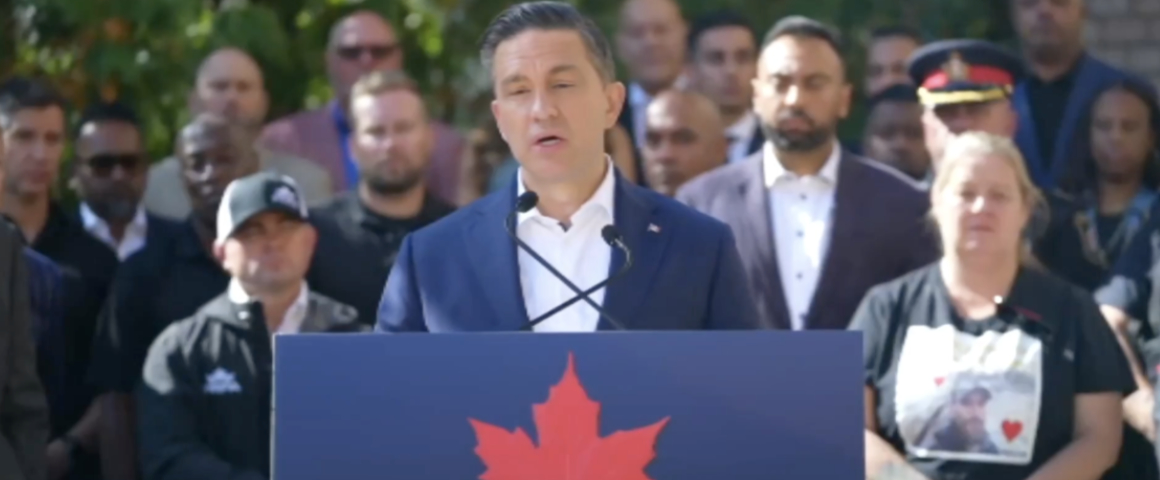
[Photo: Screen grab from Pierre Poilievre video honouring Charlie Kirk]
Support working-class media!
If you found this article useful, please consider donating to People’s Voice or purchasing a subscription so that you get every issue of Canada’s leading socialist publication delivered to your door or inbox!
For over 100 years, we have been 100% reader-supported, with no corporate or government funding.