By Dave McKee
Working people in Canada find themselves caught between two pretty big economic challenges these days. On the one hand, several years of declining real wages – combined with the skyrocketing post-COVID cost of living – mean that huge numbers of working people now face a financial crisis. Do they pay the rent on time, or do they buy groceries this week? Can they afford to pay for medication this month, or do they use the money to buy back-to-school clothes for their kids? For increasing numbers, the choice is even more stark –do I need to move to an encampment just to survive?
Alongside this pressure, working people also face widespread job losses in the wake of Donald Trump’s tariff war. Entire industries are at risk of being lost in this country – from auto to steel to lumber to pharmaceuticals and beyond – and the half million or more workers who depend on them are currently finding little solace in Ottawa’s pro-corporate responses to that situation.
Small wonder, then, that we have seen an uptick in labour militancy and a corresponding surge in strike activity.
At the same time, though, we’ve seen a rapid increase in government-boss collusion to shut down that militancy, even to the point of denying basic labour rights. A big part of this is the fact that corporations are feeling many economic pressures of their own. Some of these, like the tariff war, are the same factors which directly confront working people; others, like the decline in their rates of profit and the increased concentration of capital in huge monopolies, are not. Faced with such an existential crisis, capitalist governments like Canada’s are becoming increasingly aggressive about protecting and trying to help expand “their” corporations’ interests.
Within this context, it’s logical to expect union struggles to be steadily – albeit unevenly – drawn to the political arena. And that’s exactly what we’ve been seeing.
CUPE and Air Canada
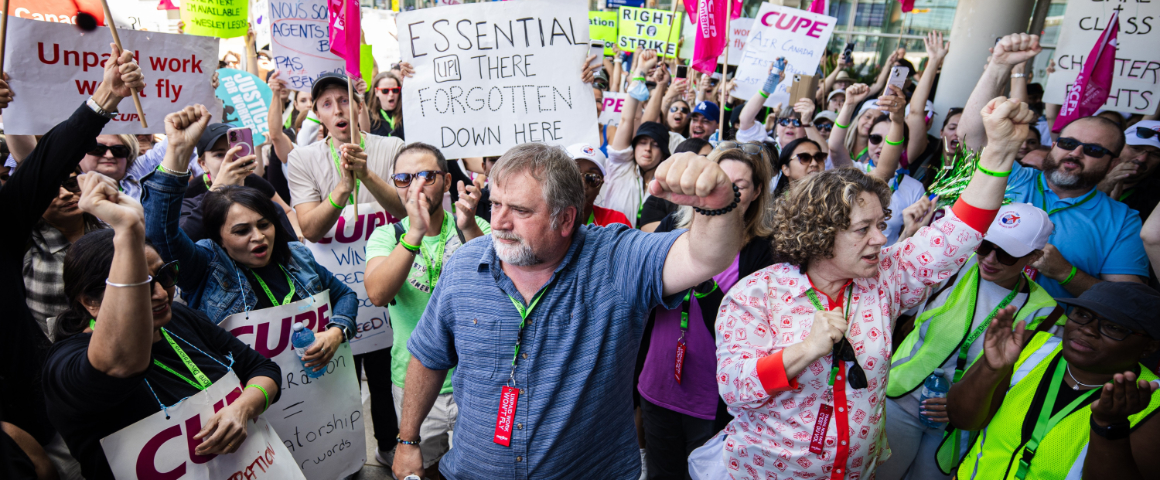
When flight attendants at Air Canada entered contract negotiations in the spring, they identified their key issues as a decent wage increase and an end to unpaid “ground” work, which averaged a shocking 35 hours each month. These are clear collective agreement issues, around which the 10,000 CUPE members struck.
But the nature of the strike changed almost immediately, when the federal government used Section 107 of the Canada Labour Code to override the workers’ right to strike and negotiate, ordering them to both return to work and take the dispute to binding arbitration. In response to this government interference – which wasn’t entirely unexpected or without precedent – flight attendants announced their refusal to obey back-to-work orders, and union leaders signalled they were prepared to go to jail in order to defend workers’ rights.
CUPE’s now political fight quickly drew support from the broader labour movement. The Canadian Labour Congress convened an emergency meeting of union heads who voted unanimously to call on Ottawa to immediately withdraw the order to end the strike, to cease its use of Section 107 to end or prevent a legal strike, and to amend the Canada Labour Code to remove Section 107 as the first order of business when Parliament resumes. Through the CLC, unions across the country also committed to coordinating a comprehensive fightback campaign in support of these demands.
On the basis of this unity and militancy, CUPE defeated Ottawa’s threat and forced the employer to return to the table for serious bargaining – which resulted in a tentative agreement within just one day of defying the back-to-work order.
While the flight attendants have continued their struggle at the workplace level, by voting against the tentative deal, labour unity won the political fight.
CUPW fighting Ottawa and Canada Post
When the Canadian Union of Postal Workers began bargaining in 2024, they knew they were up against an intransigent employer. Canada Post refused to negotiate and instead chose to endlessly parrot its line about fiscal crisis, unviable operations and the need for deep concessions from the workers.
Each time the union presented well-prepared proposals for safeguarding the postal service by expanding its operations, the employer was dismissive and made sure that the government echoed its position. So, when CUPW struck in November 2024, it was already clear that the dispute had a political character.
But that aspect has only deepened as the struggle progressed – from the federal back-to-work order in December 2024, to the government’s forced vote on Canada Post’s “final offer” in the spring of 2025, to Transformation, Public Works and Procurement Minister Joël Lightbound’s September 25 directive – in the midst of contract negotiations – that Canada Post end door-to-door postal delivery.
Without question, this is a coordinated government-corporation attack on free collective bargaining, on tens of thousands of jobs, and on a vital public service.
Here again, the union has not cowered in the face of a political fight. CUPW responded to Lightbound’s directive by resuming its Canada-wide strike and shining the light squarely on Ottawa’s privatization agenda. Interestingly, while the CLC has issued a number of strong condemnations of the federal government’s political interference, we have not yet seen the same public expression of broad labour unity and militancy as during the fight at Air Canada.
Quebec Common Front
The public sector struggle in Quebec in 2023 provides another important example of union struggles moving to the political level. Four different unions, three of which were labour centrals, formed the Quebec Common Front in order to coordinate negotiations and actions. Notably, these unions were not organizationally bound to one another through a common labour central. Through the struggle, they were joined by unions representing teachers and nurses.
They key issue was wages, with the right-wing Coalition Avenir Québec (CAQ) government insisting on limiting increases to 9 percent over 5 years, combined with cuts to pensions.
While the dispute was mainly over collective agreement issues – wages and pensions – the struggle quickly developed a political component. Partly, this was due to the incredible scale of the fight – ultimately, 520,000 workers representing 12 percent of Quebec’s labour force went on strike against the government.
But the political nature of the strike also reflected strong public support for the Common Front. The unions were also fighting for public services – improvements to classrooms, for example – and they built strong connections with a public that was increasingly frustrated with the CAQ austerity and privatization policies.
Partly in response to the Common Front’s spectacular mobilization, the CAQ government recently introduced Bill 89, legislation that mirrors the federal Section 107 and gives the Quebec government the power to declare strikes illegal and order workers back to work. This anti-union legislation has mobilized the labour movement in Quebec, in much the same way that unions across the country united against Ontario government’s use of the notwithstanding clause against striking education workers in 2022. So far, however, the opposition to Bill 89 does not seem to have engaged the labour movement beyond Quebec.
In addition to these examples, there are many others across the country. These include the strikes by public service workers in BC and college support workers in Ontario, as well as the Alberta Common Front campaign and the struggles of teachers and education workers in that province.
Whether or not they step up for the political fight – and many do not – union struggles are increasingly drawn in that direction. This means that the labour movement needs to consider how it can most effectively fight in that arena.
Here, there is a key role for the CLC, provincial labour federations and local labour councils. These are the bodies which bring together workers and unions from across sectors and jurisdictions, to fight for the rights and conditions of all working people. They also maintain alliances with a broad range of social movements. As such, these bodies are uniquely situated to forge active solidarity in an increasingly escalating political fight. This needs to include engaging unions currently outside the CLC, starting with Unifor, and the unions in Quebec.
There are around 4 million union members in Canada. Most have never been on strike, because they have never had to – if they are able secure decent collective agreements, then strikes and lockouts are seldom an issue.
But the politics of the class struggle are always present in their lives, even if they don’t always realize it. Government legislation that limits or prohibits union organizing, picketing or bargaining affects the entire labour movement, as does anti-scab legislation and government interference in contract negotiations. These are weapons used by employers and governments to minimize labour militancy and, in the process, tame working people.
But how effective would those weapons be if all 4 million members of the labour movement were organized and mobilized against them? Unity and struggle are the keys to victory in the big struggles ahead, but it is up to the labour movement itself to use them.