By Rodrigo León Cordero
Informed prudence suggests that when the effects of a catastrophe are systemic, it can never be attributed to a single cause. In every perfect storm, various elements come into play. This is the case with the collapse of Spain’s electrical system in the spring.
On April 28, the electrical flow in Spain became unstable after two periods of oscillations, in the Iberian Peninsula and in Europe, followed by generation loss at three substations. This led to emergency activation of disconnect mechanisms to protect the grid, so that in just 5 seconds, 15 gigawatts vanished from the Spanish electrical system and the Iberian system decoupled from Europe. This caused a massive blackout, which lasted at least ten hours throughout Portugal and Spain.
The collapse has prompted several questions about a system which until then was believed to be robust. As noted earlier, there are several factors at play.
The private sector will not invest in infrastructure
The first issue is that the private sector has not wanted to take responsibility for the necessary investments in infrastructure to ensure the security of the electricity system. Energy specialist Alonso Romero states that the privatization of Red Eléctrica de España (Spanish Electricity Grid, with 80 percent private capital) created a situation in which no one wants to bear the additional costs of stabilizers to facilitate the use of solar energy in the system.
In a 2019 report, the National Commission for Markets and Competition recognized the need to change “obsolete regulatory standards” in order to introduce such stabilizing elements into the grid. However, only a pilot project was carried out, which warned of the “strong economic impact that this would have [on the sector].”
“The tragedy of the commons” is the idea that what belongs to everyone ends up being devoured and plundered by everyone. But as the electrical collapse shows clearly, when the commons is privatized, the consequences are catastrophic for everyone. In fact, the situation is even worse: with 15 gigawatts disappearing from the system, high-voltage infrastructure has been damaged and now needs to be repaired.
The second issue driving this crisis is greed, with Spanish President Pedro Sánchez himself pointing clearly at private operators. On the day of the blackout, the generating companies seem to have acted as a cartel for their own short-term interests, by choosing to not activate gas-fired power plants which were offline at the time of the collapse. Even though the government subsidizes companies for the operation of these plants, and their engagement would have partially alleviated the collapse, there is evidence that the private operators concluded that this was not profitable enough and therefore left the plants disconnected them from the grid.
This seemingly intentional idling of available power plants during a blackout, for reasons of economic profitability, points to a key failure of privatization. Specifically, when a small group of private corporations has control over an entire sector, they are willing to risk letting the system fail because they are unable to see beyond their own profit.
All of this raises a series of questions that need to be answered: Who in such a competitive sector is going to invest the necessary money? What role should public and private entities play in developing the electrical system? The experts will analyze the recent crisis to extract all lessons and evaluate the technical feasibility of possible solutions. At the same time, the responsible agencies and administrations will need to be courageous and decisive to implement the necessary changes.
The blackout allows us to clarify a chain of past decisions that have contributed to the collapse of the system. The first is the privatization of this sector, which leads to higher costs for consumers, a lack of transparency and a significant environmental impact. The second is the reliance on large-scale power plants instead of combining them with connected local networks that generate electricity as close as possible to where it is consumed.
A final but not insignificant lesson involves the role of the public sector. It is true that the pursuit of profits in the shortest possible time is typical of the private sector, so it is understandable (although not justifiable) that there has been no long-term strategy. However, this crisis shows that the public sector has also been driven by short-term interests, by failing to fulfill its regulatory function.
One thing is clear: major decisions do not emerge only from individual governments, but they also arise from decisions in decades past which are rooted in a savage capitalist energy model.
It is time for change – the crisis calls for it.
Originally published at elsaltodiario.com
Translated from Spanish and edited for length and context by PV staff
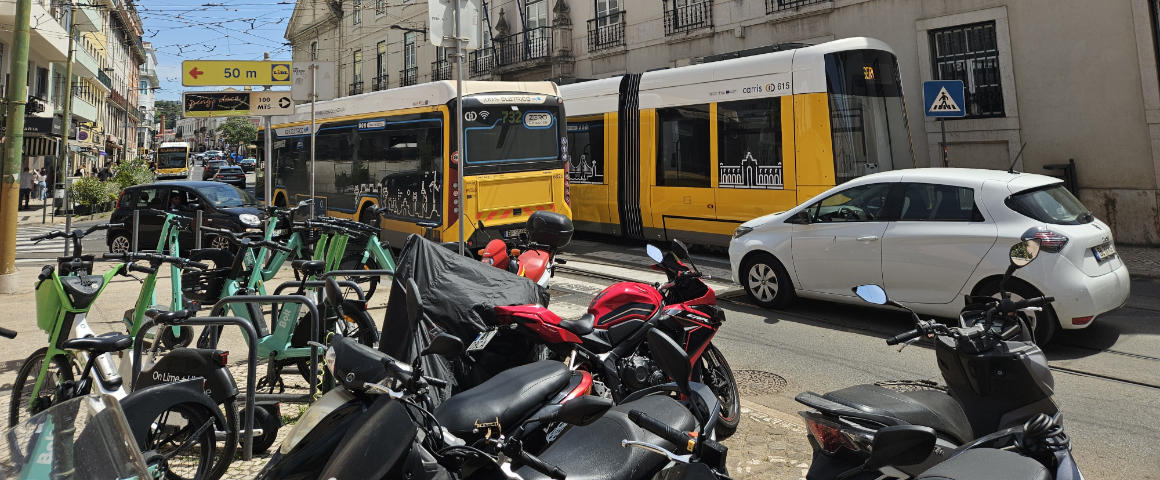
[Photo of electric vehicles in Portugal, idled during massive power outage in Spain: Creative Commons]
Support working-class media!
If you found this article useful, please consider donating to People’s Voice or purchasing a subscription so that you get every issue of Canada’s leading socialist publication delivered to your door or inbox!
For over 100 years, we have been 100% reader-supported, with no corporate or government funding.